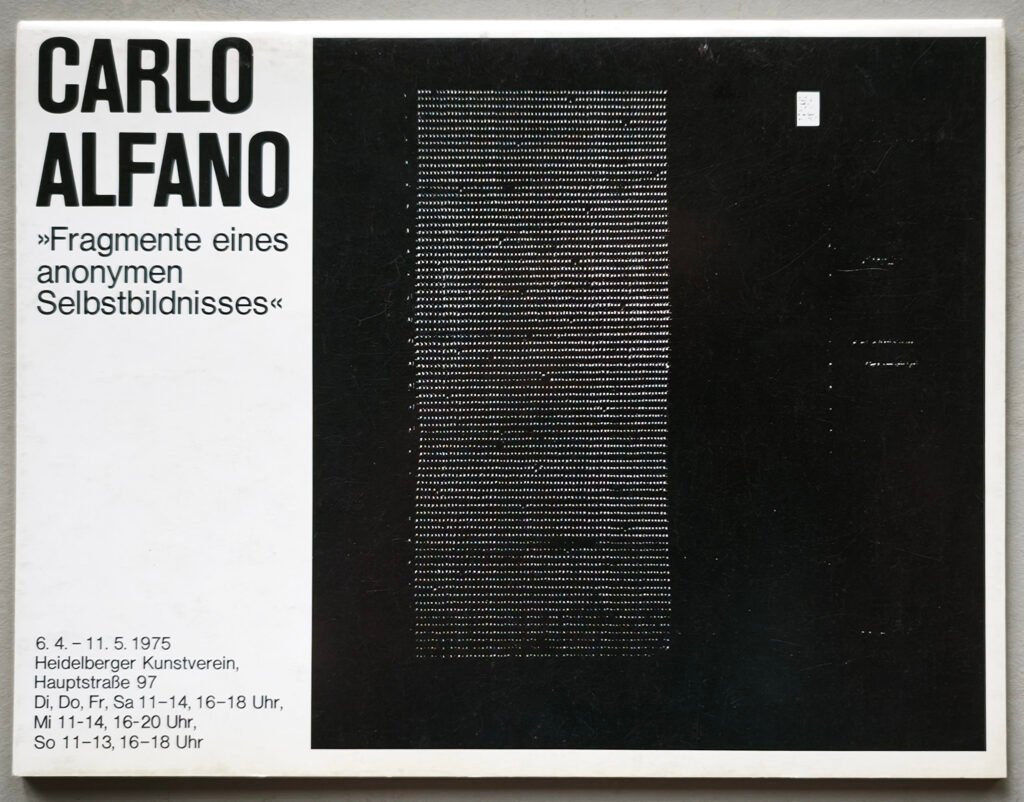


On May 22, 1932, Carlo Alfano was born in Naples. Following his education at the local Academy of Fine Arts, he developed into a painter and a notable figure in intermedial art. His artistic inquiry was driven by a rigorous effort to visualize the unrepresentable through fragmentation and decomposition, a pursuit that earned him a reputation as an explorer of shards and remnants. Central to his philosophy was the concept of self-representation as a bridge between subjective experience and the objective universe. His body of work consistently interrogates the nature of representation, the process of painting itself, and, more profoundly, human existence. He framed temporality as a form of self-reflection, seeking an expansive space where the individual could engage with the world.
Alfano held his inaugural solo exhibition in Naples in 1955, which preceded a long sequence of solo and group showcases, particularly across the Campania region and in Germany. His early style, rooted in informal figurative painting, evolved by 1962, when he began incorporating metallic cylinders to manipulate light and achieve distorted geometric reflections. In 1965, he began a professional association with art dealer Lucio Amelio at the opening of the Modern Art Agency; Amelio, who later moved to New York, went on to curate three solo exhibitions for Alfano in 1966, 1969, and 1970.
During the late 1960s, Alfano garnered acclaim for his audiovisual endeavors, including 1969’s *Archivio delle Nominazioni* and *Stanza per voci*. From 1969 until his passing, he devoted himself to the *Frammenti di un autoritratto anonimo* (Fragments of an Anonymous Self-Portrait) cycle—a series of self-analytical works utilizing a dialogic interplay of numbers, symbols, and characters, all governed by a precise, balanced rhythm. As the 1980s progressed, his focus shifted toward the interplay of light and shadow within his canvases. Carlo Alfano’s career ended prematurely with his death in 1990.
www.ftn-books.com recently added Heidelberger Kunstverein publication from 1975 to its collection.