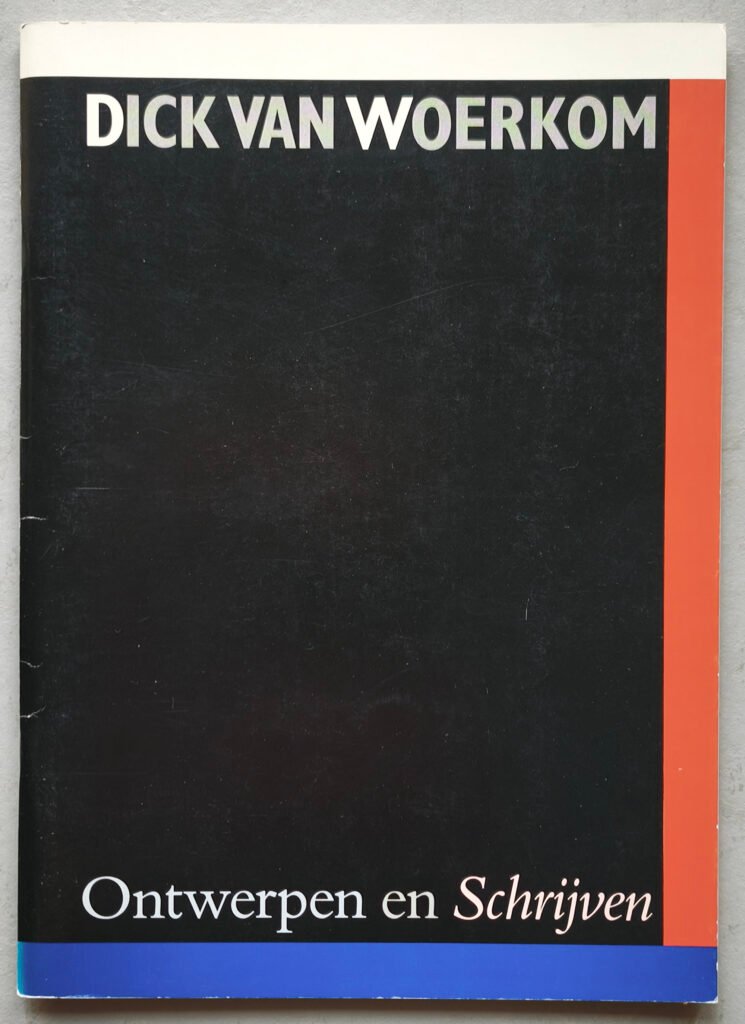

The Architect Who Kept De Stijl Alive
Dick van Woerkom was born on 24 April 1924 in Rangoon (present-day Yangon, Myanmar). During the Second World War he studied at the MTS (a secondary technical school) in The Hague and Haarlem. After the war he completed his training at the Technical University in Delft and the Academy of Architecture in Amsterdam.
He began his career as an architectural draughtsman at the Amsterdam offices of A. Komter and Merkelbach & Elling, before setting up his own independent architectural practice in Amsterdam in 1955.
Van Woerkom held strong, explicit convictions about what architecture should be. He saw himself as a successor to the De Stijl movement, and worked to carry its ideals — clarity of form, the interplay of plane and line, and a search for universal visual principles — into postwar architecture.
This ambition led him into a fruitful collaboration with the visual artist Joost Baljeu, with whom he created a series of scale models that attempted to apply Theo van Doesburg’s ideas on integrating architecture and visual art. Their partnership began in 1955, when they designed a neighbourhood centre in Amsterdam North together with sculptor C. Visser, and continued with a series of models until 1964.
Their shared pursuit of a “synthesis of the arts” — merging painting, sculpture, and architecture into a single, indivisible whole — did not always survive contact with the practical demands of real clients, and many of the resulting designs were never built. Still, the work was influential enough that in 1962 Van Woerkom, together with Baljeu, Jean Gorin, Charles Biederman, and the journal Structure, received the Sikkens Prize for the revival of constructivism and the presentation of universal principles in the tradition of De Stijl.
Van Woerkom never built up a large body of executed work. As is often noted of him, his importance lies more in the theoretical realm than the practical one — in the ideas he pursued and the questions he raised about the relationship between architecture and art, rather than in a long list of completed buildings.
Later in his career he also directed the Netherlands Documentation Centre from 1978 to 1986.
Dick van Woerkom died on 18 September 1987, leaving behind a modest but conceptually rich contribution to Dutch architecture — one rooted in the enduring spirit of De Stijl.
www.ftn-books.com has the scarce publication on van Woerkom now available.