

Born in 1914 in Rotterdam, Dirk de Herder was cradled by the melodic cadence of his father Alle’s musical vocation. Initially, he sought solace in the tactile dance of the paintbrush; yet, the camera lens whispered a more profound siren song—a medium where visual observation and rhythmic composition coalesced.
He navigated the avant-garde corridors of the era with the tactical grace of a diplomat. Cultivating a kinship with Brassaï amidst the flickering lights of Paris and aligning his aesthetic compass with the seminal Henri Berssenbrugge in the Netherlands, De Herder became a conduit for creative convergence. His lens served as a silent observer for the explosive Cobra collective, forging intimate bonds with visionaries like Karel Appel and Corneille. This chronicle of faces eventually migrated to the studios of the VARA; between 1954 and 1964, he immortalized a pantheon of performers. Whether capturing the whimsical guise of Pipo de Clown or the cerebral intensity of Arthur Rubinstein, his portraits were not mere documentation.
To witness his portfolio is to behold a realm where light serves as the architect of reality. The quotidian—the sighing curtains in a sun-drenched aperture, the obsidian sheen of a rain-lashed thoroughfare—became his sanctums. Like a painter wielding illumination rather than pigment, he transmuted the commonplace into the ethereal. Small wonder he found his spiritual kin in the luminescent shadows of Brassaï and the surrealist inquiries of Man Ray, for De Herder’s craft breathed, shimmering like a mirage caught in the aperture of a shutter.
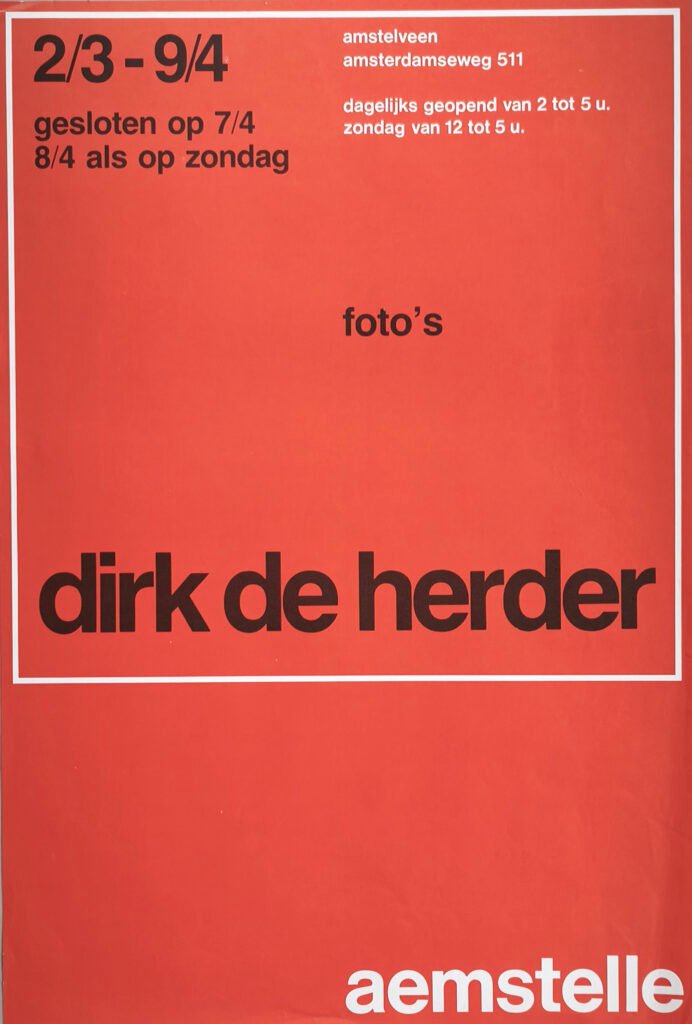
www.ftn-books.com has the Aemstelle poster for his exhibition now for sale. This is probably designed by Wim Crouwel, who knew de Herder well.