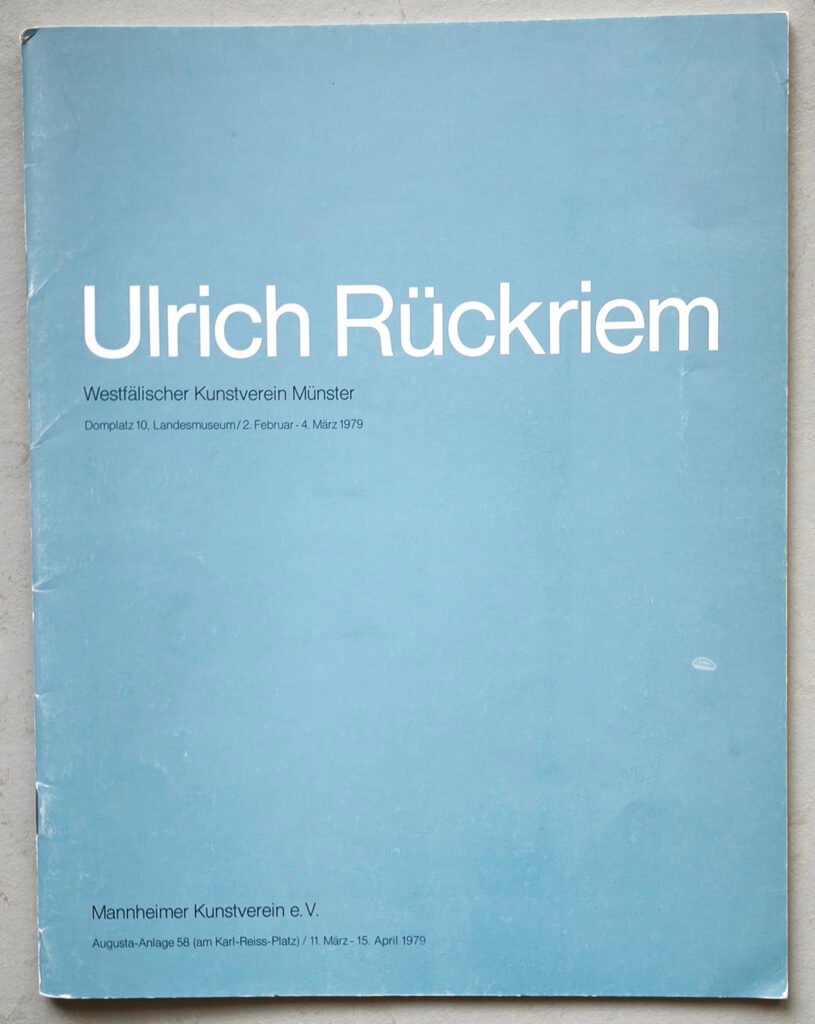

Ulrich Rückriem has a substantial and well-documented presence in the Netherlands, both through permanent works and through his role in shaping the local sculpture scene of the 1970s.
Presence and works in the Netherlands
Permanent works by Rückriem are installed in the Netherlands at the Kröller-Müller Museum in Otterlo and at Landgoed Baasdam in Tubbergen. At Baasdam, near the German border, Rückriem placed a stele in 1992 in the Drenthe province’s Bargerveen, at the site of the last peat-cutting pit — a memorial stone marking where peat was once extracted as fuel, standing at a crossing of sandy paths and roughly three meters tall. His piece Bahndamm is even more directly cross-border: it consists of seven square, upright pillars placed at varying distances along an eleven-kilometer stretch of a never-used railway track, beginning right on the Dutch-German border and ending near the Museum Insel Hombroich in Germany.
His work also entered major Dutch museum collections: the Van Abbemuseum in Eindhoven holds his “Granit bleu de Normandie coupé et scié,” and the Stedelijk Museum Amsterdam holds pieces including “Diagonalen-Diagonals” and “Bodenarbeit.” The Gemeentemuseum (now Kunstmuseum) in The Hague later devoted a show to his conceptual working method, presenting a series of drawings in which Rückriem charted 560 possible variations of his cutting-and-splitting technique on stone, most never executed, revealing the conceptual basis underlying his whole body of work.
Why he mattered to Dutch artists
The importance of Rückriem for artists working in the Netherlands is closely tied to a specific curatorial moment. Enno Develing, the Gemeentemuseum curator, organized an influential 1968 exhibition on Minimal Art that introduced American minimalist and conceptual sculptors like Andre, LeWitt, Judd, and Morris to Europe for the first time — the context into which Rückriem’s work was received. He then became a recurring presence in the major Dutch survey shows that followed: in 1971 Sonsbeek’s exhibition on the sculpture of the preceding five years included Rückriem alongside Andre, Beuys, Dibbets, Judd, LeWitt, Nauman, Serra, Smithson, and Dutch artists such as Boezem, Van Elk, and Visser, all invited to choose the site for their own work rather than have it imposed by the museum.
Rückriem had his first and only solo exhibition in the Netherlands at the Stedelijk Van Abbemuseum in Eindhoven in 1977, and the following year the Stedelijk Museum Amsterdam’s 1978 exhibition “Door beeldhouwers gemaakt” (Made by Sculptors) placed him again alongside Carl Andre and Richard Serra. That show left a direct mark on at least one Dutch artist’s own account: the sculptor Paul Gees later recalled visiting it and being fascinated by how artists like Carl Andre, Ulrich Rückriem, and Richard Serra engaged with space and material in such a fundamental way, calling it the lasting foundation of his own practice. HomeKunstmagazine
More broadly, Dutch art history places Rückriem within the generation of sculptors concerned with the fundamental properties of sculpture — material, measure, form, weight, and space — a lineage running parallel to, and in dialogue with, Dutch constructive and conceptual sculptors like Carel Visser, Ad Dekkers, and Stanley Brouwn, who was noted as an important source of inspiration for many younger Dutch sculptors. His work has also been read through a Dutch land-art lens: because he works with simple forms while also introducing a piece of nature into the landscape, his sculptures are seen as sitting at the intersection of Minimal Art and Land Art, a framing that resonated with the wider Dutch/German landscape-art tradition (herman de vries, Paul de Kort) active in the same border region.
In short: Rückriem wasn’t just exhibited in the Netherlands — through Sonsbeek, the Stedelijk, and the Van Abbemuseum, he was part of the exact circuit through which Minimal and process art reached, and helped form, a generation of Dutch sculptors.
www.ftn-books.com has several Ruckriem catalogs available.