

Annalies Klophaus and the Color of Words
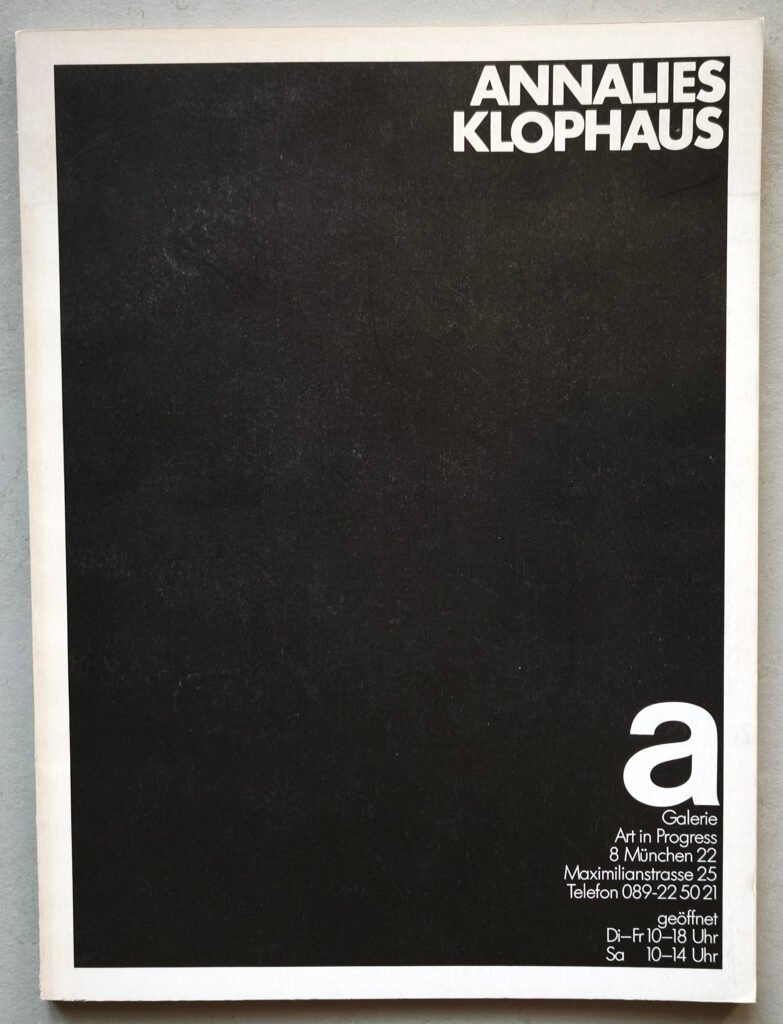
Among the many artists who shaped concrete poetry in the second half of the twentieth century, Annalies Klophaus occupies a quiet but distinctive place. Born in Germany in 1940, Klophaus worked as an artist, writer, and concrete poet, focusing much of her practice on a single, deceptively simple question: what happens to a word when you change its color?
Word, Color, and the Space Between
Klophaus’s best-known work is her 1970 artist’s book Mot-Couleur-Roman / Farb-Wort-Roman (“Word-Color-Novel”), published as part of the Editions Agentzia series founded by Jochen Gerz and Jean-François Bory. The book pairs handwritten text with color in a way that treats each element as equally important — the word is not simply illustrated by color, and the color is not simply named by the word. Instead, the two are set against each other, so that meaning shifts depending on how they interact.
Klophaus described her own method as an experiment in using color and word as independent materials, then bringing them together to see what survives the collision. Her suggestion was that color could alter or even neutralize the emotional charge of certain words — that writing “death” in green, for instance, might soften its weight, or that pairing opposite feelings with contrasting colors could make one of them redundant. It’s a small, almost playful proposition, but it points to something concrete poetry as a movement was deeply interested in: language as a visual and material object, not just a vehicle for meaning.
Part of a Larger Movement
Klophaus’s work sits alongside that of contemporaries like Ilse Garnier, Mary Ellen Solt, and Mira Schendel, all of whom pushed poetry away from the linear page and into visual space. She was included in Mirella Bentivoglio’s 1976 exhibition and card collection surveying women’s contributions to visual and concrete poetry, and more recently her work has been featured in the anthology Women in Concrete Poetry: 1959–1979, which set out to recover figures who were active in the movement’s key circles but often overlooked in earlier, male-dominated surveys of the genre.
Her papers and books are held today in collections such as the Ruth and Marvin Sackner Archive of Concrete and Visual Poetry, now housed at the University of Iowa — a fitting home for an artist whose work was always, in some sense, about archiving the strange life of words.