

The transformative contributions Ellsworth Kelly made between the late 1940s and early 1950s fundamentally altered the landscape of abstract art for generations. By pioneering monochrome canvases, multi-panel compositions, and a commitment to seriality and aleatory methods, Kelly played a pivotal role in liberating painting from the conventions of expressionism during the 1960s. Yet, his path toward abstraction remained distinct; rather than chasing universal truths, he anchored his work in the specific. By elevating “found” imagery—such as the silhouette of foliage or the creases in a discarded pack of cigarettes—he unveiled fresh creative vistas, guided by his philosophy that the world offered objects that demanded to be recreated with absolute fidelity and zero embellishment.
Spanning a professional life of seventy years, Kelly distilled these discovered forms into a diverse portfolio comprising sculpture, photography, prints, and traditional painting, each piece possessing a visual gravity that defied categorization within any single movement. Regardless of his forays into novel mediums or structures, an unwavering stylistic core rendered his work instantly identifiable.
Richard Shiff described Kelly’s process as the translation of “fragments of visual experience,” a practice he pursued with immense discipline, frequently revisiting archival sketches and initial concepts. This synergy between spontaneous sensory perception and meticulous execution fueled his lifelong capacity for innovation. John Coplans observed in 1969 that Kelly’s system was profoundly non-restrictive; he rarely discarded a concept, preferring to allow nascent thoughts to develop at their own pace. This patient, deliberate maturation is perhaps the hallmark of a career that produced perhaps the most reliably inventive body of work in the contemporary canon.
A native of Newburgh, New York, Ellsworth Kelly (1923–2015) relocated to France in 1948, where his artistic sensibility was shaped by exposure to both traditional and avant-garde influences. Following his return to New York in 1954, he debuted at the Betty Parsons Gallery two years later. His first major retrospective occurred at the Museum of Modern Art in 1973, setting the stage for subsequent global showcases at prestigious institutions, ranging from the Tate in London and Paris’s Centre Pompidou to the Guggenheim in New York and Munich’s Haus der Kunst.
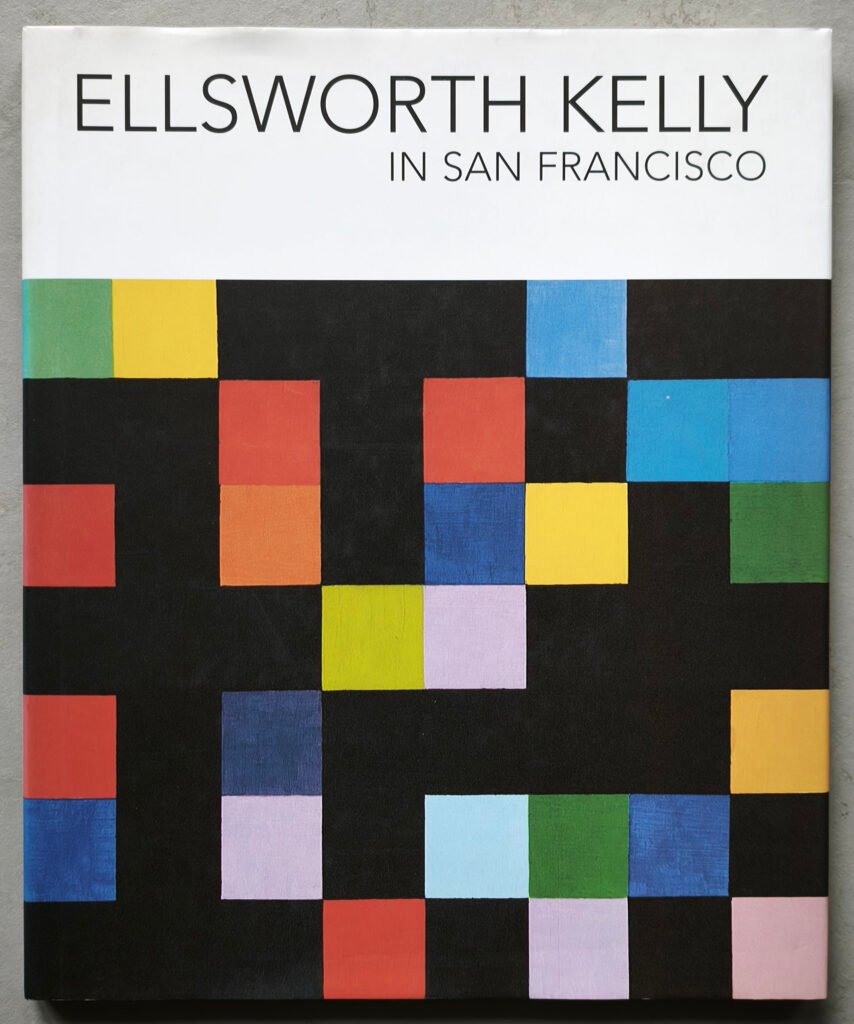
I am a great admirer of Kelly and have collected many interesting publications over the years and recently i added the ELLSWORTH KELLY IN SAN FRANCISCO book to www.ftn-books.com
and i still have one beautiful Wim Crouwel designed/ Vormen van de Kleur available.
