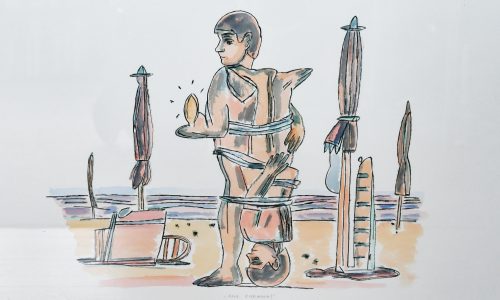
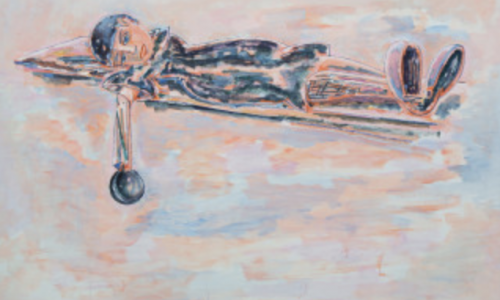
December 2021 i wrote a blog on Peer Veneman , not knowing that I could offer a nice work by Veneman within a year at FTN art. It is a very nice multiple in a small edition of only 12 . Signed and numbered by Veneman. Numbered 3/12 . depicting a scene with a semi nude girl on a bar at a burlesque theater. The thing that won me over for this multiple was the rather strange clamcat / kikker that is fixed to the work. One wonders what the meaning is? what should you fix? …..but because of the clamcat I keep looking at it. The work is now for sale at www.ftn-books.com
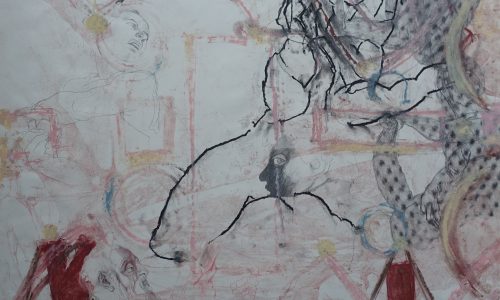
Jaroslav Kozlowski (Srem near Poznan) is one of the most outstanding Polish contemporary artists. His work is closely associated with conceptual art, usually in the form of installations that include other disciplines and media such as drawings, light, sound, photographs and objects. Kozlowski is also the author of numerous books, prolific photographer, artist, painter and performer. His work is characterized by critical and analytical discourse about art and the mechanisms of perception, self-reflection and creating links between the grammar of artistic language and realm of meaning. In the seventies Kozlowski became interested in the position of artists and art in modern civilization, believing that the system, whether it was socialist or market economy, or any other, necessarily affects the art production, so the alternative practice of conquering space of freedom is necessary and constant. He implemented this thesis in his own practice in 1972 with a project of autonomous networking of artists. The project had an international character and began by creating a mailing list and a manifesto that was written by Kozlowski and his friend Andrzej Kostolowski, although they denied authorship in the manifesto. The project resulted in a large international rhizomatic (non-hierarchical, with many inputs and outputs) network of personal relationships, which surpasses all political and geographical constraints. The response of artists from around the world was excellent, and when Kozlowski decided to present the received materials in his apartment to ten of his close friends, because of the report of one of the participants, the presentation was interrupted by the police and secret agents. On the legal basis of the culpability of the unregistered gathering of people in private premises that cannot be thought of as family – and the police further considered that it was an anarchist gathering that threatened the country – the appropriate charges were brought against Kozlowski. All of his materials were confiscated, then partially restored, and he alone was repeatedly questioned at the police station or in the apartments used by the secret police. Although the trial was adjourned the last day, Kozlowski was not allowed to teach at the academy for years, he was forbidden to travel abroad for five years, and his persistent and continuous art, gallery and publishing activities were closely monitored until the fall of the ruling system.
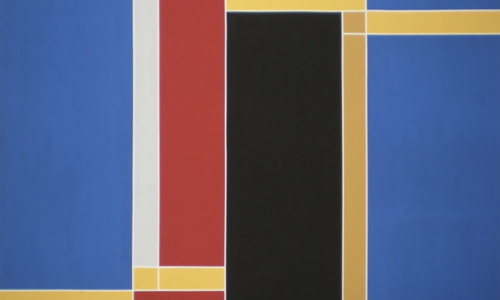
Robert Zakanitch was born in 1935 in Elizabeth, New Jersey and grew up in Rahway. He lived and worked in New York City.[1] At the time of his June 3 through September 17, 2017 exhibition in the Hudson River Museum, he had recently moved his residence and studio to Yonkers, New York (as stated in the exhibition’s literature).
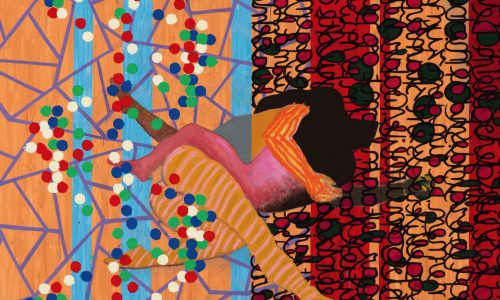
In the late 1960s he began experimenting with Color Field painting but would go on to be one of the founders of the Pattern and Decoration movement in the mid 1970s. While working in the Color Field he was strict to adhering to an abstract style inspired by Minimalism until he learned about decorative imagery. He kept the same color schemes and structures, but incorporated floral motif and a more painterly style. Zakanitch was exhibiting in New York as early as 1968. In 1975 he met Miriam Schapiro while he served as a guest instructor at the University of California, San Diego. A year later, in New York, the two artists would organize an organization around Pattern & Decoration artists.
www.ftn-books.com has the Robert Miller 1985 catalogue now available.
Marjolijn van der Assem is a really established artist in the dutch art scene from almost 50 years now. She has had exhibitions at the very best of dutch galleries. Asselijn, weakens and Phoebus all presented nd represented her at one time. She has had numerous museum exhibitions and group exhibitions and yet….her name is not the most well known in dutch art , but her works deserve to be known by a much larger number of art lovers.
The following text comes from the CBK Rotterdam site:
Cycling along the Schaardijk along the Nieuwe Maas is a beautiful journey to the studio of Marjolijn van den Assem, which, together with her husband’s house and architectural office, is located in a barely conspicuous sleek box above the river. Once inside I am surrounded by beautiful vistas and special works of art. On the built-in bridge to her workspace, Van den Assem draws my attention to a beautiful small painting. She painted it when she was 11 years old. It is the beginning of a conversation that takes us from misunderstood desires via Friedrich Nietzsche to one twig.
Marjolijn van den Assem (Rotterdam, 1947) has been at the forefront of Dutch drawing for decades. Her work can be seen in many places at home and abroad and is also included in many collections. As is often the case, however, this was not without a struggle. “In my youth I was extremely shy for a while and felt misunderstood. I identified with artists and poets, but found no resonance with my environment. My father had his own business and so his ideas about the future of his children. Of course, an artistry did not fit in at all, at most as a fun hobby. I went back to Rotterdam from Emmen, where I moved with my parents at a young age, to do the Academy there. In the end I didn’t finish because I was pregnant with our daughter and suddenly felt ten years older than the rest of my academy class ”.
Van den Assem can hardly remember anything of the earliest years as a professional artist (“I think you are born as an artist!”). “That is a blind spot. I do remember that I had an exhibition at Albert Waalkens in Finsterwolde (1978) and in the Groninger Museum (1981, 6 Dutch artists in the Mohr-Mathon collection). At that time, an article by Hans Vogels appeared in the Volkskrant about fundamental drawing. “That’s when I realized I was being seen.”
A decisive event in her artistic career Van den Assem calls the meeting with Josine de Bruyn Kops (1940-1987), who was director of Museum Gouda from 1976-1986. “The meeting with her and later also with Liesbeth Brandt Corstius, their support and encouragement have been very important to me. My way of working was very monomaniacal and withdrawn, it was my way of survival. De Bruyn Kops and Brandt Corstius gave me solo exhibitions in their museums in Gouda and Arnhem because they felt that my work should be seen in the outside world, they thought that could also be encouraging for other female artists! ”
At that time, Van den Assem was already working on work that arose from her intense interest in the work of the philosopher Friedrich Nietzsche. “I fought for Nietzsche’s work and gained a lot of self-confidence from it. But I didn’t tell anyone about that, because that was not a job for me, but an inevitability, the only way to get my brain going. From the artist John van ‘t Slot I received a not yet opened copy of Ecce Homo, which I myself cut open page by page and ‘conquered’, it became my favorite Nietzsche book.
After that, I started reading Nietzsche’s entire oeuvre and many interpretations of it in a very disciplined way, even if I sometimes didn’t understand much of it at the time. However, a good friend and guide, who was important to me at the time, said: If it ever comes up, you will be amazed at what you know. “
Marjolijn van den Assem thus discovered Nietzsche around her thirtieth birthday and began to trace the journeys he made and to visit the places where he worked. A few years after the fall of the Berlin Wall, while traveling through eastern Germany, she arrived in Naumburg (an der Saale), a town in a deplorable state. A note was attached to the derelict Nietzsche-Haus stating that a Nietzsche Gesellschaft would be established, including the address of the founders. “When I got home, I wrote a note that I would like to become a member and I added the German marks that we had left from our holiday as a deposit. Never heard anything again, until about ten years later I received a pass as member. Years later I received a call from Paul van Tongeren (Nietzsche Research Group, Nijmegen) who had been asked by the director of the Nietzsche Dokumentationszentrum Naumburg to mediate for a solo exhibition there.
As it turns out, you will be given space, but nothing else is being arranged, no transport, no jetty, no assistance, no fee. You really see that more and more, also in museums, everyone is paid, except the artist. The artist is often screwed, the child of the bill. Unfortunately, you cannot live off your artistry, despite regular good sales and stipends.
I jumped in the air! I was more or less instructed to make a work especially for a space of six meters high. But I rarely do commissioned work, it does not suit my working method. Fortunately, Jisca Bijlsma (now director of the Chabot Museum, Rotterdam) knew my curator for this exhibition Seelenbriefe, to convince me that I could do it in this particular case. I then retired to my studio and made a work that eventually gained a place of honor next to the bust of Nietzsche, which I am still extremely proud of. I made small drawings on a roll of ten meters, which slowly became more and more spatial, in the end they literally crawled out of that roll. ”
Van den Assem leads me through her studio and tells about an exhibition that she is currently working on, Big Art in the Bijlmerbajes (2018). She wants to show the monumental work she showed in Naumburg there in a gym, but while she talks about it, her irritation increases. “I feel more and more called upon to protect my profession. As it turns out, you will be given space, but nothing else is being arranged, no transport, no jetty, no assistance, no fee. You really see that more and more, also in museums, everyone is paid, except the artist. The artist is often screwed, the child of the bill. Unfortunately, you cannot live off your artistry, despite regular good sales and stipends. Fortunately, I still have my ‘work of the month’, my own materials fund on my blog, with which I can use the proceeds to buy materials from Harolds every month. Marjolijn is commercial, colleagues say, yes, fortunately, because that means I can continue to work and do not have to take out loans that I have to pay back later. ”
Marjolijn van den Assem has learned to use her voice. For example, she is one of the few of her generation who is very active on social networks and has her own blog on which she regularly posts and shares her views. “As an artist you have to have character to survive in life. Many people say that I am so nice and cooperative, but in the meantime I am one through all the experiences twig become when necessary. So in the end I became an adult. ”
Hans van der Ham studied classical piano at the Royal Conservatory in The Hague and the Utrecht Conservatory (graduated 1984). He then studied autonomous art at the Academy of Fine Arts in Rotterdam where he graduated with paintings, drawings and graphics (graduated 1989). However, Van der Ham was mainly active for more than 30 years as a sculptor and became known for his black clay sculptures. Vulnerable souls, wrapped in rock hard material. But his indefinable worlds on paper, made of gouache or black ink, also characterize his oeuvre. Until 2020, the need arose to return to his old metier and to make a new start from the spatial work with paintings in various formats.
Van der Ham has been working as an independent visual artist in Rotterdam since 1989 and regularly has exhibitions at home and abroad. His work was represented by Galerie Nouvelles Images in The Hague until its closure in 2018. His work is included in various museum and corporate collections.
In 2012, Van der Ham cofounded Garage Rotterdam, together with a Rotterdam patron, where he was responsible until 2015 as curator and artistic director. Van der Ham makes exhibitions on a regular basis, including for Museum Boijmans Van Beuningen: as a guest curator in 2018 he produced the exhibition ANIMA MUNDI.
www.ftn-books.com has the Nopuvelles Images publication PERSONAE now available.
Jan Grosfeld (Valkenswaard, 1956 – Amsterdam, 2019) was a very well respected Dutch artist who’s works have found their way to the Museum Boijmans van Beuningen and many other institutional collections. He lived and worked in Rotterdam. Several publications about his work have been published and his work was widely exhibited by renowned museums and galleries.
This is what I encountered on the internet, but the paintings I encountered in the Jan Grosfeld catalogue that I now have for sale at www.ftn-books.com surprised and amazed me. They are timeless and made me realise that my knowledge of Modern art is by far complete.
This is an artist that I will follow from now on and hopefully one day I can add a work by Grosfeld to our collection.
He was born in Maastricht, the Netherlands. After attending the technical school in Maastricht he joined the marines as war volunteer trained in Camp Lejeune, N.C., United States, to end the occupation by Japan in World War II. During his training the war was ended by the atom bomb and he was sent to the late colony of the Netherlands Indonesia. In 1947 he came back to the Netherlands, only to leave soon afterwards to the far East in an attempt to escape the poverty of his native surroundings. Ten years later he decided to emigrate to the U.S. Here he studied art and philosophy at the New York University. Combining his art classes with earning a living and visiting all art happenings, museums and galleries, for example the Tinguely happening at the MOMA in NY in 1960 he was overwhelmed by Abstract expressionism and left for the Arabian desert in Dhofar, a sultanate of Muscat and Oman where he worked in his former trade as a petroleum engineer. He did one more important job project, the erection of the Telstar Horn Antenna at the Andover earth station in Maine, then he traveled to California, inspired by the movie he watched while working in the Arabian desert Strangers When We Meet. He studied at the Monterey Peninsula College, California, the Monterey Institute of Foreign Studies and San José College (arts and humanities) subsequently at the University of California, Berkeley, a.o. with David Hockney, R.B. Kitaj, Elmer Bischoff and Richard Diebenkorn In 1967 B. A. in Philosophy, in 1969 M.A. in arts . He returned for a “short visit” to the Netherlands where he continued his art practice without realizing there is no intellectual resonance where he works but he is so possessed with his newly discovered Pentagonism that he does not realize he has landed on the moon. To this day he works continually, evolving new ideas, executes them, and making them public through exhibitions and publications, remaining optimistic, believing that ha has added a new chapter to the history of art self coined as Pentagonism. ( the above text comes from Wikipedia)
This is what the press office of the Gemeentemuseum Den Haag said on the Vaclav Cigler exhibition what was held in 2005 on their exhibition on Vaclav Cigler
The first ever presentation of modern glass from the Czech Republic and Slovakia in any Dutch museum. Thanks to the loan of a major private collection, the Gemeentemuseum is now in a position to reveal the skill and sophistication with which glass artists in these two countries exploit the optical effects of glass in their sculptures. The exhibition will be designed by the internationally renowned designer Václav Cigler (1929), who is regarded as the founding father of this school of glass art.
According to the book that I now have for sale , this exhibition was held 30 years after Cigler’s solo exhibition at the Museum Boymans van Beuningen. Of course this does not mean that the Gemeentemuseum was not important…..it was….and its catalogue is one of the best that was published on Cigler ever. But is is not true that it was the “first ever”
exhibition. I love the works of Cigler , but I prefer the lesser known Boymans catalogue, because of the small sketches that are included at the end. Both catalogues are now available at www.ftn-books.com
A legend of Czech artistic glassmaking, Cigler has played an active role both domestically and internationally since the 1960s. He studied at the Nový Bor Glass School and with Professor Josef Kaplický at the Academy of Arts, Architecture and Design in Prague. He established and subsequently headed (1965–1979) the Glass in Architecture studio at the Academy of Fine Arts and Design in Bratislava. He participated in dozens of group as well as solo exhibitions around the world. In addition to his country of origin, his works can be found in both public and private collections in Germany, Switzerland, the Netherlands, Denmark, France, Great Britain, USA, Canada and Japan. On the occasion of winning the Czech Grand Design award, he was inducted into the Czech Design Hall of Fame in 2018.
Baskin is known for his sculpture and graphic arts, especially monumental woodcuts. He was committed to figurative art in a time when the art world focused on abstract expressionism. His work emphasized portraiture and the human condition, often malformed, exaggerated, and animal-like. Common themes include natural history, the Hebrew bible, Greek mythology, and poetry. As the son of a rabbi who grew up in a Jewish community in Brooklyn, Judaism and the Jewish Orthodox community are commonly featured. He was a frequent collaborator with many writers, especially Ted Hughes. Baskin’s work is included in the collections of most major institutions in the United States. He is recognized as a key contributor to the revitalization of fine art presses in addition to his distinction in sculpture and woodcut.
www.ftn-books.com has a few Baskin titles available.
The reason of this short blog is not the mechanical body fan by Rebeca Horn ( see photo above ) but the garden sculpture she made for the Gemeentemuseum Arnhem and which was executed in the garden in 1989. Together with the sculpture “Venus Funnel” a book was published in a very small edition. Only 28, but very important pages on this Rebecca Horn project. Small edition now available at www.ftn-books.com
Artist/ Author: Oliver Boberg
Title : Memorial
Publisher: Oliver Boberg
Measurements: Frame measures 51 x 42 cm. original C print is 35 x 25 cm.
Condition: mint
signed by Oliver Boberg in pen and numbered 14/20 from an edition of 20


.jpeg)