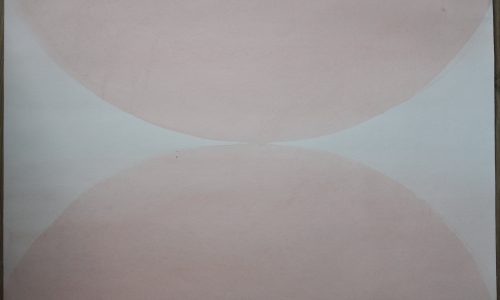
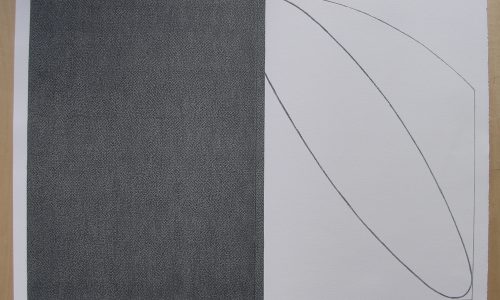
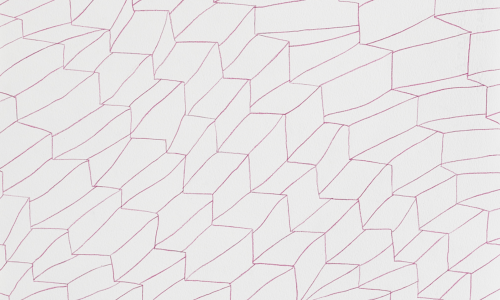
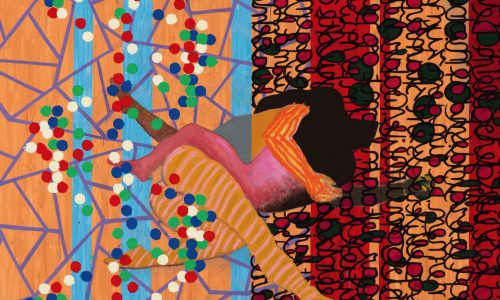
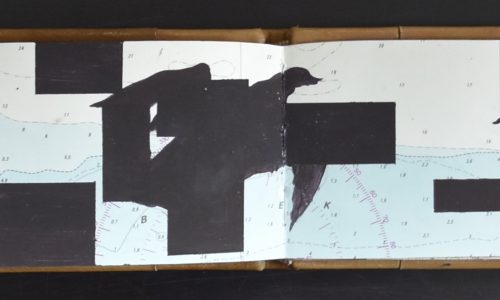
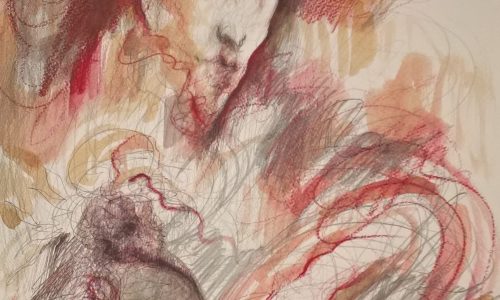
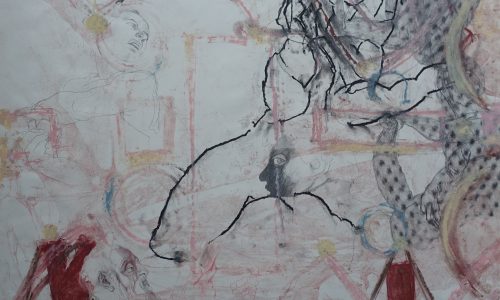
Hantaï began creating pliage paintings in 1960, conceiving of the process as a marriage between Surrealist automatism and the allover gestures of Abstract Expressionism. The technique dominated the work he made during the rest of his career, re-emerging in diverse forms—sometimes as a network of crisp creases of unpainted canvas spanning the composition, and at other times as a monochrome mass manifesting in the center of an unprimed canvas. His technique of “pliage” (folding): the canvas is first folded in various forms, then painted with a brush, and unfolded, leaving apparent blank sections of the canvas interrupted by vibrant splashes of color. The technique was inspired by the marks left folding on his mother’ apron.
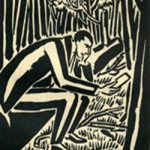
From 1967 to 1968 he worked on the Meuns series where he studies the theme of the figure. Meun is the name of a small village in the Forest of Fontainebleau where the artist lived starting 1966. Hantaï stated: “It was while working on the Studies that I realized what my true subject was – the resurgence of the ground underneath my painting.”[3] In contrast with the Meun (1967–68), the figure, in the Studies (1969), is absorbed and the white detaches from being the background and becomes dynamic.
The poet, painter and graphic artist Camille Bryen (Camille Briand) is regarded a protagonist of French Tachism. Camille Bryen was born Camille Briand at Nantes in 1907. He is an all-rounder and was not only active as visual artist, but also as writer. In 1932 he published a collection of drawings, collages and poems with the title “Expériences” under the pseudonym Camille Bryen. As painter Camille Bryen (Camille Briand) followed a path of subjective, expressive abstraction. Together with Georges Mathieu he started the movement “Non-Figuration-psychique” in 1947. A year later Camille Bryen, Georges Mathieu and Michel Tapié organized the first exhibition for this “psychic-abstract” painting called “L’Imaginaire”, “HWPSMTB” as well as “White and Black”. Camille Bryen (Camille Briand) executed his expressive-abstract works, which are close to Tachism, in various techniques. In 1947 he made abstract watercolors called “Structures Imaginaires”, as of the late 1940s Camille Bryen (Camille Briand) became increasingly occupied with oil painting and graphic techniques. Camille Bryen (Camille Briand) was quite successful with his strong abstraction as of the 1950s: He had his first grand retrospective at the Musée des Beaux-Arts in Nantes as early as in 1959, in 1973 another large exhibition at the Paris Musée National d’Art Moderne followed. International museums are in possession of works by Camille Bryen (Camille Briand), among them the Musée d’Art Moderne et Contemporain (MAMCS) in Strasbourg, the Macedonian Museum of Contemporary Art in Thessaloniki, the Israel Museum in Jerusalem and the Museum of Modern Art in New York.
www.ftn-books.com has now the Christian Fayt Art gallery catalogue from 1985 available
Leonardo Cremonini was born on 26 November 1925 in Bologna, Italy.
He studied at the Academy of Fine Arts in Bologna and at the end of the war, in 1945, he moved to Milan where he attended Brera Academy and met important figures in the Italian cultural scene. In 1951 he moves to Paris thanks to a bursary, where he installs his main residency. He lived for long periods abroad, in New York, where he exhibited extensively from 1952 to 1960, Florence, Andalusia, Normandy, and the isle of Panarea in Sicily.
His most significant retrospectives have been held worldwide in the museums of Basel, Brussels, Metz, Paris, Prague, Siena, Strasbourg, Spoleto, Tokyo, Aosta, Monte Carlo, Grenoble, Toulon and Milan.
In 1964 he exhibited at the Venice Biennale. In 1967 he got the Marzotto International Prize and in 1979, the Prize from the Italian President of the Republic. From 1983 to 1992 he directed the painting course at the “Ecole Nationale des Beaux-Arts” in Paris. He was nominated “Commandeur des Arts et des Lettres” in France, member of the Royal Academy of Belgium, member of the San Luca National Academy in Rome and of the “Accademia delle Arti e del Disegno” in Florence.
Under a title that is a nod to German artist Joseph Beuys (“Every human being is an artist”), this exhibition dedicated to Pierre Bismuth (b. 1963, lives and works in Brussels) at Centre Pompidou highlights the singularity of the artist’s practice.
Covering a little more than 20 years of activity, it features a set of works revealing of his method and reflection. What does it mean to be an artist in an age where culture has become part of the leisure industry and where industrial production instantly assimilates every aesthetic issue? How to create artworks in the absence of any specific know-how?
Pierre Bismuth responds by applying the logic of productivism to the artistic field, broadening the skillset as much as possible, whether through his multiple relationships with cinema, or by the creation of strange hybrid industrial materials, the random proliferation of names, the automatic production of geometric abstraction based on national emblems, or quite simply by the creation of a real product from everyday consumption.
The exhibition thus presents about 30 works including a large series of drawings/photograms in which the artist follows the gestures of Marlene Dietrich, Louise Brooks, Catherine Deneuve but also Sigmund Freud and Jacques Lacan or the famous video installation The Jungle Book Project (2002) in which each Disney character is speaking a different language.
Two new works from 2021 mark this exhibition: Portrait du collectionneur, the Saab automobile that once belonged to the great Belgian collector of conceptual art Herman Daled, in which the upholstery has been entirely redone and now features the names of the artists included in Daled’s collection. The second work, Pierre Bismuth’s Chocolate is a presentation and distribution of chocolate bars whose recipe has been developed by the artist. As the artist says: “if the art public cannot escape its role as cultural consumer, then they might as well eat good chocolate.”
Thomas Lange (Berlin, 1957) is a German painter and sculptor. With spirited brush strokes and movements, his paintings are visionary portraits or scenic views on the borderline between abstraction and figuration. This is achieved by constant and complex repainting and layering, meant as the overlapping of different temporal dimensions, from which the human figure emerges and takes on the leading role. His artwork and projects have been exhibited worldwide in prestigious art galleries, museums and foundations, such as the Berlinische Galerie and the Martin Gropius-Bau in Berlin, the Solomon R. Guggenheim Museum of New York, the Palais de Beaux-Arts in Brussels, the Musée d’Art Contemporain de Nice, the Mocak in Krakow, the Kunsthalle in Budapest, the Haus der Architekten of Düsseldorf, the Resim ve Heykel Müzesi in Istanbul, and the Mori Art Center in Tokyo.
www.ftn-books.com has a few Lange titles available among them the Brauschweig catalog
Born to a family of Polish immigrants in Paris, Maurice Frydman creates his work in a field that he scours tenaciously: the skin. The skin – the first and last bastion of our being – is a reflection of intimacy and experience and connects us to the outside world via touch. Skin is a living testament, down to the smallest wrinkles, creases and folds. The artist has made this the subject of his work, in order to tell us about the individual, love and hate and sensuality, but also fractures, stigmata and scars. He strives to evoke the skin in different forms and through different techniques: sometimes personal memories, sometimes recollections of the dark spirals of the past.
Maurice Frydman’s roots were initially figurative. He depicted maternity and paternity, but also the opposite of this humanity through drawings and washes of intense emotion, illustrating the horrors of the Holocaust. In these, we imagine the human form rather than recognising it in the attitudes of these naked, slaughtered bodies.
A few years later, the discovery of transparent plastic film marked a turning point in Maurice Frydman’s style. While he is inspired by this unconventional, supple, elastic and seemingly banal material, it is because it is malleable, mobile and alive, closely mirroring the plasticity of the skin. In the hands of the artist, when associated with painting, it quickly takes on a meaning and allows for a range of hybrid works that play with texture, with a language that is common to both sculpture and painting. Abstraction and 3D then take centre stage. The relationship with the material is decisive and essential and both visual and tactile; it is almost carnal because Maurice Frydman shapes it with his own hands by stretching and twisting it. He brings the plastic to the point of breaking, with the material in a permanent state of action/reaction, leading to an explosion of folds and tears. Gesture and thought go hand in hand. This is because, behind the handiwork, behind the texture, which graduates the effects of chance and light, beyond the successive layers of paint that coil and create a sense of relief in this material, there is a mirrored surface that is full of meaning. Certain three-dimensional works, which are formed from luminous matrices that are folded and creased, depict imaginary landscapes in bas-relief, shifting between abstraction and figurative work.
The ebb and flow of the docile plastic calls to mind the skin (be it pleasure or pain), onto which vital energy and concealed emotions are grafted. This skin retains the remnants and marks of our experiences and reveals both the dark and light side of our existence. While Maurice Frydman follows in the footsteps of Michelangelo, he suggests exceptional variations on David’s torso. This part of the human anatomy is the most complex and varied when it comes to its movements. In addition to its formal beauty and the research that continues ad infinitum, this work serves as a cry from the abysses of history. Tragedy is present and muffled in the large formats or the huge sheets, which are produced with masterly dimensions.
Arnaldo Pomodoro was born in Montefeltro in 1926, he spent his childhood and education in Pesaro. He lives and works in Milan since 1954. His works from the 1950s are high-reliefs where a unique and previously unknown sculptural “writing” emerged, variously interpreted by the most important critics. In the early 1960s he turned to three-dimensional work and focused his research into the solid geometric form: spheres, discs, pyramids, cones, columns, cubes – all in burnished bronze – are lacerated, corroded, excavated in their depths, with the intention of destroying their perfection and discovering the mystery closed within. The formal juxtaposition between the shiny perfection of their geometric shape and the chaotic complexity of their insides from now on becomes a constant in Pomodoro’s production. In 1966, he was commissioned to make a sphere, three and a half metres in diameter, for the Expo in Montreal. Now in front of the Farnesina in Rome, it marks his shift towards monumental sculpture. This was the first of several works by the artist placed in symbolically important public spaces: in many city squares (Milan, Copenhagen, Brisbane, Los Angeles, Darmstadt), in front of Trinity College, Dublin, Mills College in California, the Cortile della Pigna in the Vatican, opposite the United Nations in New York, at the Paris headquarters of UNESCO, in the PepsiCo sculpture gardens in Purchase, and in those of the Storm King Art Center in Mountainville, just outside New York City. He has made many environmental works, ranging from the Project for the New Cemetery of Urbino of 1973, excavated into a hill in Urbino, which was, however, never built, due to local issues and disagreements, and Moto terreno solare, a long concrete wall for Il Simposio di Minoa in Marsala, through to the Sala d’Armi for the Poldi Pezzoli Museum in Milan, Entering the Labyrinth, dedicated to the epic of Gilgamesh, which he completed in 2011, and Carapace, a wine cellar in Bevagna made for the Lunelli family. Memorable retrospectives have consolidated his reputation as one of the most significant contemporary artists. His traveling exhibitions have toured throughout Europe, America, Australia and Japan. He has dedicated himself to set design since the start of his activities and created “spectacular machines” for numerous theatrical works, from Greek tragedy to melodrama, from contemporary theatre to music. He has taught in the art departments at various American universities: Stanford University, University of California at Berkeley, Mills College. He has been the recipient of many prestigious awards: the Sculpture Prizes at the Biennials of São Paulo (1963) and Venice (1964); the Japan Art Association’s 1990 Imperial Praemium for Sculpture, and the Lifetime Achievement in Contemporary Sculpture Award from San Francisco’s International Sculpture Center (2008). In 1992 he received a degree in the humanities honoris causa from Trinity College Dublin, and in 2001 an honorary degree in architectural engineering from the University of Ancona.
Lee Krasner was a force of nature, always pushing abstraction forward. Her work over 50 years suggests perpetual, restless reinvention, encompassing portraits, Cubist drawings, collage, assemblage, and large-scale abstract painting. A pioneer of Abstract Expressionism, she was also one of the key crusaders for Jackson Pollock’s legacy. As the art historian Helen Harrison, now the director of the Pollock-Krasner House in Springs, NY, once wrote, Krasner “squeezed the juice out of her imagery.”1
Krasner was born in 1908, to Russian-Jewish refugees in Brooklyn. She always wanted to study and make art, and attended the Women’s Art School at Cooper Union and the National Academy of Design. When The Museum of Modern Art opened in 1929, Krasner said, “It was like a bomb that exploded…nothing else ever hit me that hard, until I saw Pollock’s work.”2 She became a mural painter for the Works Progress Administration, the Depression-era public art project, and an arts activist. In 1937, she studied with the influential teacher and artist Hans Hofmann and joined the American Abstract Artists group; she went dancing to jazz with Piet Mondrian. In many ways, she was at the center of the burgeoning New York art world. As one dealer remarked, Krasner “knew more about painting than anyone in the United States, except John Graham.
It was the artist Graham who brought Krasner and Jackson Pollock together. In 1942, both were included in his major exhibition French and American Painting at an antique furniture store in midtown New York. Krasner was inspired to knock on Pollock’s apartment door to check out his work. It was the start of a tempestuous relationship that would be a central and at times eclipsing presence in her own career.
Krasner introduced Pollock to many artists and gallerists, including Willem de Kooning, Hans Hoffman, and Sidney Janis, and most importantly to the art critic Clement Greenberg, who became a champion of Pollock’s work. In 1945, Krasner and Pollock married and moved out to Springs, East Hampton, on the East End of Long Island, to get away from the city scene. (Pollock was already suffering from debilitating alcoholism.) There they clammed, rode bikes, and painted. Krasner, working in her upstairs bedroom studio, began her breakthrough Little Images series—its canvases small enough to fit on a bedside table—and made mosaiced tabletops. She imagined the dense compositions of her Little Images as unreadable hieroglyphics, thick with paint sometimes applied directly from the tube. Krasner also began working on collages—using paper and scraps from canvases she and Pollock had discarded—that demonstrated her admiration for Henri Matisse.
In 1956, while Krasner was in Europe, Pollock died in a car crash. A year later, Krasner moved into the barn studio that Pollock had used on their property, and the scale and energy of her paintings expanded. Nature became an immersive theme: The Seasons (1957) stretched 17 feet wide, and Gaea (1966), after the Greek earth goddess, shows her moving toward broad swaths of color and rhythm. In 1965, she had her first solo exhibition at Whitechapel Gallery in London, and in 1975, at the Whitney Museum of American Art. She died in 1984,
www.ftn-books.com has several Lee Krasner titles available.
In the last 15 years we ordered our Alsace wines and has a long weekend in the region , we almost every time veisted the Beyeler Museum in Basel. I made some great discoveries there in the museum store, which all are not available anymore ( fo example the SOT) silkscreened poster )
You can still pick up some great titles in the shop, but none have are from small edition sizes. Edition runs are several thousands of books for each title. However in the Fifties and Sixties some great catalogs were published in small edition runs. I am always keen on these early Beyeler publications and can now offer some from the Fifties and Sixties . Both are from great artists which are part of the Beyeler collection. These are Edvard Munch and Piet Mondrian. Bot are presented on a regular basis.
Robert Burda has participated in painting therapy since 1976 and in art therapy since 1984. The different stages and events of his life are collected in his portfolio. Robert Burda begins with a drawing, and then emphasises detail with colour. An eidetic disposition allows him to recall emotionally charged experiences precisely as they occurred. He is also able to elevate himself, to view a situation from above and paint it as if from a bird’s eye view. An important aspect is the way he maintains a temporal or spatial distance to the events and the fact that he puts himself into the scene. Then he writes his name, as if to say “I was there”.
The creative atmosphere of his paintings can be sensed in the juxtaposition of light and dark, which itself penetrates the darkness with a structure created through different blacks. Robert Burda sees and forms himself within the contexts both of the group and the hospital, and appears, in the tension between light and dark, to be connected with the whole of creation.
Artist/ Author: Oliver Boberg
Title : Memorial
Publisher: Oliver Boberg
Measurements: Frame measures 51 x 42 cm. original C print is 35 x 25 cm.
Condition: mint
signed by Oliver Boberg in pen and numbered 14/20 from an edition of 20