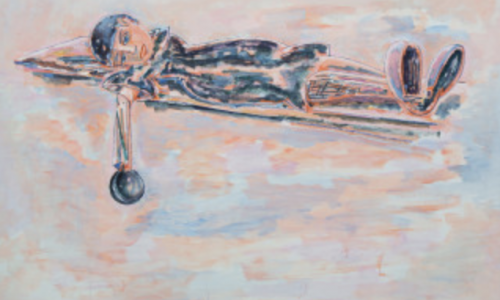
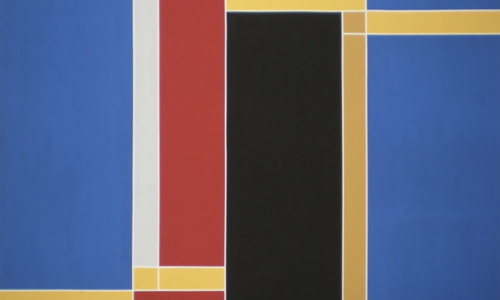
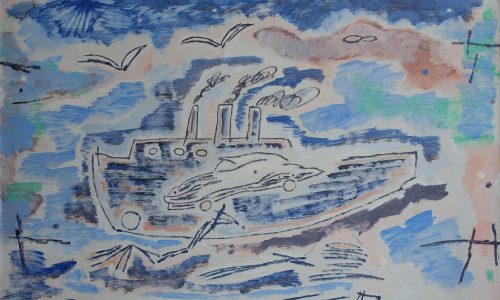
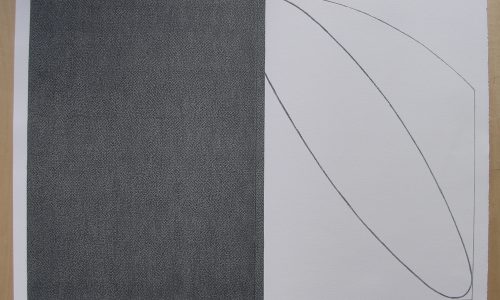
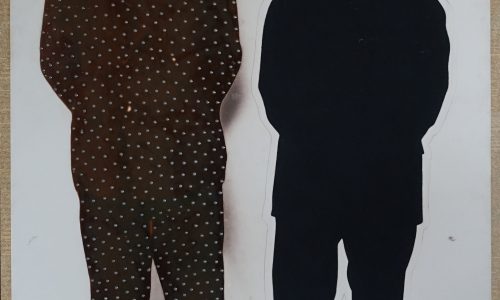
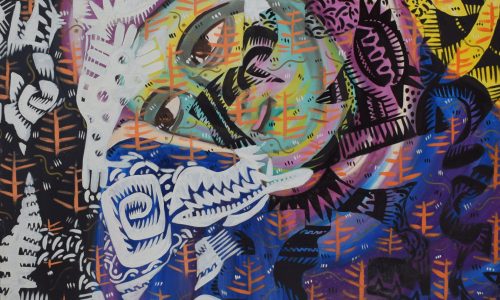
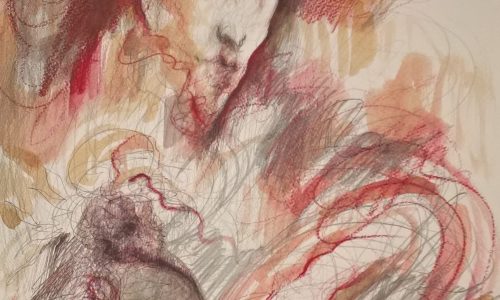
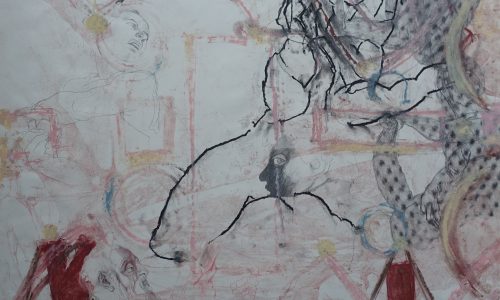
Erwin Bohatsch, born in 1951, numbers among the most important Austrian artists of his generation. And now, the ALBERTINA Museum is honoring his diverse output with a solo exhibition. Bohatsch’s oeuvre is characterized by a constant back-and-forth between figuration and abstraction, between color and non-color, and between line and surface. It also prominently features the question as to painting’s currency, a question that itself remains as current as ever. This exhibition juxtaposes the artist’s latest works with representative examples from the past few decades to explore a multifaceted kaleidoscope representing 40 years of unique and consistent creativity.
www.ftn-books.com has the galerie Krinzinger catalogue from 12984 available.
One of Spain’s most acclaimed contemporary artists, Miquel Barceló is known for his relief-like mixed-media paintings, expressive bronze sculptures and ceramics. An artistic nomad, his fascination with the natural world has inspired richly textured canvases that evoke the earthy materiality of Art Informel, as well as compositions that study the effects of light and the ever-changing colours of the sea. Always experimenting with non-traditional materials such as volcanic ash, food, seaweed, sediments and homemade pigments, his works carry the traces of the fierce energy that animates his creative process.
In the mid 1980s, Barceló began eliminating narrative elements from his works, creating an increasingly unreal space punctuated by holes, cracks and transparencies. This process of simplification culminated in 1988, a year in which he travelled across the Sahara and created his white paintings. Relying on cultural and geographical diversity for inspiration, his time in Mali, where he established a studio, was a formative experience. For Barceló, painting is a visceral way of relating himself to the world and, as such, his art connects with the primitive beauty of cave paintings. He expands the technical boundaries of representation, while remaining rooted in the grand tradition of painting, following in the footsteps of Picasso or Goya when representing bullfight scenes or Baroque painters when completing a commission for the Palma de Mallorca Cathedral.
George Apostu was born in 1934 in Stanisesti, Bacau. In 1959 he graduated from the Institute of Fine Arts in Bucharest, studying sculpture. From 1964 he had numerous solo exhibitions in Romania and abroad.
By working with traditional wood and stone carvings, Apostu found abstract ways of escaping the conventions of a narrow realism. Like Brancusi, he was fascinated by returning to mythical origins and primitive art, and was inspired by architectural space, but his work is quite different: where Brancusi polished and refined in precise symbolism, Apostu left the elemental marks of the act of sculpting and did not impose rigid interpretations.
In 1965 he took part in the Paris Biennale and was awarded a prize by André Malraux. He made outdoor sculptures, such as ‘Butterflies’ and ‘Mirror of the Son’, across Europe and in Japan. In 1982 he was appointed Professor of Sculpture at Academia Michelangelo in Agrigento, Italy. He moved to Paris and in 1983 was granted a studio by the mayor, Jacques Chirac. Apostu never received quite the same recognition in Romania.
Two of his most famous cycles, ‘Father and Son’ and ‘Maternity’, were sculptural representations of the relationship between humanity and the vegetal world in their organic regeneration. He regarded them as updating the myths of the cosmic ‘tree of life’ and of ‘eternal renewal’. In the last years of his life he developed the primitivism of his early works, which engaged conceptually with Eliade’s Neolithic ecumenical mysticism, bringing the themes of father and son and mother earth into the area of Christian significance.
He died in 1986 and is buried in Père-Lachaise cemetery. However, his legacy lives on: in 2001 “Zona Apostu”, a space of outdoor sculptures, was created in Kiseleff Park, Bucharest. In 2012 an “Apostu Summer School” at the Centre of Culture and Arts “George Apostu” was set up in Bacau.
www.ftn-books.com has the Teatral National from Buklarest now available.
Normally i write a blog on Modern art , but here is the exception. The reason is the design of the Boymans van Beuningen poster for the Bernardo Bellotto exhibition at the Boymans van Beuningen museum.
The design was done byBennoo Wissing, making the exhibition poster one of exceptional quality and bridging the modern sixties posters with the more classic inspired fifties posters.
Bernardo Bellotto (c. 1721] or 30 January 1721 – 17 November 1780), was an Italian[4] urban landscapepainter or vedutista, and printmaker in etching famous for his vedute of European cities – Dresden, Vienna, Turin, and Warsaw. He was the student and nephew of the renowned Giovanni Antonio Canal Canaletto and sometimes used the latter’s illustrious name, signing himself as Bernardo Canaletto. In Germany and Poland, Bellotto called himself by his uncle’s name, Canaletto. This caused some confusion, however Bellotto’s work is more sombre in color than Canaletto’s and his depiction of clouds and shadows brings him closer to Dutch painting.
Bellotto’s style was characterized by elaborate representation of architectural and natural vistas, and by the specific quality of each place’s lighting. It is plausible that Bellotto, and other Venetian masters of vedute, may have used the camera obscura in order to achieve superior precision of urban views.[2]
Last month wer had our annua; visit to the Alsace region in France to pick up the wine we ordered at Agathe Bursin. This means that we are in 50 km of our favorite museum , the Fondation Beyeler. When we visited in spring the museum presented itself in the best possible way with rooms devoted to Agnes Martin and Mark Rothko, but this time it was possibly even better. Their larges room was devoted to a remarkable piece of art by Doris Salcedo . The work PALMIMPEST covers the floor of the largest room of the Beyeler. 400 square meters are covered wth 66 stone tabs that show in water the names of people that died trying to reach Europe . 171 names emerge and disappear in a continuous process. This is not a work of art that is easy to admire since it appearances not very spectacular, but it is a powerful statement which shows the names and commemorates those that tried to reach a better life.
Doris Salcedo was born in 1958 in Bogotá, Colombia. Salcedo earned a BFA at Universidad de Bogotá Jorge Tadeo Lozano (1980) and an MA from New York University (1984). Salcedo’s understated sculptures and installations embody the silenced lives of the marginalized, from individual victims of violence to the disempowered of the Third World. Although elegiac in tone, her works are not memorials: Salcedo concretizes absence, oppression, and the gap between the disempowered and powerful.
While abstract in form and open to interpretation, her works serve as testimonies on behalf of both victims and perpetrators. Even when monumental in scale, her installations achieve a degree of imperceptibility—receding into a wall, burrowed into the ground, or lasting for only a short time. Salcedo’s work reflects a collective effort and close collaboration with a team of architects, engineers, and assistants—and, as Salcedo says, “with the victims of the senseless and brutal acts” to which her work refers. ( www.ftn-books.com has the info publication now available for sale.
A few years ago i wrote a blog on Vali Myers. She was the” Muse” of Ed van der Elsken for many years and his series with her as a subject is a classic amonglast-century photographs. A few years ago the Stedelijk Museum in Amsterdam organized an exhibition on Ed van der Elsken and his works. The series with Vali Myeres stood out and was used in the publication to illustrate his Parisian years. The book is now available at www.ftn-books.com and for those interested in Vali Myers the invitation card for a book presentation on her is still available.
Siegelaub ran his own gallery, Seth Siegelaub Contemporary Art in Manhattan from 1964 to 1966. As an independent curator, he played a vital role in the emergence of Conceptual art between 1966 and 1972, working with artists such as Carl Andre, Robert Barry, Douglas Huebler, Joseph Kosuth, and Lawrence Weiner. Among his groundbreaking projects were The Xerox Book (1968) and July/August Exhibition (1970), which explored the phenomenon of the “group exhibition” in its most radical form: a book or a journal. In 1972, he turned away from the New York art scene and moved to Paris, where he worked as a publisher. Siegelaub began collecting and researching textiles and books about textiles in the early 1980s. He moved to Amsterdam and founded the Center for Social Research on Old Textiles, which conducts research into the social history of textiles. At the turn of the 21st century he started the Stichting Egress Foundation in Amsterdam to bring together his varied range of projects: contemporary art, textile history, and time and causality research.
Siegelaub was certainly one of the leading forces in Conceptual Art and the Stedelijk Museum exhibition from 2016 proves the importance of Siegelaub. The catalogue with the exhibition was designed by Irma Boom and is now available at www.ftn-books.com
Born 17. 12. 1945 in Uherské Hradiště. Painter, draughtsman, graphic designer, artist of compositions in the field of applied art and large- scale works, theoretician, exhibition curator and writer. As a curator he has prepared and introduced dozens of exhibitions and is the author of a number of professional texts. Studied at Slovak Technical University in Bratislava, field of architecture (1964–1966); Department of Art Theory and Education at the Philosophical Faculty of Palacky University in Olomouc (1970–1975, V. Zykmund, F. Dvořák, Z. Kudělka, I. Hlobil, A. Nádvorníková), where he received the doctor degree in the field of philosophy in 1983. He has exhibited in solo shows since 1981 (CZ, A, D), collectively since 1970 (CZ, PL, D, A, NL, I, E, SK, LT, LV, EST, V, USA). Represented in collections at: Muzeum umění Olomouc, Galerie výtvarného umění in Ostrava
www,ftn-books.com has currently one Hastik title available.
Wim Gijzen (Rotterdam, 1941) has been working on his diverse, but consistent oeuvre since the 1960s. In 1965, he stood out with his submission of three paintings for the Salon van de Maassteden in the Stedelijk Museum Schiedam. However, he has always identified a conceptual artist. In the years that followed, Gijzen made a.o. mural objects, special works, videos, and photography, in which the Dutch landscape was a recurring theme. At this time, he also created his iconic photomontage of a meadow with grazing cows on the Schouwburgplein, a square in the centre of Rotterdam (1969). From 1975, he concentrated on drawings and paintings. His entire oeuvre is characterized by the de- and reconstruction of recognizable scenes. Traditional still-lives and landscapes are cut up and reinterpreted, to form new, abstract images. His approach is reminiscent of the cubist still-lives of Picasso and Braque, that show different facets of one and the same scene. Gijzen however, does not show the cut-up fragments, but presents a new image that bridges the figurative and the abstract. In this way, he confronts the viewer with his or her subconscious orientation on the horizon, vanishing points and recognizable elements in an image.
This influential proponent of the Neue Wilde style is one of Austria’s most significant contemporary artists. The Neue Wilde were Austrian and German artists of the 1980s whose work was marked by a free and spontaneous style; other proponents in Austria include Herbert Brandl, Hubert Scheibl and Hubert Schmalix.
Damisch studied painting and graphic design at the Academy of Fine Arts Vienna from 1978 –1983 where his teachers were Maximilian Melcher and Arnulf Rainer. He was also a member of the punk band Molto Brutto during this time. After completing his studies, he began exhibiting his work in Austria and Germany. From 1981 onwards, he worked on sculptures in wood and assemblages, from 1985 on ceramics, followed by his first bronzes in 1990. Damisch worked in a broad range of media in his studios in Vienna and the Mostviertel, with his oeuvre encompassing drawings, prints, serigraphy, sculptures and photography as well as large-scale paintings.
His art features strong colouring and is highly abstract, with sweeping brushstrokes and a furious and intense painting style on the mainly large-format works.
He was awarded many prizes, among which the Max Weiler Prize (1985), the Karl Rössing prize (1991), the Anton Faistauer prize awarded by the province of Salzburg (1996), and the Lower Austrian culture prize (2011).
Damisch was a visiting lecturer at the Academy of Fine Arts Vienna from 1992 before later becoming a regular professor.
www.ftn-books.com has the1991 Folkwang Essen catalogue available. The publication has an original lithograph used as cover which was printed by Atlas.
Artist/ Author: Oliver Boberg
Title : Memorial
Publisher: Oliver Boberg
Measurements: Frame measures 51 x 42 cm. original C print is 35 x 25 cm.
Condition: mint
signed by Oliver Boberg in pen and numbered 14/20 from an edition of 20