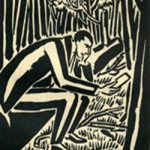
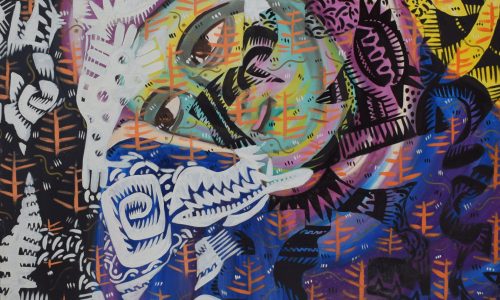
Born into a family of art merchants, Nat Leeb’s interest in painting was sparked at a young age. He attended the Strasbourg School of Decorative Arts from 1920 to 1923. In 1926, he received an award for one of his posters and in 1928, he exhibited his paintings at the Librairie des arts in Strasbourg. While his early known works were strictly figurative, he later turned to expressionism and showed sensitivity to avant-garde movements. In 1951, he exhibited at the Galerie Charpentier. By the 1940s and 1950s, his paintings had become abstract, textured, and intensely colorful. In 1965, he met art merchant Lawrence Jeppson (1926-2019) who organized several exhibitions of his works in the United States. Two important exhibitions were dedicated to him in the 1980s, one at the Quadrat Museum of Bottrop and the other at the Städtische Kunstsammlung in Eschweiler.
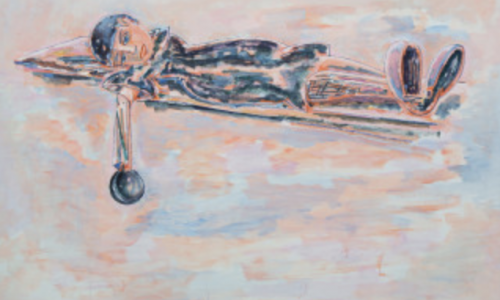
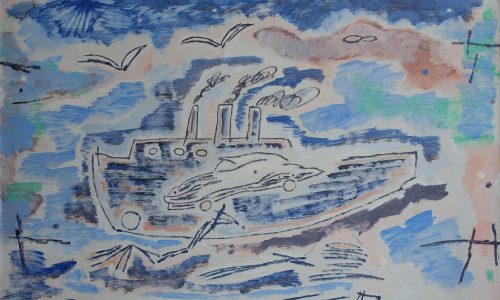
Edward Burra, a prominent figure in British art during the 20th century, is renowned for his bold and satirical depictions of urban life and queer culture in the ‘Roaring Twenties.’ A virtuoso of watercolour, the exhibition will demonstrate how Burra defied conventional limits of this delicate medium to produce striking and dynamic scenes. His artistic repertoire encompasses a diverse range of imaginative works, shaped by influences ranging from music and performance to popular culture, literature, and art history.
Marking his first retrospective in London in four decades, the exhibition delves into Burra’s fascination with exploring foreign societies and cultures. A keen observer and chronicler of social realities, his works also feature haunting landscapes, mirroring his experiences of major world events such as the Spanish Civil War, Second World War, and post-war industrial revolution. Burra’s own experience of disability may have informed his portrayal of marginalized communities.
Discover the intricate journey of Burra’s career through a collection of over 80 paintings and drawings, along with material from the Edward Burra archive at Tate, providing unique insights into the artist’s exceptional creative process.
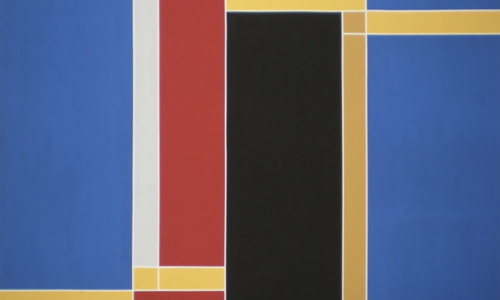
The evolution from abstract to concrete, no longer based on external perceptions but rather on shapes and colors generated through pure mental speculation and technical experimentation, took place around 1947-1948, when Moretti transformed from an imitator to a creator of art. “After the turmoil of war, there was a deep desire to move towards something that would free us from that state, to connect with the essence of things, the relationship with the cosmos, what was known as geometry, harmonious relationships. At that moment, I truly felt the urge to overcome this tragedy and start anew from what could form the foundation of a new artistic expression.”
Moretti does not reject nature, but rather examines it beneath the surface to capture its essence, “the unchangeable” that exists outside of time. “While nature is regulated by strict geometric rules, it also displays fluctuations in the creative process. Natural shapes deviate from their theoretical model. These deviations are the mark of life and the reason for the beauty of the form in which it reveals itself.”
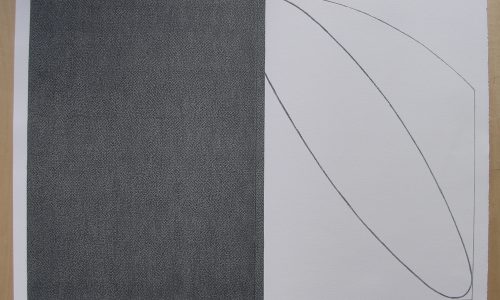
In line with the zeitgeist of his time, Moretti aligns himself with the abstract art practices in Florence and the proponents of the Concrete Art Movement in Milan. He takes part in various exhibitions with them between 1951 and 1957, showcasing his works such as Perspective, Dynamic Composition, Poiesis, and Idol.
Born in 1930 ( Valencia), Genovés is the foremost representative of modern Spanish painting. His works, executed in critical realism, can be seen as his response to the fascist violence of the Franco regime. He tragically experienced the Spanish Civil War firsthand, where friends, neighbors, acquaintances, and even family members became enemies and fought each other in the most horrific ways. The gruesome battle between Republicans and Nationalists turned Spain into an inferno.
Genovés studied at the Escuela de Bellas Artes de San Carlos in Valencia and later moved to Madrid in 1958. His first solo exhibitions took place at the Alfil Gallery in Madrid and at the Museo de Arte Moderno in Havana, Cuba in 1957.
In 1976, he was arrested and spent 7 days in solitary confinement for creating a poster calling for amnesty for political prisoners in Franco’s Spain.
In the 1980s, his artwork gained more and more national and international recognition, while he continued to actively advocate for peace. Thanks in part to his efforts, democracy was restored in Spain. His work is a symbol of Catalan pride.
Genovés’ artwork focuses on two themes: the individual and the mass. Many of his works examine the concept of the masses from a bird’s eye perspective, omitting buildings, trees, or other objects, creating a sense of abandonment and loss.
His artwork can be found in numerous public collections in the United States and Europe, including Le Centre National d’Art Contemporain in Paris, France, The Museum of Modern Art and The Guggenheim Museum in New York, USA, The Israel Museum in Jerusalem, Israel, The Art Institute of Chicago in Chicago, IL, USA, Galeria Nazionale d’Arte Moderna in Rome, Italy, Museo Nacional Centro de Arte Reina Sofia in Madrid, IVAM in Valencia, Spain, and Musees Royaux de.
Gustavo de Maeztu was a unique and enigmatic artist, known for his dispersion and individuality. He was both lyrical and romantic, yet controversial, characterized by his passionate and sensitive creations. It was difficult to categorize his work into a single movement, as he actively avoided conforming to classifications and constantly strayed from his own identity. His life was a constant push forward, but also a series of backward moves, leading him to the brink of impressions and precise moments. This made him a captivating and unparalleled figure, impossible to classify due to his quest to find personal explanations that were disconnected from reality.
During the height of his creative period, from 1910 to 1925, De Maeztu crafted a large body of work that revolved around merging personal aspirations, interior aesthetic formulation, and his identification with Spain’s intellectual reflection. This resulted in an ambivalent artistic output that was both intimate and social, lyrical and epic, restrained and overwhelming, and at times, both melancholy and hopeful. This magical duality was simultaneously his downfall and his eternal legacy.
Two recurring themes characterized his work during this period: man and woman. His depictions of men were often melancholy, deep in thought and occupied with matters that were beyond human understanding. This hermeticism and subsequent sense of alienation only added to their mystery. On the other hand, his female figures were powerful, voluptuous, and sensual, with an air of elegant sophistication that seamlessly integrated elements of folk boisterousness with aristocratic grace. His female figures were often adorned with a magnificent display of vibrant colors, reminiscent of the shimmering tones of ceramic.
With a strong literary essence in his paintings, Gustavo de Maeztu skillfully used the diptych and triptych techniques in his compositions to tell a story. This can be seen in his paintings, such as The Samaritan Women (Museo Gustavo de Maeztu, Estella-Lizarra) and The Women of the Sea. Through these techniques, he was able to bring life to his paintings and further enhance the enigmatic complexity and linguistic dynamism of his work, making him a true master of his craft.
The artist creates from the dualistic language of imagery, using it as a dreaming vessel that contains deeper symbolism. “The Samaritan Women” portrays women from a despondent region of Castilla, heavily burdened but determined, showing no signs of weariness as they confront their destiny. In contrast, “The Women of the Sea” reveals a stark and ominous landscape, with women who do not wear a smile and have no prospects for the future. Their only desire is for the safe return of their loved ones, and the endless wait is reflected in their somber countenances. These women are monumental in their depiction, exerting a greater force than the very architecture of the houses that make up the serene backdrop, particularly against the languid waters that mirror their forms. The bridge and the faces are etched with anguish, with eyes that search, inquire, and scan the distance in an attempt to understand, yet only being met with endless waiting. The artist’s treatment of the figures resembles that of a sculptor, emphasizing the notion that they are massive paintings come to life. His close friend and art critic, Juan de la Encina, who was captivated by this piece, marveled at the “iridescent skirt, with a dominant shade of violet, on the reclining woman or the one resting on her lap (though we suspect it is more of a lap), adorned in a crimson gown that seems to ignite the entire painting.”
Since 1965, Paul Steenhauer has created a body of work that illustrates a coherent idea of his conception of the art of painting. His aim is to depict the world as a perfect yet elusive cosmos on a very limited scale.
It is a composition that evokes associations with classical landscape images because there is always a division in the construction of the painting: a horizon suggesting a land and a sky.
The landscape is merely a preconceived notion of what we consider to be such. There is no life below or above the horizon. There are well-defined spaces of color, sometimes displaying geometric shapes. The position of the horizon, whether it be high, low, central, or curved, defines the effect of these zones and invokes unfathomable spaces, regardless of the size of the painting.
As we gaze at the paintings, we are drawn into a cosmic world beyond the conception of a landscape. The geometric shapes themselves create a rhythm within the spaces and discreetly blend “nature” and human interference, realizing a symbiosis of the two.
The overall image is further enhanced by the modulations of light, range of color, changes in form, and layered painting technique. This lends the work an atmosphere of supernatural mystery and poetry.
The meticulous execution, unique use of color, and surprising combination of landscape painting and constructivist elements imbue the work with its specific and distinctive character.
The work may not be easily accessible, but those who are truly absorbed cannot let it go.
In the course of his existence, Oldenburg has harbored a fervent affinity for amassing diminutive objects. Over time, he developed the practice of arranging and grouping them, as if each item were a precious artifact in a grand museum. At the 1972 exhibition Documenta 5 in Germany, he unveiled the Mouse Museum, a structure brimming with shelves for visitors to peruse and admire the meticulously curated array of unassuming, American curios. Alongside the found objects, there are also small, handcrafted pieces that Oldenburg deemed worthy of inclusion in the Mouse Museum.
CLAES OLDENBURG: These objects were caught somewhere between chance encounters and works of art. Several of them served as catalysts for subsequent creations.
The layout of the museum mimics a colossal mouse head, inviting guests to enter through its snout. The mouse is an iconic motif in Oldenburg’s repertoire. From the 1960s onward, his “geometric mouse” manifests itself throughout his oeuvre in varying sizes, each with the same angular form. It serves as a counterbalance to Mickey Mouse, which embodies warmth and roundness. In contrast, the “Geometric Mouse” lacks any curves, sporting somnolent eyes with teardrops attached. It functions as a symbol of intellectual engagement, unlike Mickey Mouse, which is associated with mirth and entertainment.
Beside the book on Mouse Museum, www.ftn-books.com has now the Kassel/ Mouse Museum poster available.
For 70 years, through 600 sculptures and 3000 graphic works, Ipoustéguy crafted a figurative oeuvre that is both masterful and accessible to the masses. These works can be seen in the greatest public collections, from Berlin to Melbourne, Tokyo to London, and everywhere in between. A prolific artist whose creations illuminate the depths of humanity – its springs, shadows, and lights – and its voids.
“My work is sufficient in itself; it expresses my reality. As for the rest…”
Recognized by the greatest minds, yet fiercely independent, recipient of prestigious commissions but avoiding the frivolity of courtly games and power struggles, Ipoustéguy, so universal, still has not received the public recognition and tribute demanded by fellow artists, intellectuals, and even the crowd of strangers moved by his powerful art.
Marie-Françoise Plissart, born in 1954, is a prominent figure in Belgian photography.
From the beginning of her career, she has been fascinated by the relationship between text and image, collaborating with Benoît Peeters on the book Correspondance (Yellow Now, 1981). This pursuit led her to develop a passion for photographic narration, from Fugues (Minuit, 1983) to Mauvais œil (Minuit, 1986) to Droit de regards (Minuit, 1985), Prague (Autrement, 1985), Aujourd’hui (Arboris, 1993), and Bruxelles, horizon vertical (Prisme, 1998).
Since 1987, she has worked as a freelance photographer, creating numerous projects in various fields such as architecture, theater, portraiture, and illustration. Her photographs have been exhibited in Brussels, Liège, Paris, Geneva, Amsterdam, The Hague, Rotterdam, Berlin, and Vienna.
In addition to photography, she is also a videographer, captivated by the exploration of urban fabric and its transformations. She has created works such as L’occupation des sols in 2002, L’Atomium, in/out in 2006, Le Quatrième mur in 2013, and D’errance et de Racines in 2014.
She has also collaborated with François Schuiten and Benoît Peeters on multiple occasions, including in Voyages en utopie (Casterman, 2000), La Maison Autrique (Les Impressions Nouvelles, 2005), and L’Enfant penchée (Casterman, 2007).
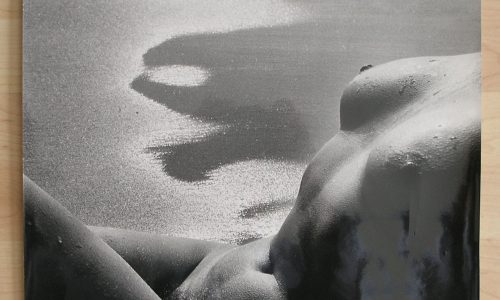
Bernard Dufour was a French artist, born in Paris in 1922 and passed away in Foissac in 2016. He was a painter, writer, and photographer. Initially, he pursued a degree in agricultural engineering and worked in this profession full time. However, after World War II, he turned his focus to painting. His early works were abstract and boldly executed, without succumbing to strict geometry. He participated in the Salon de Mai in 1946 and co-founded the Salon d’Octobre in 1952, along with Jean Degottex and Pierre Alechinsky. In 1954, his works caught the attention of art dealer and gallery owner Pierre Loeb. This prompted him to quit his engineering job and fully embrace his career as an artist. In 1959, he began to distance himself from abstraction and started to have models pose in his studio. He exhibited in New York at Albert Loeb’s gallery, took part in Documenta 3 in Kassel, and was connected to the musical circles of Pierre Boulez. In 2008-2010, he was honored with a dedicated hall at the Musée d’Art Moderne in Paris for his work.
Artist/ Author: Oliver Boberg
Title : Memorial
Publisher: Oliver Boberg
Measurements: Frame measures 51 x 42 cm. original C print is 35 x 25 cm.
Condition: mint
signed by Oliver Boberg in pen and numbered 14/20 from an edition of 20