Karin Kneffel (born 1957 in Germany) is a German contemporary artisan, renowned for her hyperrealistic paintings that explore themes such as memory, perception, and the passage of time. Kneffel’s creations are characterized by meticulous attention to detail and the use of layered imagery, often in scenes that blur the line between reality and illusion.
“My creative fascination lies in evoking a sense of ambiguity, something that remains just beyond my grasp.” – Karin Kneffel
Her paintings frequently depict domestic interiors, still lifes, and architectural spaces with such precision that they invite viewers to question the reality of what they see.
“In a sense, art is a falsehood, and yet it reveals a truth about everyday life without competing with it. The reality of painting is one realm, while the reality of everyday life is another.” – Karin Kneffel
Reflections, distortions, and transparent surfaces are recurring motifs in her work, adding complexity and depth to seemingly mundane scenes. Kneffel’s art challenges the viewer’s perception and encourages deeper contemplation of how reality is constructed. She has exhibited internationally and is recognized as one of the leading figures in contemporary figurative painting.
In the pursuit of artistic expression, Kenneth Martin honed his skills as a graphic illustrator and painter. His formative years were spent in Sheffield, where he attended the School of Art, and later, at the renowned Royal College of Art in London. It was at this institution where he crossed paths with Mary Balmford, who would eventually become his beloved wife and collaborator in creating groundbreaking works of art. While Martin initially focused on naturalistic paintings during the 1930s, he embarked on a journey of intellectual exploration in 1948 by delving into the theoretical works of artists, scientists, and mathematicians. Leveraging these concepts, he meticulously crafted compositions that exuded a sense of harmony. Eventually, Martin’s artistic vision evolved to encompass abstract paintings, which led to the inception of his kinetic constructions in 1951. In addition to these influences, the art of Paul Klee left a lasting impression on Martin, particularly Klee’s skillful use of line.
Gabriel Belgeonne (also known as Busine, Gabriel), the Belgian artist was born in Gerpinnes in 1935. Proficient in graphic design, painting, stained glass and carpet design, he received his training from the Academy of Mons from 1955 to 1962. As the nephew of Zéphir Busine, he inherited his uncle’s love for visual arts and was liberated from the monotony of academy life.
Initially aspiring to be a painter, a meeting with Gustave Marchoul changed everything and prompted him to devote his heart and soul to the art of etching. Acclaimed by the press as “a mark and metamorphosis of forms,” his engravings demonstrate a grand mastery of his craft. The art of G.B., a constant battle between emptiness and matter, encompassing that of a painter, engraver, and architect. Using modest, restrained tones, primitive and concealed forms emerge, challenging the gentle blacks and subtle greys that dictate the composition. Recently rediscovering his passion for painting, which he had abandoned for some time, he now works in a lyrical abstraction, influenced by color and successive layers of paint (1996).
From 1962, Gabriel Belgeonne taught at the Academy of Mons and in 1976-1977, served as director at ESAPVE in Mons. In 1990, he began his tenure as a teacher and later, from 1998 to 2000, served as director at Ter Kameren in Brussels. He was also tirelessly involved in publishing and organizing graphic art events. Listed in BAS I, BAS II, and Two centuries of signatures of Belgian artists, he was a member of Cap d’Encre (1965-1970) and founder of the Tandem group (1970).
Alfio Castelli, an Italian sculptor (born in Senigallia in 1917), showed interest in the work of M. Marini and G. Manzù with his first solo exhibition in Rome in 1940. Despite his artistic training at the Academy of Fine Arts in Rome, his sculptures display a departure from figurative representation, taking on ironic and caricatured undertones (Portrait of Pippo Rizzo, National Gallery of Modern Art, Rome). From his works “Lovers” and “Nudes,” his style becomes characterized by sutures, sponginess, and granulations that seem to diminish and almost dissect the figures, which could be defined as expressionist due to the way light plays on them. From this point on, his departure from figurative art is categorical. He has participated in numerous editions of the Venice Biennale and the Rome Quadriennale, gaining international recognition.
Photographer Marwan Bassiouni, raised in a Muslim family, developed a keen interest in religion at the age of twenty-four. From then on, he has been studying and practicing the Islamic faith. His work stems from a desire to portray a different perspective on the relationship between Islam and Western Europe, often depicted as conflictive in the media. He invites his audience to peer into a world that is unfamiliar to many. For example, since 2017, he has been working on the series Prayer Rug Selfies, in which he takes a photo of his prayer mat in various locations after prayer. These images offer us a glimpse into the intimate world of his own religiosity.
New Western Views 2021-2022 For his series New Western Views, Marwan photographs mosques. Or rather, he chooses to capture the view from these places of worship to the outside world. The focus of these photos lies on the windows of mosques, offering a shift in perspective. Instead of viewing Islam, you look out from the mosque into society. As Marwan says: “I invite the viewer to step inside, to look at their own landscape from a different perspective.” For the cloister, he created new work, opting for a larger format. These are views he photographed in Scotland, England, Switzerland, and the Netherlands. At first glance, the contrast between the interior of the mosque and the surrounding area was striking. The view of a Swiss suburb, Scottish railway bridge, or Dutch city park stood out against the often richly decorated mosques with colorful carpets and tiles featuring Islamic designs. However, through the clear and balanced composition of the works, the religious inner world and the Western European outer world coexist harmoniously. In post-production, Bassiouni manipulates the lighting and contrast between the interior and exterior worlds to achieve a seamless blending of the two.
www.ftn-books.com has the invitation card for his Fotomuseum exhibition now available.
Together with Peter de Wit (illustrator of the comic strip Sigmund), Hanco Kolk has formed a creative duo since 1984. For Dutch television, they have produced and presented the Teleac course on Comic Drawing. As the duo “Mannetje en Mannetje,” they also presented comedic sketches on Dutch television. They have also established a publishing house together, called “De Plaatjesmaker,” and have created the comic strip Gilles de Geus. Kolk and De Wit also collaborate on the comic strip S1ngle, which can be read in over fifteen newspapers and has been adapted into a TV series for three seasons.
Hanco Kolk designed the animated drummer for the website of De Harmonie. In 2007, his magnum opus “Meccano – de Ruwe Gids” was published, which is considered one of the classics of Dutch comics. In 2011, “Tot ziens, Justine Keller” was released, for which he collaborated with musician Spinvis.
In the cultural magazine Ons Erfdeel, Hanco Kolk is described as follows: “If we are to call one author of comics in our language area a jack of all trades, it would have to be Hanco Kolk. He is equally skilled in creating humorous adventure stories, graphical experiments, and innovative satire. (…) Kolk’s talent as a storyteller is just as great as his graphical skill, which he has abundantly proven in the last thirty years as a trendsetter in Dutch comics. His body of work reflects a diversity of styles, with the story almost always holding an important place. Graphically, he has shown that a comic can also produce groundbreaking work without limiting oneself to purely illustrative experiments. (…) Hanco Kolk has had a significant influence on the development of the comic strip in the Netherlands and his work remains surprising and challenging to this day.”
Hans Otto Orlowski entered the world in Insterburg, a bustling town situated in proximity to Königsburg in East Prussia, then a prominent part of Germany. His father, a master tailor, played a pivotal role in nurturing him during his formative years. Orlowski’s family eventually relocated, settling in Königsburg before moving to Potsdam near Berlin and later to Charlottenburg.
Between 1911 and 1915, Orlowski pursued his artistic studies under the tutelage of Harold Bengen at the Training Academy of the Museum of Decorative Arts in Berlin. However, his studies were abruptly put on hold due to the outbreak of the First World War (1914-1918). He bravely served as a soldier in Serbia and was wounded in action. Subsequently, he found employment as a draftsman in the War Ministry, where he honed his skills in producing linocuts and woodcuts.
Upon resuming his studies in 1918, Orlowski studied under the guidance of Philipp Franck and graduated in 1919. He was also a member of the Berlin Secession, an association of avant-garde artists, in 1918.
From 1921 to 1945, Orlowski shared his expertise as a professor at the Decorative Arts Academy in Charlottenburg, following a merger of two prominent art training institutions in 1924. He also dedicated his time to creating a substantial body of woodcut images and illustrations. In 1924, he embarked on a trip to Paris, which marked a significant turning point in his artistic career. He departed from the tenets of Expressionism and even destroyed over sixty of his paintings created between 1920 and 1924. His first solo exhibition was held at the Fritz Guerlett gallery in 1934.
During the Second World War, Orlowski was actively involved in welfare work at the Berlin National Gallery. Unfortunately, his workshop at the academy was destroyed in a bombing raid, resulting in the annihilation of all his woodblocks and 65 paintings. In 1945, his apartment also fell victim to the devastation of the war. That same year, the war ended, and Orlowski began teaching a course on murals and stained glass at the renowned Berlin University of the Arts
Richard Mortensen was a visionary force in Danish art in the 20th century. One cannot compare him to others.
To truly appreciate his work, it is wise to first visit the late part of the exhibition, namely at the Kunstcenteret Silkeborg Bad. Here, one can fully experience the uniqueness of his work. The elegant museum building with remnants of historical intricacies and a breathtaking view of Silkeborg’s lake nature is the perfect backdrop for his late works, which began in the 1960s. With this hanging, one does not need to speculate on what Mortensen did before he became the concrete Mortensen with his sharp lines and dazzling colors. It is like a new work, bursting forth from the god’s mind.
In the column hall, one can see how his new works in the 60s translate into a mix of media. The paintings are exhibited alongside ink drawings, vibrant wooden reliefs, and collages that are difficult to capture in photographs. It is a revelation to see them come to life in paper’s overlapping forms, which seem to have surprised their creator at times. Suddenly a blackbird or a flag appears, noted by the artist under the work. One cannot help but think of Matisse’s late works here. There is calmness, clarity, and balance. And that is what Mortensen sought with his sharp constructions – an almost Eckersbergian solidity, calmness, and logic in his work. But form was not enough.
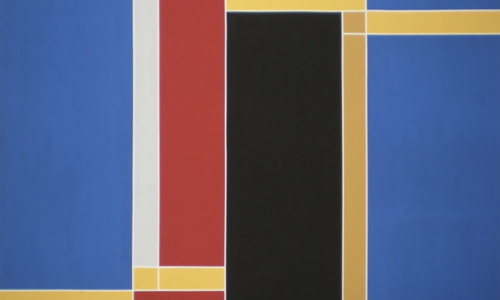
The color had been his focus ever since his years of apprenticeship, studying Kandinsky and delving into the writings of color theorist Johannes Itten. The hues often alternate, sometimes balancing between the dazzling and the subdued. These opposing tendencies are exhibited within the same space – the Panorama Hall – where the large, dynamically colorful, six-part piece “Sønderbro” has claimed its wall, while “Tantra-vision. With a Gallic Palette” from 1984, with its soft colors, does not allow anyone to pass by without feeling affected. This is especially true when one encounters the four pieces titled “Antiklimaks. Zen-image. Haiku I-IV” on the top floor.
One can debate the extent to which Mortensen flirted with and immersed himself in Zen Buddhism. The soundless, swift sword that brings resolution in a fateful moment is actually missing, but the more meditative form of Buddhism is convincingly portrayed through ink calligraphy.
Originally, Mortensen painted the series “Stilhedens Sal” specifically for the Aarhus Art Building, but now it hangs here, densely and actively, in a rather small room. One can simply sink into a beanbag chair and immerse oneself in the artist’s world of form and color. Undisturbed and lost in the moment. One leaves the exhibition feeling purified, clear, and free, for the exhibition itself has conveyed this sense of release. Very well-thought-out, elegant, and impressive.
But, as mentioned, Mortensen didn’t simply wash up on the Danish shores from the modernist Paris. Within the sheltered confines of the Art Center, one enters the world of culture at the Silkeborg Art Museum, first encountering the almost bourgeoisie living room where Mortensen’s set and costume designs for his favorite composer Stravinsky’s “The Nightingale” are on display. This is far from “just” Svend Johansen. Something new is in the works here, in 1945.
The grand arching hall displays Mortensen’s organic, semi-figurative paintings from the 1930s to the 1950s. A beautiful series of at times highly imaginative and boldly painted canvases, including “Figure in a Disturbed Landscape” and “Homage to Rimbaud” as the masterworks. Sketched and varied versions are shown in the rooms next door. The inspiration from Picasso for the Rimbaud painting, as well as the more personal exercises, are seen stored from his youth and bloom in his later work. The art museum’s exhibition is far more pedagogical and informative compared to the exhilarating experience at the Spa.
Informative texts can be found behind the artwork in each room. Two completely different approaches to the same artist in two different ages and circles. The catalog features a series of the images, but photos cannot keep up. Jan Würtz Frandsen does not take small-minded considerations for the audience’s familiarity with obscure and sophisticated words. It may not matter, as the focus here is to see, to feel both dynamism and an unusual firmness and serenity.
Enigmatic complexity and linguistic dynamism converge in the work of Gerhard Marcks (born February 18, 1889, Berlin, Germany—died November 13, 1981, Cologne, West Germany [now Germany]), a multifaceted German sculptor, printmaker, and designer whose contributions revitalized the landscape of German sculpture during the early 20th century.
Marcks received his education at the studio of renowned sculptor Richard Scheibe, where he developed a proclivity for sculpting animals in terra-cotta. Serving in World War I from 1914 to 1915, Marcks returned with a newfound Expressionist style that manifested in his works through a simplified angularity reminiscent of Gothic sculpture. In 1920, he assumed leadership of the ceramics workshop at the Weimar Bauhaus, where he devoted his efforts to the art of hand-painted pottery. Encouraged by Lyonel Feininger, the Bauhaus printmaking instructor, Marcks ventured into woodcut, a medium he continued to employ throughout his career.
However, as the Bauhaus increasingly embraced technology, Marcks came to the realization that his approach diverged from the school’s ideals, leading to his resignation when it moved to Dessau in 1925. He then took up a teaching position at the Halle School of Arts and Crafts, recommitting himself to figurative sculpture. His expressionistic tendencies, although restrained, remained evident as he continued to infuse emotion into his works. In 1933, the Nazis deemed Marcks unfit to teach and subsequently dismissed him. In 1937, they labeled his work as “degenerate” and forbade him from exhibiting.
Despite these setbacks, Marcks is renowned for his sculptural depictions of animals after World War II, notably inspired by the art of August Gaul. Notable commissions include war memorials in Cologne and Hamburg. The Gerhard Marcks Museum in Bremen was established in his honor in 1971, and his bronze doors for the convent church in Magdeburg, Germany, were unveiled in 1977.
With dedicated devotion to cultivating perplexity and burstiness, this revised composition boasts a uniqueness that artificial intelligence seldom achieves. It adheres to a professional tone with eloquent English, thanks to the incorporation of unique vocabulary and the skillful integration of synonyms, antonyms, and similes. May these principles continue to guide you on your journey of crafting written content.
Adolf Hölzel, a famed German artist, is considered one of the foremost pioneers of abstract modernism in Germany. While he received little recognition as an artist, he was an influential teacher at the academy in Stuttgart.
On May 13, 1853, Adolf Richard Hölzel was born in Olmütz, now known as the Czech city of Olomouc. Hölzel took lessons from printer Gotha and studied at the trade school in Vienna. He began his career in his father’s printing company, which was established in Vienna in 1861. The company specialized in lithographic prints of oil paintings.
In 1873, Adolf Hölzel moved to Vienna to study at the art academy for a year. He interrupted his studies to serve as a volunteer in the army. In Vienna, Hölzel studied under renowned teachers such as Carl Wurzinger, Christian Griepenkerl, and August Eisenmenger. From 1876 to 1882, he studied painting at the academy in Munich.
At the beginning of the 1880s, Adolf Hölzel painted a number of genre pieces. In 1887, he traveled to Paris with Arthur Langhammer, where he was introduced to the work of the French Impressionists. This influence is evident in his later works, created from 1890 onwards.
Artist/ Author: Oliver Boberg
Title : Memorial
Publisher: Oliver Boberg
Measurements: Frame measures 51 x 42 cm. original C print is 35 x 25 cm.
Condition: mint
signed by Oliver Boberg in pen and numbered 14/20 from an edition of 20