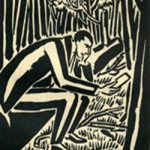
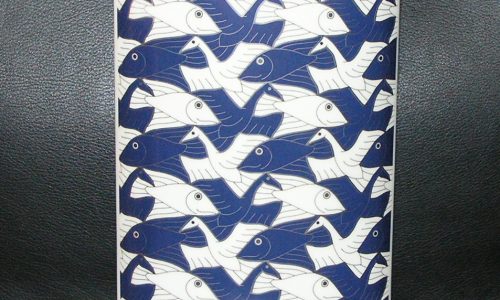
Time for a blog on Krijn Giezen. An artist who deserves not to be forgotten,
His latest show at the GEM museum in Den Haag was not the success it deserved to be. but here is an artist who’s ideas are still there and have been executed over the last 4 decades in several prestigious places in the Netherlands. There is this impressive staircase at the Kroller Muller museum , but others like the making visible of the source of the
Haagse Beek are also there without being known by the public. An interesting artist who works are there but not known, what can one do about it? Raising an interest in his works is one, making his publications is 2, but the best way to make this artist appreciated by a largeraudiences is making a large retrospective.
Let’s hope a young curator in the Netherlands will embrace the idea.
The story of Missoni begins in 1953 when Ottavio Missoni and his wife Rosita Jelmini create a small workshop in their home in Gallarate where the unmistakable colorful knitwear is born and so they found the company that will revolutionize knitwear made in Italy.
Ottavio, Italian athletics champion in the 400 meters, already owned a business dedicated to the production of sports suits while Rosita had developed experience in the production of household linen and shawls in the family company. They combined their skills to look for something completely new and in 1958 the first Milano-Simpathy collection was presented in Milan, which immediately received orders from none other than La Rinascente. The publisher Anna Piaggi was among the first to notice the potential of the collections so much so that in 1967 the brand was featured on the cover of the magazine Arianna by Arnoldo Mondadori Editore.
It was in 1967 that Missoni made her debut at the Pitti Palace in Florence, where she caused a scandal by showing the models without a bra, thus revealing her breasts in the most transparent dresses. This only increased the success of the brand that in 1969 opened a new headquarters in Sumirago and in 1970, became the absolute protagonist of the largest fashion magazines from Paris to the United States, with the support of Diana Vreeland director of Vogue.
Bloomingdale’s New York office opens a Missoni store, the brand gets a great international success, is acclaimed by all the press and Missoni garments are desired by the biggest fashion retailers.
The great ingenuity of its founders brings into the knitwear something never seen before: the processing “put-together”, or the creation of garments in knitwear with patterns and colors that are a unique mix. The result is a game of geometric patterns, such as the famous zigzag, in an infinity of different colors.
The “put-together” has now become the hallmark of the brand, which makes a Missoni garment immediately recognizable and inimitable. Clothing is a mix of textures, materials and graphics: from patchwork to stripes, from bright shades to black and white. In any case, the materials, whether wool, cotton or lamé are always the protagonists.
In 1976 he opened the first flagship store in Milan, followed by those in Paris, New York and many others. For the 25th anniversary of the brand is organized a retrospective at the Rotonda della Besana in Milan and followed by the Whitney Museum of American Art in New York. In addition to clothing, one of the strengths of the brand is definitely swimwear; moreover, since the mid-70s, have been created the collections dedicated to household linen and furniture and in 1998 was born the second line M Missoni.
Since the foundation has remained a family business, in 1997 the management passed to the sons of Ottavio and Rosita: Angela Missoni as artistic director; Vittorio Missoni, who died prematurely from an airplane accident in 2013, as sales manager; Luca Missoni, technical manager; his niece Margherita Missoni, daughter of Angela, follows the creative part and is ambassador of the brand.
In 2001, Luca Missoni also created his first men’s collection. Despite the huge expansion of the business, Missoni continues to emphasize the values of the family and craftsmanship made in Italy. The house’s 50th anniversary is celebrated in 2003 with an epic fashion show of more than 100 archival models. Archivio Missoni is still a reference point not only for knowing the history of the brand but also for the realization of projects and artistic events.
Since 2007, the company has started a process of transformation at management level, but keeping the members of the family on the Board of Directors. Since 2018 the brand has been part of the Italian Strategic Fund and since 2022 the new creative director is Filippo Grazioli, for both men’s and women’s collections. Missoni has always stood out for the excellence of materials and knitwear with unique patterns; the zig-zag pattern, at the time a symbol of modernism, has now become a true icon of the history of fashion.
The above text comes from the encyclopedia of Fashion.
www.ftn-books.com has now the AutumnoInverno 1990/91 Missoni catalog available.
Harald Vlugt is a well known Dutch sculptor, and collagist who works and lives in Amsterdam where he has an impressive studio in a former distillery downtown. Immediately upon graduation from De Witte Lelie Amsterdam he got involved in alternative gallery Aorta in Amsterdam. He collaborated for several years with Aldert Mantje. As a duo they joined the prestigious gallery The Livingroom. From the eighties onward he also worked in New York where he exhibited at gallery Germans van Eck on West Broadway. Later he joined gallery Nikki Diana Marquardt in Paris. After his participation in the Biennale of Venice in 1989, Vlugt quickly gained an international reputation.
He won many prizes and exhibited in well known museums and galleries all over the world. From 1996 to 2002 he worked with Rob Scholte on the Huis ten Bosch City project in Japan.Vlugt’s work is part of the collections of Stedelijk Museum Amsterdam, Rijksmuseum Amsterdam, Museum Boymans van Beuningen, Stedelijk Museum Schiedam and the Kröller-Müller Museum. Many large institutional collections have acquired works by Vlugt.
Besidese some interesting publications on the artist. www.ftn-books.com recently acquired the beautiful “WHERE ANGELS DARE”
Why a blog oon a swimwear and lingerie designer. One simple reason. Beside the designs she made herself, she had a lucky hand in choosing the right people for her catalogues. Gert Dumbar designed her catalogues and she commissioned Erwin Olaf and Inez van Lamsweerde for her fashion photographs. The result a highly appealing catalog which is now available at www.ftn-books.com
Born in 1952, Edy Brunner grew up during the 1970s and was inspired by the artistic culture of the time. The 1970s were a period of consolidation and progress in the arts, most often defined as a response to the central strains of the previous decade. Conceptual art emerged as a influential movement, a partial evolution of and response to minimalism. Land Art took the works of art into the sprawling outdoors, taking creative production away from commodities and engaging with the earliest ideas of environmentalism. Process art combined elements of conceptualism with other formal considerations, creating mysterious and experimental bodies of work. Expressive figurative painting began to regain prominence for the first time since the decline of Abstract Expressionism twenty years before, especially in Germany where Gerhard Richter, Anselm Kiefer, Georg Baselitz became highly powerful figures worldwide. A number of the artists who gained fame and successful in the 1960s remained dominant figures. For example, Andy Warhol branched out into film and magazine publishing, the first kind of pan cultural activity for a visual artist. This secured his reputation as a globally renowned celebrity in his own right. The largely Italian Arte Povera Movement gained global recognition during the 1970s, with artists like Jannis Kounnelis, Mario Merz, and Michelangelo Pistoletto attaining international acclaim.
From his studio in the Belgian province of Limburg, Hans Lemmen creates drawings and sculptures that in a deeply philosophical way make the connection between man, time and space.
In his work he connects the things that are close to him with universality. A landscape, for example, is supplemented with electricity pylons, animals talking to people or mythological figures. The landscape carries the history, the figures carry the thinking. By working with the elements that his immediate environment offers him and by building his work layer by layer in an almost ritual way, he lays under his drawing an almost archaeological basis that both conceals and reveals the story.
Hans Lemmen’s work is regularly presented in a museum format. It was also selected in 2009 by Jan Hoet for his farewell exhibition Colossal in Osnabrück / Kalkriese (D).
www.ftn-books.com has 2 Lemmen publications available
I would not have heard of Emilio Kruithof if it was not Piet Dirkx who wrote the first few pages in Kruithof his first catalog/ Audition.
Emilio Kruithof graduated from the Sint Joost Academy of Fine Arts in Breda in 1995, and went on almost immediately to mount a number of exhibitions. Emilio’s fascinating portraits of women are highly regarded both in his native country and abroad, and were even featured in the US soap Gossip Girl.
He explained in an interview: “I go for what touches my heart. I find women beautiful: women are my subject. I used to collect illustrations of women from LP covers, internet and magazines. My female friends read Vogue and Cosmopolitan, and whenever I can I browse through their magazines. The colours of creams, make-up, lingerie… these are the colours of my palette.
The skin of models looks so magical. The skin must be unblemished, smooth to the touch. Silence of the Lambs? Ah, my favourite B-film. But I’m a painter, you understand. For me, the skin is everything. I can’t go for long walks along the beach, I have to paint. And when I do, I can’t have women around me. They are loved ones, my objects. They don’t mean any more to me than the form on which I project my love. Yes, they’re objects, like a vase for Morandi or celebrities for Warhol.
I paint for the same reason as women apply makeup. They do it every day with infinite care. I paint every day with the same care: erotic minimalism. The form, the appearance, the attitude, the tone, impasto, transparencies and the brush stroke. The final touch is what it’s all about. Once I’ve put my model on canvas, I’ve done everything I can. She has the right posture, the appropriate framing, a depth and structure. Finally comes my last, intimate ‘touch’, the brush stroke that justifies her slip or renders her lips monumental.”
When Dutch actress Halina Reijn was awarded the prestigious Theo d’Or in 2013, she commissioned Kruithof to paint the portrait of her that now hangs permanently in Amsterdam’s Stadsschouwburg theatre.
Chanel is arguably the most iconic fashion label of all time and the classic fashion of Coco Chanel and the great designers that worked for this fashion house resulted not only in some of the ultimate fashion of all time, but also in some of the greatest in house publications by a fashion label . The period of the late Eighties and early Nineties resulted in catalogues photographed by the very best of Fashion photographers and worn by the greatest of all famous models. Specially the photographs by Karl Lager field of his muse Claudia Schiffer belong to the very best of fashion photographs ever. www.ftn-books.com has bought a small collection of Chanel publications and can offer there’s now on its site.
Last Friday the exhibition MAARTEN PLOEG opened at the Kunstmuseum in Den Haag with impressive personal speeches by Ryu Tajiri and Rogier van der Ploeg. After the speeches it was time to visit the exhibition. Far too busy to have a good look at all these timeless works, but the day after I returned to make some photographs for my personal archives. Part of these I share now with you with just one reason……to encourage you to visit this exhibition. HET PAROOL reviewed the exhibition and concluded that beside the art of Marlene Dumas, Rob Scholte and Rene Daniels other great art was made by Maarten Ploeg….. a well-deserved retrospective.
There is a reason to write another blog on Michel Seuphor. Not only because his growing importance for Modern Art as we know it nowadays, but also because I just added a signed limited edition to my inventory. The book was published. by Galerie Het Mondriaanhuis in 19889 in an edition of 150 copies only . Numbered and signed by Seuphor. The book is published on the occasion of his 88th birthday and is dedicated to the 64 Hexagramms of the Yi-King. A highly collectible item and a rare occasion to add this to your collection.
Artist/ Author: Oliver Boberg
Title : Memorial
Publisher: Oliver Boberg
Measurements: Frame measures 51 x 42 cm. original C print is 35 x 25 cm.
Condition: mint
signed by Oliver Boberg in pen and numbered 14/20 from an edition of 20