Posted on Leave a comment

Anuli Croon (1964)

Here is what Anuli Croon says about her work on her website.

www.ftn-books.com has currently 2 Croon titles available.

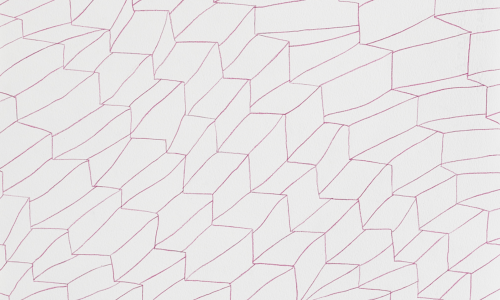
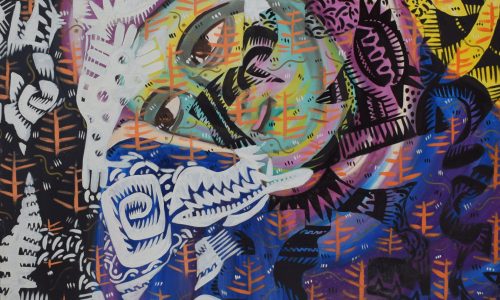
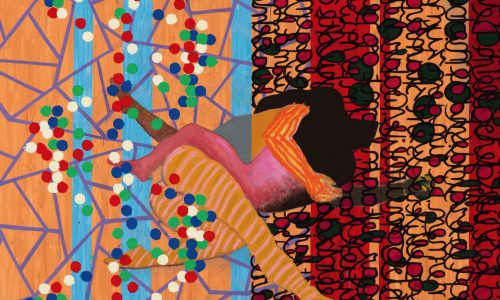
My paintings and works on paper show constructions that represent figures, interiors, and parts of cities as autonomous identities.

The figures as well as the urban fragments are composed of an assemblage of visual elements of different origins.

In a painting I always take my departure from varying viewpoints/perspectives. This way the paintings are becoming constructions that are open to several interpretations. The body shapes, noses and hands are stylized, the ambient features are made up of evenly looking planes and patterns.                                                                    

In my work I aim to combine different viewpoints in order to achieve a convincing picture. Basically everything is equally important and weighs equally heavily. I make no distinction in terms of time or style: classical, modern, folk art, fashion, textiles, architecture, art, comic strips – anything that comes to mind crystallizes out and I force it together in paintings to give it an individual identity.                                   

My influences are diverse:

Modern art, applied art, folk art; tapestries and textiles; comics and graphic novels; posters, stamps, book covers from various times and cultures.

– Artists: Giotto, Malevich, Roy Lichtenstein, Holbein, Seurat, Zurburán, Rogier van der Weijden, Philip Guston, Jean Brusselmans, Hendrik Werkman, Saul Steinberg, Eduardo Paolozzi,  Charley Harper, Patrick Caulfield, Matisse, Ikko Tanaka, Escher, Dick Bruna, Yrrah, Charles & Ray Eames, Alexander Girard.

These influences have fostered my imagery and strengthened me in my ambition to find what I was looking for.  My paintings relate to a crystallized reality, but not in the form of a story. It is rather a matter of interrupted narratives and connotations that resound in the space.  The viewers can wander among the various painted layers, or via the tangent planes where the layers converge.                                                                                   

In the paintings there is no centre; everything seems equally important. They are intangible puzzles that do not allow repetition or unambiguous explanations.  This way the paintings are becoming lucid and autonomous constructions that are open to several interpretations.

Posted on Leave a comment

Karin van Dam ( continued)

I am still fascinated by the works of Karin van Dam. A new addition QUARTIER SOULS LE VENT made during her Paris stay sparked the interest in her again. The book si now available at www.ftn-books.com

Renowned for her installations, Karin van Dam (1959) constructs her pieces using unconventional materials like boat bumpers, ropes, and insulation pipes. She has even utilized pre-fabricated plastic ponds, suspending them in the space of the Vleeshal in Middelburg. Van Dam perceives her installations as three-dimensional drawings, inviting viewers to walk through them. She prepares her works in advance, creating small-scale drawings incorporating spatial objects such as rubber caps, ropes, and wooden sticks. Urban structures and street patterns serve as a crucial starting point for her creations, but she freely and intuitively translates them, exploring the possibilities that the materials and objects she finds offer.

For years, Karin van Dam has been working on an ongoing project titled Steden op doorreis/Traveling Cities. The title references Italo Calvino’s novel Le città invisibili (Invisible Cities), where Marco Polo narrates imaginary cities to Kublai Khan. In the series’ initial works, Van Dam draws inspiration from Italian Renaissance towns, combining black facades with arches, battlements, and wool and other materials. Over time, the cities become more abstract and are suspended freely in space. In recent years, she has collaborated extensively with the Textielmuseum Tilburg, producing complex knitted covers for her work.

Posted on Leave a comment

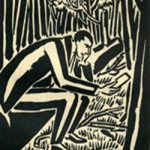
B.C. Epker (1968)

Intriguing drawings and woodcuts are the hallmark of B.C. Epker (Harlingen, 1968), provoking contemplation on our contemporary situation. Possessing a penchant for landscapes, these works feature one or more figures, alluding to the influences of religion and myths, as well as the never-ending flow of media imagery inundating our lives. His pieces are a melting pot of imagery, events, passions, dreams, and unbridled imagination. Recently, he was awarded the prestigious Gerrit Benner Prize.

A graduate of the AKI, Academy of Fine Arts in Enschede, B.C. Epker completed his studies in 1996. Combining fragments from a diverse collection of images (ranging from historical engravings, pornographic images, advertisements, memorial cards, and postcards), he creates unexpected and unique compositions. Idyllic landscapes serve as the backdrop for a colorful cast of characters in his works, including armed citizens, cartoon characters, Greek gods, mythological figures, and people in traditional dress. Initially, the scenes may seem familiar and accessible, but upon closer inspection, this is not the case. Nothing is straightforward in Epker’s depictions. Concepts such as good and evil, or beauty and ugliness lose their meaning; rigidly-held norms and values are called into question.

www.ftn-books.com has the Lucis Domains book from 2006 now available.

Posted on Leave a comment

Niels Helmink (1976)

This is what Helmink says on his own site about himself and his work:

I make photographs in order to create images that stick in your mind, to be able to show a situation as it is when I encounter it and to preserve it forever. What I record is the reality. My subjects must first of all be socially relevant, but they must also have an aesthetic function. In my work I investigate ostensible trivialities and cultural phenomena, both Dutch and foreign. What also interests me are trivialities and cultural phenomena which are slowly vanishing and becoming more and more unpopular. What is the social significance of the fact that certain situations are disappearing in our society? When is something no longer a part of our times? Where does the turning point lie? In my work I try, among other things, to find out where this turning point is (to my mind, at least).

Another major theme in my work is architecture. I particularly use architecture’s cultural and social significance, its function, as a decor for my subjects. In my opinion, society, people’s actions and architecture are inseparably connected with one another. A person is nothing without a space in which to live or to work, and the other way around, a space devoid of the people that are connected with it does not come alive.
Through my composition and execution, I enhance the aesthetic element that I see in the subject matter, showering the viewer with details and impressions through categorization and repetition. With the same elements repeatedly coming to the fore in each individual picture, the message becomes clearer. I systematically work out my subject matter, as Bernd and Hilla Becher did with their typologies of industry, in order to achieve a clear line in my method of presentation.

www.ftn-books.com has the SHOPKEEPERS book by Helmink now available

Posted on Leave a comment

Gjalt Blaauw (1945)

Gjalt Blaauw’s work is characterized by distinct forms and a poetic playfulness. His material of choice is steel, painted in cheerful colors or red-brown rusted, and stone. Despite the weight and solidity of the material, the sculptures exude a lightness in their essence. They often seem to flutter like a flag or flicker like a flame. Other works resemble a cloud or plume of smoke. With Narcissus, Blaauw even managed to suggest a rippling water surface with steel. Many of his works consist of two or more separate elements, arranged in a seemingly precarious composition. They give the impression of being constructed with an oversize set of building blocks rather than being the result of an artistic concept. Yet, it is precisely this direct and unpretentious nature that gives these sculptures their attraction.

GJALT BLAAUW (1945) was educated at the art academies of Leeuwarden, Arnhem, and Groningen. After graduating in 1969, he participated in over one hundred exhibitions both nationally and internationally, including ‘Op losse schroeven’ at the Stedelijk Museum Amsterdam (1969), ‘Lyrisch schetsboek voor de stad’ at the CBK Groningen (1994), and ‘Beelden op de Scheldeboulevard’ in Terneuzen (2012). He had solo presentations at the Fries Museum (1992) and around Borg Rusthoven in Wirdum (2005). For public spaces, Blaauw created the untitled sculptures for the Winschoterbrug in Winschoten (1989), the nature and recreation area Kardinge in Groningen (1999), and Park Sijtwende in Leidschendam-Voorburg (2010).

Gjalt Blaauw currently resides and works in Groningen.

www.ftn-books.com has several Gjalt Blaauw publications now available.

Posted on Leave a comment

Jan de Cock (1976)

While enrolled at the Royal Academy of Fine Arts in Ghent, in the 3D Multimedia department, he presents himself as a self-taught artist.

He conceives and actualizes projects comprised of multiple “figures”, with parts that can be reused in future works. The large modules made of raw wood (particle board) resemble architectural models, as used by architects. These installations possess an unfinished quality that impressively transforms the surrounding space. The viewer is compelled to position themselves in relation to the installation, sit or move around it. Hence, the artwork exists in the interaction between space, the piece itself, and the viewer. He refers to his particle board sculptures as “Denkmal”, with a house number on the back. The German word “Denkmal” means “monument”, while in Dutch it means “a form of thinking”. This is how the artist aims to reform reality, challenging the viewer’s way of thinking.

It is, in its own way, connected to the tradition of Futurist Boccioni and the rigid geometry of Modernism. He is also fascinated by the architecture of Mies van der Rohe and the highly engaged work of sculptor Constantin Meunier. Additionally, he has been influenced by Constructivism and, more recently, by the Minimalism of Donald Judd and the conceptual work of Dan Graham. In his pieces, he blends painting and cinematic references, such as those to Jean-Luc Godard. English art historian Jon Wood places it in the tradition of the modern sculpting studio, yet simultaneously identifies it as unique to contemporary studios, where people and ideas are blended. This is far more complex than traditional workshops of the past.

www.ftn-books.com has the scarce RANDSCHADE publication now available.

Posted on 1 Comment

Gerhard Lentink (1956)

Gerhard Lentink (1956) could be described as both an artist and a mathematician. After completing his Gymnasium-B education, he studied at the Academy of Fine Arts Sint Joost in Breda. Lentink is a globetrotter, with extended stays in Mali and the Ivory Coast before settling in Dordrecht in 1982. His body of work is characterized by grand wooden sculptures, often centered on classical or poetic themes. With utmost precision, he translates his ideas into design drawings, which he later reads from the paper as he begins constructing his pieces. Lentink possesses a vast knowledge of (art)history and culture, which he expertly weaves into his monumental sculptures in a poetic and tender manner.

www.ftn-books.com has several titles on Lentink now available.

Posted on Leave a comment

Cornel Bierens (1949)

Cornel Bierens, born in 1949, is both a visual artist and a writer. He obtained a degree in clinical psychology from Utrecht University and studied art at the Artibus Academy in Utrecht (now known as HKU, he dropped out prematurely) and the Gerrit Rietveld Academy in Amsterdam (also dropping out prematurely).

Bierens’ artistic development has evolved from being a painter and draftsman to a creator of large installations, often utilizing techniques such as anamorphosis and mosaic. he is assisted by a rotating team of collaborators, with Dick and Margo van Berkum being the permanent members.

He has published art criticism and columns in various publications, including Metropolis M, NRC-Handelsblad, De Witte Raaf, De Groene Amsterdammer, and Het Financieele Dagblad. He has also written fiction, often with visual art as its theme, including “Schildpad met Roos en Mes,” a young adult novel. His most recent book is “De handgezaagde ziel,” exploring the revival of craftsmanship in art and its surroundings.

Over the years, he has been a guest lecturer at nearly every Dutch academy for visual arts, and has held long-term teaching positions at the Gerrit Rietveld Academy in Amsterdam, the Academy for Popular Culture in Leeuwarden, the Free Academy/Gemak in The Hague, and the Design Academy Eindhoven. He was a member of the jury for the Witteveen+Bos Art and Technology Prize from 2001 to 2008. In 2015 and 2016, he curated three exhibitions on Vincent van Gogh with contemporary artists, respectively at Arti en Reuten in Amsterdam (two-dimensional) and at MOTI in Breda (three-dimensional).

www.ftn-books.com has now the Mondriaan Fonds publication available.

Posted on Leave a comment

Anton Pieck ( continued )

Many of my customers collect Anton Pieck for nostalgic reasons, but this collection of books i added to my inventory today shows that the quality of Anton Pieck his illustrations goes beyond nostalgia.

Today i bought a small collection of Anton Pieck titles from an avid collector who kept these books in pristine condition. All but one are in MINT condition. And the illustrator book still qualifies as MINT minus.For those who want one of these to their personal collection contact me for full information and price.

www.ftn-books.com

Posted on 1 Comment

Caren van Herwaarden

This is what van Herwaarden syas on her site about her work:

Academic Collection
After graduating from the academy, van Herwaarden spent a few years drawing in the academic collection of Leiden University to study the inner workings, the matter from which we are made. She couldn’t separate the physical form from feelings such as fear, desire, resistance, and surrender. Drives and emotions that have both a purifying and disruptive function in our lives. This research in the academic collection serves as the foundation of her work.

The Wise Body
Van Herwaarden: ‘It intrigues me that our body ‘knows’ so much, even about others. Memory and ‘intelligence’ do not reside solely in our brain. It is the body, the skin, and muscles that hold memories, experiences that are imprinted in the body: the body’s memory. Our body can tell our brain just as much as our brain tells our body.’

Empathy
The ability to empathize allows for compassion and comfort: these are achievements that Caren van Herwaarden considers universal and essential in achieving peaceful coexistence. It’s about you: are you able to put yourself into the situation of an (unknown) other, regardless of belief, age, or gender? This is the opposite of dehumanization and cold indifference. With her work, van Herwaarden aims to show and bring about this transformation. She strives to make this not only visible but also physically palpable in her work. Van Herwaarden: ‘I want the viewer to experience and recognize my work through their gut before possibly understanding it. It must be raw, something you can almost smell.’

www.ftn-books.com has the STAY book from 2010 now available.