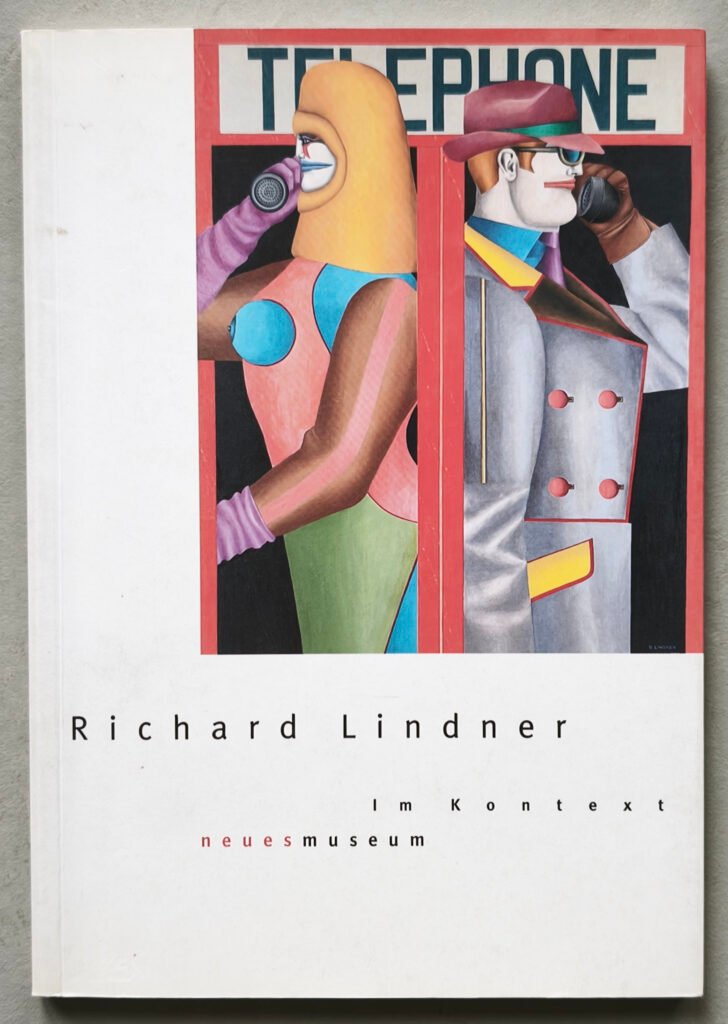


The trajectory of Richard Lindner’s life—a man born in Germany but later naturalized as an American—profoundly informs his artistic body of work. Lindner was the son of a German Jewish father and an American mother; he spent his formative years in Nuremberg, the historic home of Albrecht Dürer, and pursued his formal artistic education at Munich’s Kunstakademie. A pivotal experience during his youth was encountering the Hans Prinzhorn collection at Heidelberg University, which featured works by individuals suffering from mental illnesses and left a lasting impression on him.
By the late 1920s, Lindner resided in Berlin during the rise of *Neue Sachlichkeit* (New Objectivity), an aesthetic movement that would permanently influence his later work. Upon moving back to Munich in 1929, he wed a former schoolmate, Elisabeth Schülein, and assumed a professional role as the art director for the Knorr & Hirth publishing house. As the National Socialist regime seized control, Lindner, in common with numerous German Jews, fled his homeland. He relocated to Paris, maintaining a career as a graphic designer through 1939.
It was in 1941 that Lindner moved to the United States, making New York his permanent home. He gained rapid acclaim as a top-tier commercial illustrator for publications including *Harper’s Bazaar*, *Vogue*, and *Fortune*. Although he officially became an American citizen in 1948, he never fully identified with the country as a whole, perceiving himself instead distinctly as a New Yorker. He did not transition to fine art painting until 1952, reasonably late in his career. The vibrant, pluralistic energy of New York served as a catalyst for his creativity; his canvasses often depicted figures like circus performers, street people, and sex workers, drawn directly from the grittiness of Times Square and the broader landscape of American pop culture.
While Lindner’s practice was concurrent with the domination of Abstract Expressionism, he deliberately maintained a sense of detachment from that movement. By utilizing bold flat planes of color and high-intensity palettes to depict urban subjects, he effectively anticipated the arrival of American Pop Art. Simultaneously, his work retained a sharp, cynical edge inherited from European traditions such as Dada and New Objectivity. He was already past the age of fifty when he held his debut exhibition in 1954 at New York’s Betty Parsons Gallery—a space primarily recognized for hosting Abstract Expressionists. Later in his life, in 1969, he married for the second time, taking as his wife a young French art enthusiast named Denise Kopelman.
www.ftn-books.com has several Lindner collectibles available.