

Emerging from the fractured dawn of the twentieth century, the Bremmerianen manifested as a clandestine fraternity of female visionaries. Orbiting the gravitational pull of H.P. Bremmer—a critic whose pronouncements held the weight of gospel—these women rendered the world with an ascetic, surgical precision. They were the scions of refinement, primarily affluent, unmarried matriarchs-in-waiting residing amidst the verdant enclaves of The Hague and Laren.
It was within the ephemeral columns of the 1920s press that this moniker first crystallized into public consciousness. Within their hushed, monastic ateliers, luminaries such as Julie de Graag, Tjitske van Hettinga Tromp, and Anna Egter van Wissekerke distilled the chaos of existence into crystalline clarity. Like a jeweler carving facets into a diamond, they focused their energies upon austere still lifes, piercing portraits, and studies of the natural realm that breathed with a quiet, measured pulse. Their aesthetic, a rigorous dialogue with the tangible, found its spiritual heartbeat in the tumultuous canvases of Vincent van Gogh. To witness their craft is to peer through a lens scrubbed raw by discipline; they were not merely painters, but custodians of an uncompromising, silent elegance.
Educated at the Royal Academy of Art in The Hague, Julie de Graag pledged her allegiance to the intricate discipline of graphic arts. Tragedy, however, serves as a capricious architect; a calamitous conflagration decimated her atelier in 1908, consigning a substantial portion of her nascent portfolio to cinders. Like a phoenix tethered to the rhythmic scrape of a burin against copper, she eventually resurfaced, unbowed by the embers of her past.
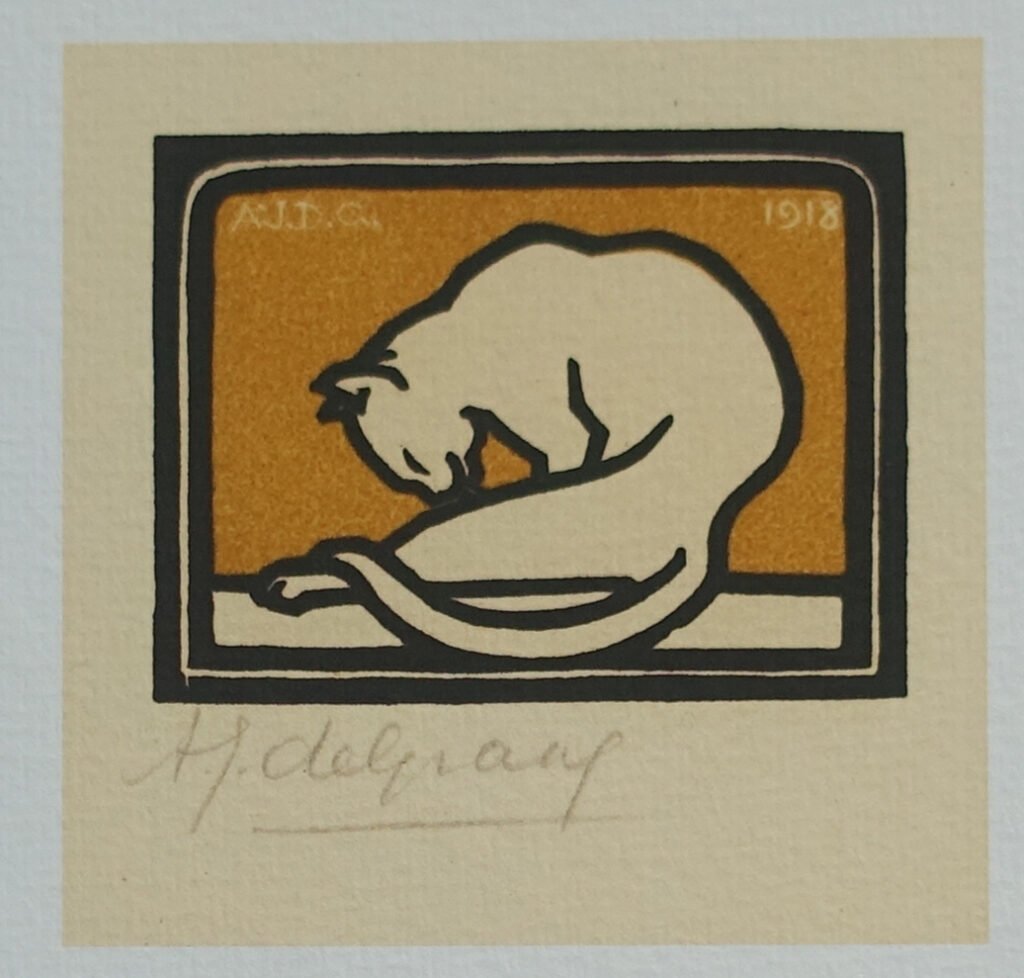
Her aesthetic lexicon was whispered in lines—taut, incisive strokes that distilled the ephemeral spirit of humanity and the raw, untamed pulse of the natural world onto parchment. Witness the 1921 masterpiece *Twee uilen*: here, the avian protagonist radiates a steely, sentry-like vigilance, shielding its trembling counterpart in a poignant display of protective instinct. Beyond the arboreal, her gaze gravitated toward the visage of the intelligentsia, famously immortalizing the enigmatic art sage Henk Bremmer.
Though she reveled in the stark, monochromatic drama of high-contrast compositions, De Graag frequently courted a rebellious palette of vivid hues, often confining these kaleidoscopic thoughts to intimate, diminutive dimensions. Her etchings functioned as clandestine vessels, housing the sediment of the Great War and the volatile turbulence of her internal state. Over time, a serene, spectral stillness began to suffuse her subject matter. Yet, as the shadows lengthened, self-assuredness metastasized into harrowing doubt—a crushing weight that eclipsed her creative luminescence. On the second of February, 1924, this fractured brilliance extinguished itself, surrendering to the finality of a self-wrought silence.
www.ftn-books.com has several de Graag items available.