

Looking into the nascent archives of Paul Van Hoeydonck’s career, one discerns the silhouette of an aesthetic engineer lurking amidst the brushes. His 1952 debut at Galerie Buyle in Antwerp functions as a Janus-faced revelation. While he flirted with the vernacular—still lifes and Moroccan vignettes—that performative display merely masked a subterranean restlessness. Those stark, looming cranes and sprawling maritime petro-refineries hinted at a deeper, clandestine magnetism toward the burgeoning machinery of a motorized era.
Yet, even this industrial preoccupation withered under the heat of his restless disposition. Two years hence, the artist pivoted sharply, discarding representational shackles for the rigorous architecture of geometric abstraction. Within his collages, forms danced, injected with a kinetic vitality that defied stasis. As an architect of the avant-garde, Van Hoeydonck sought to dismantle the old guard, aligning himself with the collective *Formes* before midwifing the seminal G58 circle alongside Jef Verheyen.
The cosmic tumult of the late fifties acted as a crucible for his ideology. With the heavens ignited by the ascent of Explorer and Sputnik, he grew impatient with the stale air of abstract expressionism—a vestige of the past rendered obsolete by the sheer velocity of the Space Race.
The canvas, once an altar, became a prison. Van Hoeydonck’s pivot toward kineticism was an act of liberation, forcing the spectator’s gaze into a participatory orbit. His later *Lichtwerken*—pristine, monochromatic expanses shimmering with tectonic light and the synthetic transparency of plexiglas—effectively cauterized his previous ties to traditional oil on canvas. By 1960, the collective consensus was crystallized: Van Hoeydonck stood solitary, a bridge-builder dismantling the traditional ramparts of the medium to accommodate a future that had already arrived.
His restless urge for creative transgression knew no singular terminus. Within the chronicles accompanying the 1960 *Monochrome Malerei* exhibition in Leverkusen, Van Hoeydonck proclaimed a tectonic shift: ‘We have embarked upon a grand revision… the Earth retreats into a mere springboard, while the cosmos, in its terrifyingly vast expanse, becomes our true destination.’ He forged cybernetic chimeras—‘mutants’ or ‘bonshommes’—cobbled together from mundane refuse and disparate metallic detritus. The KMSKA procured one such relic directly from his workshop: the 1968 *Spaceman*, recently buffed to a fine sheen for public contemplation. With the prescience of a mystic, he breathed life into *The Accident of Space* (1964) and *Cycle de la vie d’Icare* (1966) well before the era’s lunar aspirations met their calamitous ends. These works remain haunting, capturing voyagers encased in spacesuits akin to metallic shed skins—hypermodern yet irrevocably lacerated.
Throughout the decade bridging 1955 and 1965, Van Hoeydonck occupied the very eye of the creative hurricane, tethering himself to the feverish art pulses of Brussels, Antwerp, Paris, Venice, Milan, Düsseldorf, and New York. His trajectory gained gravitational pull through the Parisian orbit of Galerie Iris Clert, catapulting his portfolio into the hallowed halls of the Museum of Modern Art (MoMA). That transatlantic umbilical cord would eventually tether him to the celestial ambitions of NASA. By August 1971, the Apollo 15 mission deposited his *Fallen Astronaut* upon the lunar dust—a poignant, silent monolith honoring the fallen pioneers of the firmament.
Van Hoeydonck traversed his artistic odyssey as a mariner navigating an uncharted archipelago, perpetually grazing the jagged edges of human perception. Grounded in the scholarly rigor of archaeology, he charted the subterranean currents of our looming future. As the roar of commercialized orbital tourism slowly eclipses the silence of science fiction, the recently departed artist stands vindicated; his vision was not mere fantasy, but a cartography of the inevitable.
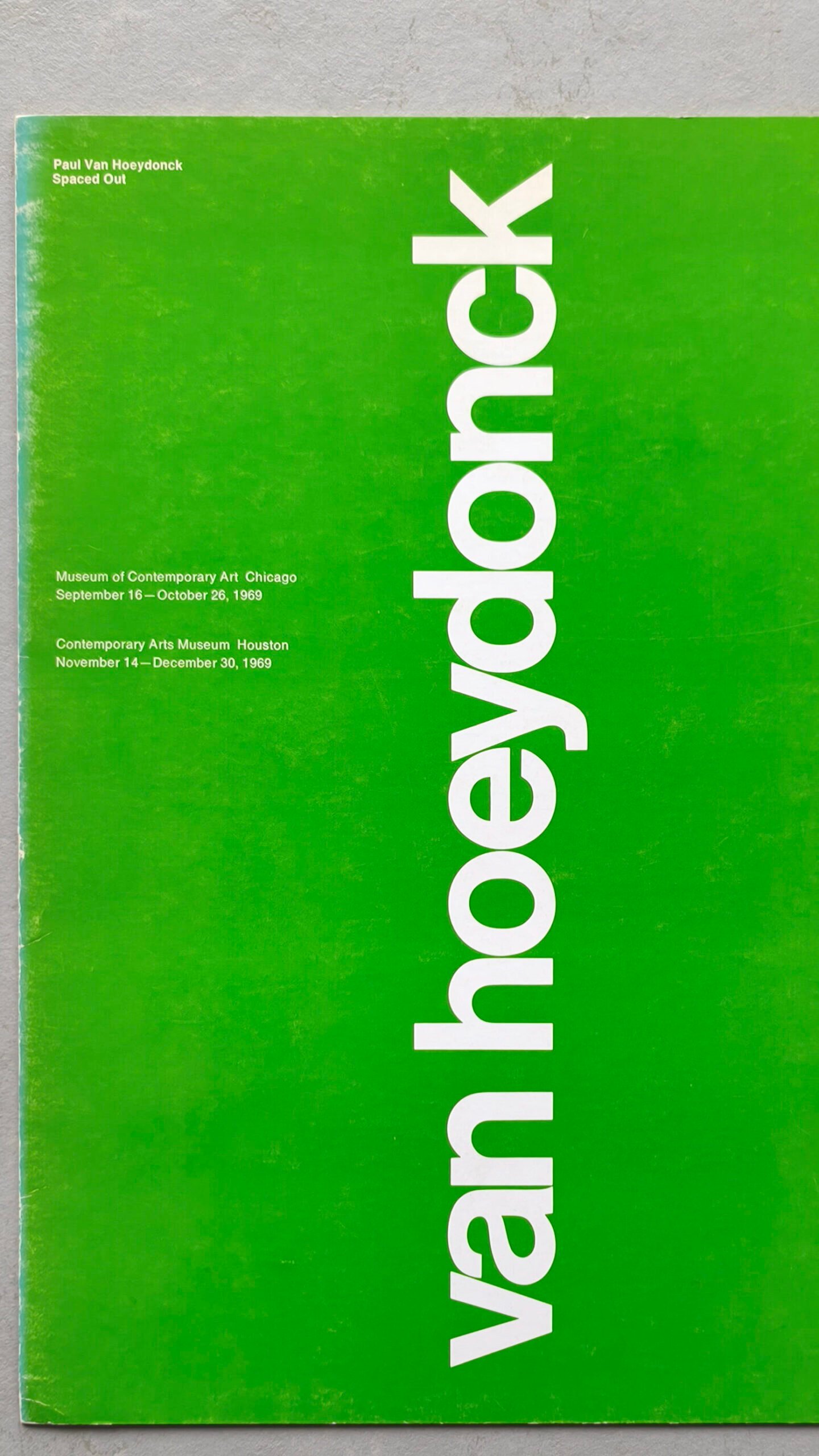
www.ftn-books.com has the Chicago van Hoeydonck catalog now available.