

Jaap Mooy (1915–1987) dwelled as an anomalous fixture within the artistic enclave of Bergen, a man whose existence functioned like a dual-chambered heart: one ventricle pumped the rhythmic, industrial soot of a blacksmith and machinist, while the other thrummed with the erratic, neon pulse of creativity. Drawn into the orbit of the local cognoscenti, he haunted the taverns, inhaling the vapors of inspiration that swirled around the Bergen School. When the prospect of formal tutelage beckoned, he rebuffed the institution upon the sage insistence of Charlie Toorop; she divined that his raw, untutored vision would wither under the sterilized glare of an academy. Consequently, he remained a stylistic hermit.
During the dawn of the 1930s, Mooy began architecting miniature dioramas—”kijkkasten”—intricate assemblages that predated his deeper immersion into the primal, visceral lexicon of the Cobra movement. His camaraderie with the poet-painter Lucebert served as a crucible for his aesthetic evolution, culminating in a prestigious ascent to the Venice Biennale, where he stood shoulder-to-shoulder with titans like Karel Appel. Yet, when the siren song of formal membership in the Cobra collective reached him, Mooy remained obstinate. He viewed artistic adherence as a shackle, preferring the solitary confinement of his own idiosyncratic vocabulary to the harmonized chorus of a group.
By the twilight of the fifties, his renown burgeoned, anchored by the jagged, haunting silhouettes of his salvage sculptures. These were not mere constructions; they were artifacts of a psyche scarred by the global conflagration of war. He scavenged the refuse of civilization, finding a perverse luminescence in the tension between dereliction and grace. Like a master archeologist of his own era, Mooy extracted profound resonance from discarded iron, forging a legacy that traversed oceans to command acclaim across the galleries of Germany and the United States—a testament to a craftsman who forged beauty from the debris of a broken world.
Mooy eschewed the siren call of renown, viewing the constriction of artistic methodology as a self-imposed tether—a shackle upon the spirit of autonomy. By dismantling his own recognizable aesthetic, he rendered his trajectory through the established hierarchies arduous, a deliberate pilgrimage through the wilderness of non-conformity. To him, the canvas was not a bastion of solipsistic glory; rather, it served as a volatile crucible, an instrument for spotlighting the fissures of human rights, the crushing weight of autocracy, and the silent cries of the disenfranchised. He remained an unquiet observer, forever tethered to the pulse of a fractured world.
That denizen of Bergen eventually navigated the arcane Labyrinth of abstraction. His terminal forays into sculpture bore the jagged hallmarks of absurdist theatre, wherein the phantasmagoria of existence functioned as a recurring, haunting motif—much like a dissonant chord echoing through an empty hall.
When the scythe of time claimed Jaap Mooy in 1987, the echoes of his endeavors did not dissipate. Today, his oeuvre serves as a coveted lodestone for those who curate the profound, remaining anchored in the esteem of discerning collectors.
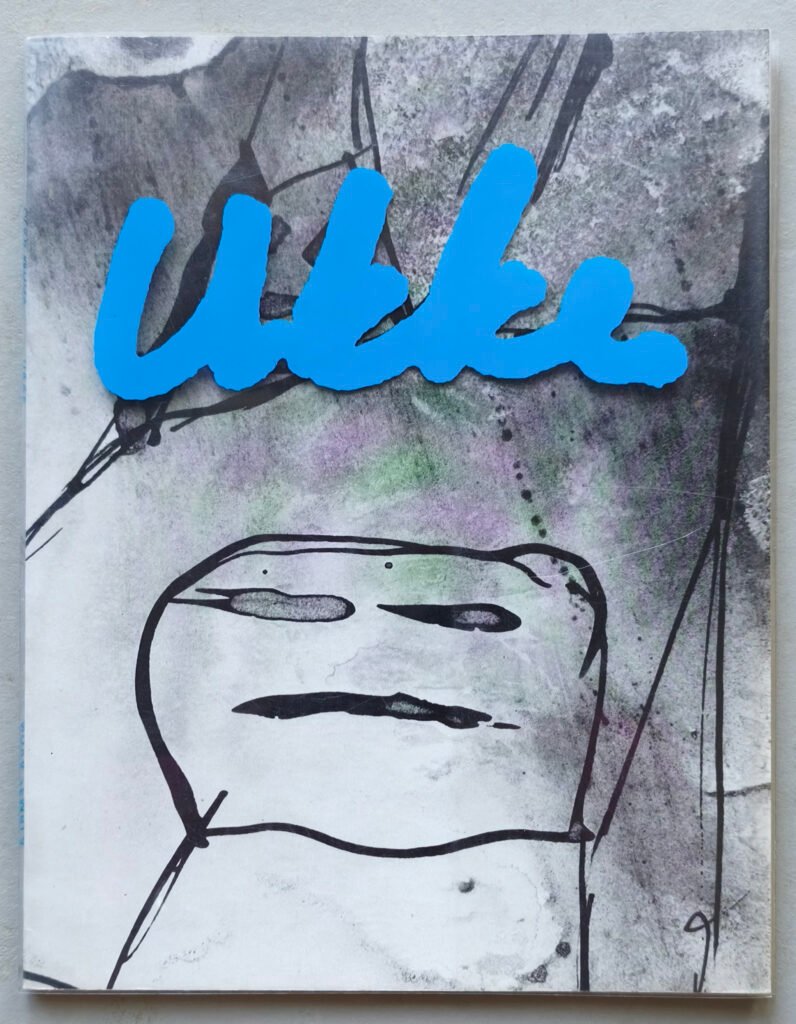
www.ftn-books.com recently added UKKE to the Mooy titles available.