

When people talk about the “Macerata series” in Sol LeWitt’s body of work, they’re pointing to a small but telling chapter in his career as a printmaker — a run of screenprint portfolios he produced in the early-to-mid 1970s with the Italian publisher Pio Monti, based in the town of Macerata in Italy’s Marche region. The prints were pulled by master printer John Campione in New York, but the “Macerata” name stuck because that’s where Monti operated, and it’s how these editions are still catalogued today.
Pio Monti was one of several small European publishers who, in the 1970s, sought out American conceptual and minimalist artists to produce limited-edition print portfolios — part of a broader wave of interest in bringing rigorous, idea-driven American art to Italian audiences. LeWitt, already established as a central figure of Conceptual art and Minimalism by this point, was a natural collaborator: his work was built on written instructions and systems that could, in principle, be executed by anyone, which made the printmaking process a near-perfect extension of his practice rather than a departure from it. Macerata itself hosted a LeWitt exhibition at Galleria Scipione in 1974, situating the prints within a broader Italian moment for his work that also included shows in Turin and at the Kröller-Müller in the Netherlands that same year.
The best-documented works from this Pio Monti/Macerata period are two related portfolios from 1972:
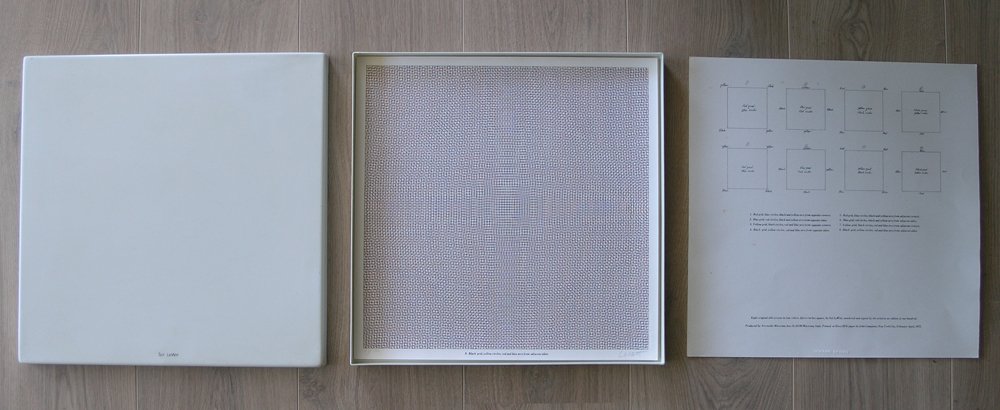
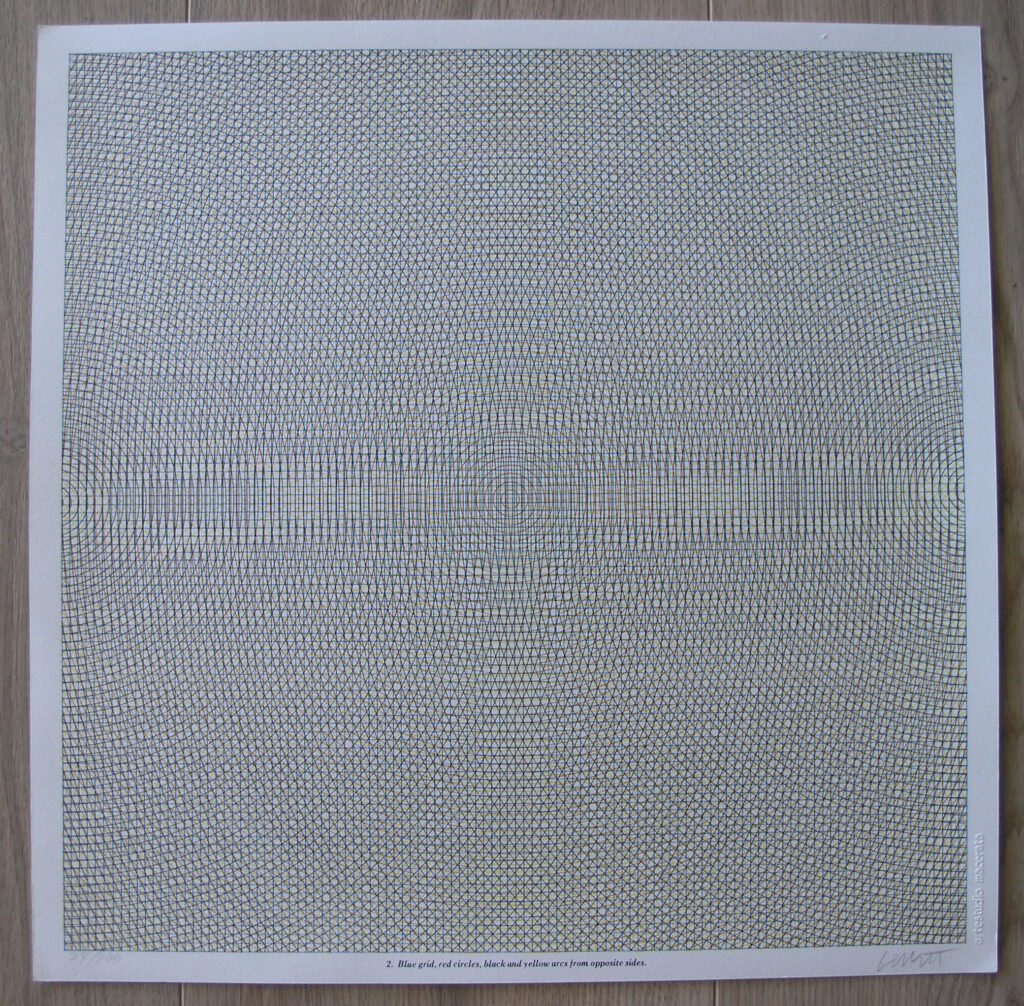
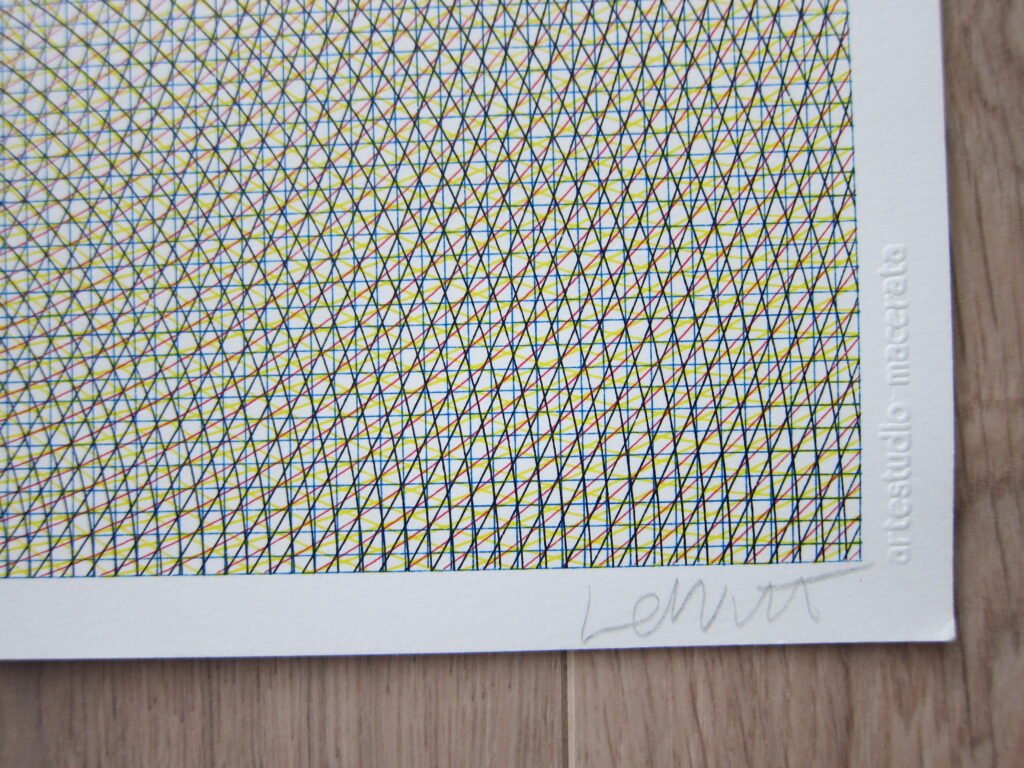
- “All Combinations of Arcs from Sides and Corners, Grids and Circles, Using Four Colors” — a set of twenty-four silkscreens, each built from the same four visual elements (a grid, a circle, and arcs drawn from the sides and corners of the square) rendered in different color combinations across black, yellow, red, and blue.
- “Arcs from Sides or Corners, Grids & Circles” — a related, smaller portfolio of eight screenprints working through further permutations of the same basic vocabulary.
Both were printed on fine French papers, signed and numbered by LeWitt, and issued in modest editions — the twenty-four-sheet portfolio in an edition of 34, the eight-sheet portfolio in an edition of 100. Structurally, they’re a textbook demonstration of LeWitt’s serial method: define a closed set of variables (a shape, a color, a direction), then let the system generate every combinatorial outcome. The artist isn’t composing an image so much as exhausting a rule.
Why the method matters more than the image
This is the key to understanding LeWitt’s prints, Macerata’s included. In his own writing on serial art, LeWitt described the artist’s role less as an inventor of beautiful objects and more as someone who sets a premise in motion and follows it to its logical end, deliberately keeping taste, chance, and unconscious association out of the equation. The Macerata portfolios put that philosophy into practice at a small, intimate scale: instead of a wall thirty feet long, you get a stack of paper sheets that, laid side by side, reveal every possible arrangement of a handful of geometric elements. The pleasure of looking at them isn’t emotional in the traditional sense — it’s the pleasure of watching a logical system unfold completely, with nothing held back and nothing left to interpretation.
By 1972, LeWitt had already been making wall drawings for several years and had established the core vocabulary — grids, arcs, straight lines, circles — that would occupy him for the rest of his career. The Macerata prints are a portable, collectible counterpart to that wall-based work: where a wall drawing is site-specific and often temporary, executed by assistants and eventually painted over, a signed print portfolio is permanent, saleable, and exactly repeatable. For collectors and museums, these Italian-published portfolios offered a way to own a piece of LeWitt’s systemic thinking in a form that didn’t require repainting a room.
The Macerata prints aren’t LeWitt’s most famous body of work — they don’t have the scale or fame of the wall drawings at MASS MoCA or Dia:Beacon. But they matter for what they show clearly and compactly: an artist treating geometry as language, color as a variable rather than an expressive choice, and the finished artwork as the visible residue of a set of rules rather than the record of a gesture. If you want to understand how LeWitt thought — how a grid, a few arcs, and four colors could become an entire body of work — the Macerata portfolios are as clean an entry point as any.
…..and this blog is not complete without the 8 prints included in the series. The series including its original “white” box is for sale at www.ftn-books.com