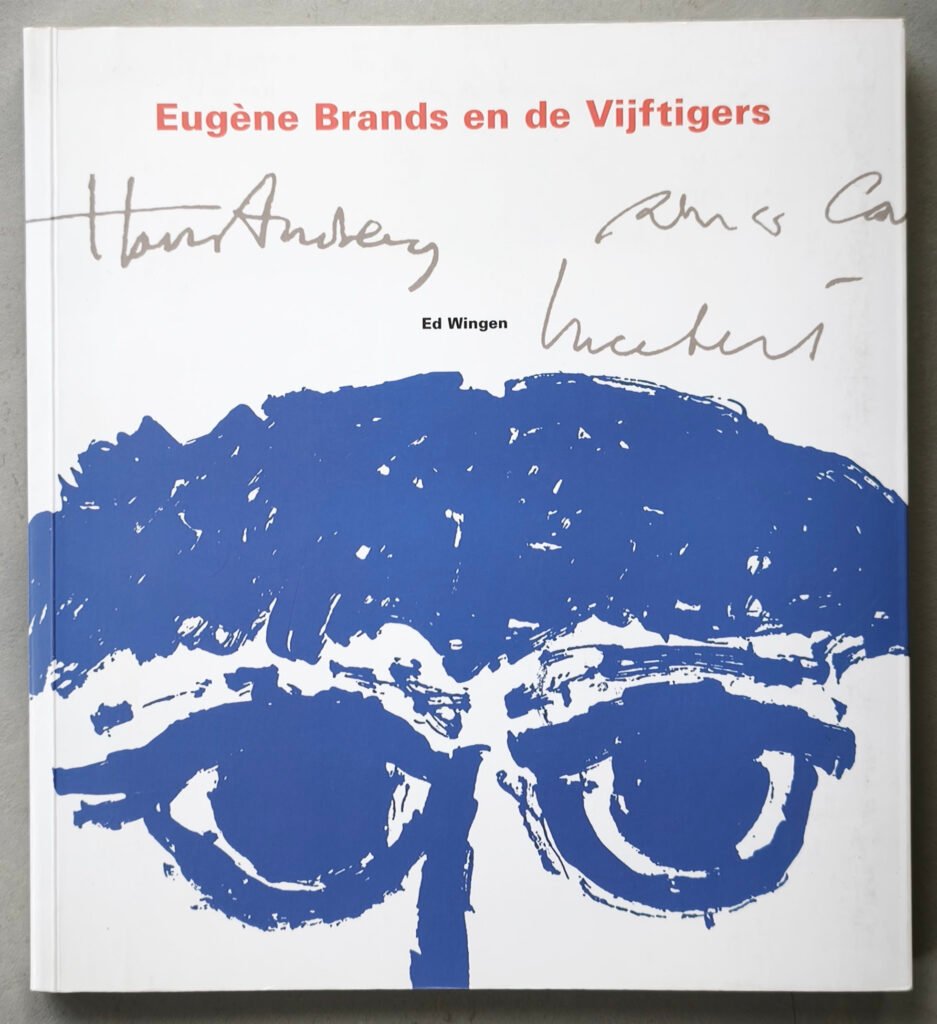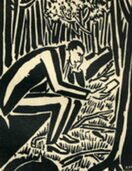


In the rubble and restlessness of the Netherlands after the Second World War, a generation of artists decided the old forms no longer fit. Out of that mood came two parallel movements: CoBrA, the painters’ revolt that Eugène Brands helped launch, and De Vijftigers (“The Fiftiers”), the poets who tore up Dutch verse at almost exactly the same moment. They weren’t the same movement, but they were siblings — sharing cafés, friendships, and a conviction that art had to be spontaneous, instinctive, and free of academic rules.
Brands and the Birth of CoBrA
Eugène Brands (1913–2002) was already experimenting with abstraction and surrealism as early as 1938, well before it was fashionable in Dutch painting. He came to public attention in 1946 when he took part in the group show “Young Painters” at the Stedelijk Museum in Amsterdam, where an entire room was devoted to his work Two years later, Brands joined Theo Wolvecamp, Anton Rooskens, and Jan Nieuwenhuys in founding the Experimental Group Holland at Constant’s house — the circle that would soon merge with Danish and Belgian artists to become CoBrA (Copenhagen–Brussels–Amsterdam).
He was one of the artists who contributed to the movement’s founding statement, published in its magazine Reflex But Brands was a restless, independent spirit. He left CoBrA not long after its notorious joint exhibition at the Stedelijk in late 1949, finding his own personal vision didn’t sit easily inside a group He went on to explore children’s drawings, non-Western music and imagery, and eventually a cosmic, abstract style of clouds and color fields that occupied him for the rest of his life.
The Vijftigers, Next Door
At the very same café tables — most famously Café Eylders in Amsterdam — a group of young poets was staging its own revolt. In 1949, Lucebert emerged as the figurehead of the Movement of Fifty, or De Vijftigers, a group of experimental poets who stirred up considerable controversy at the time Like the CoBrA painters, the Vijftigers rejected polished, traditional form in favor of raw, associative, sometimes deliberately chaotic language.
The two circles overlapped constantly, and Lucebert himself is the clearest bridge between them: as a poet he was seen as the leader of the Vijftigers, while as a painter he was closely involved with the Amsterdam branch of the experimental CoBrA group Brands and Lucebert knew each other personally Brands met the poet in 1946, right around the time Lucebert was finishing an earlier phase of his own literary work.
www.ftn-books.com has the publication on his VIJTIGERS period availale.