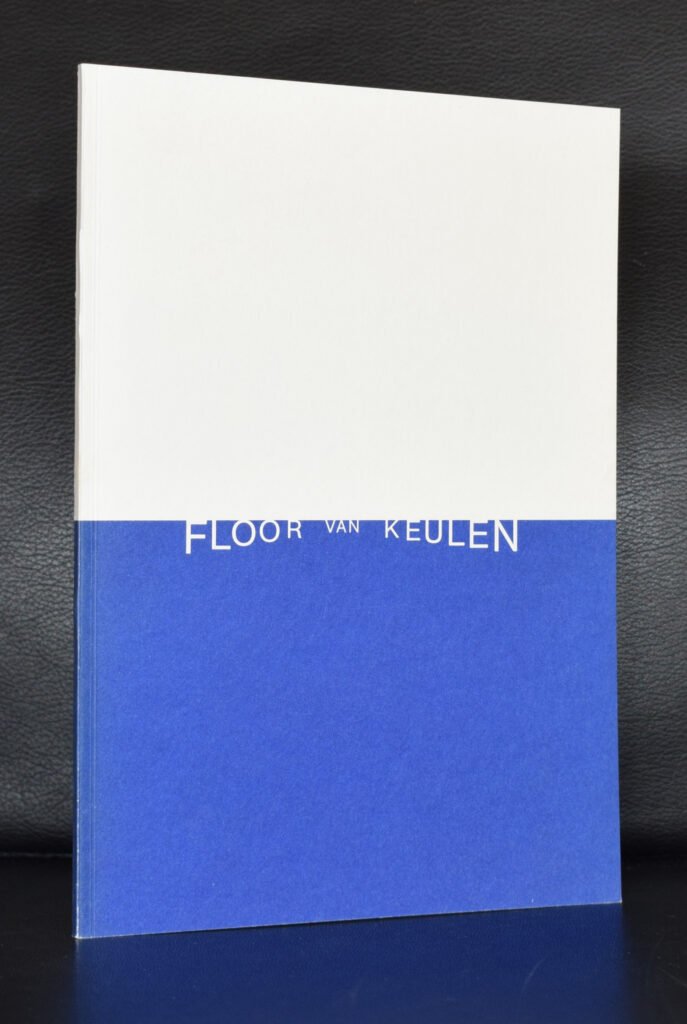


Floor van Keulen is not an easy artist to pin down, and that is precisely the point. Since the mid-1970s he has built a body of work out of a deliberate contradiction: paintings made to be seen, on walls that will eventually be repainted, in buildings that will be renovated, at events that end when the hour is up. He is best known in the Netherlands as a painter of large-scale wall pieces (muurschilderingen), as a draughtsman with an obsessively recurring cast of cartoon-like figures, and as the inventor of “schilderperformance” — painting as a live, timed act rather than a fixed object. His work sits in the collections of the Stedelijk Museum Amsterdam, the Kröller-Müller Museum, and the Centraal Museum Utrecht, among others, even though a great deal of what he’s made no longer physically exists.
Below are in-depth looks at four of the strands that define his career.
The Wall Paintings
Van Keulen’s wall paintings are the clearest expression of his whole aesthetic project, and they’re the hardest to review in the conventional sense — most of them are gone. He painted his first mural at sixteen, on the stairwell of his mother’s beauty salon in Amsterdam, and kept going from there: the Stedelijk Van Abbemuseum in Eindhoven (1981), the Kröller-Müller Museum (1984), the Centraal Museum in Utrecht (1993, 1996), the Gemeentemuseum in The Hague (1993), and dozens of gallery and theatre walls across four decades.
What makes these works interesting isn’t just their scale but their method. Van Keulen has said that when he’s working, the edge of the wall doesn’t register as a boundary — the surface becomes “potentially unbounded,” and the composition grows the way natural thought does: without a fixed plan, branching outward from a starting point rather than following a blueprint. That’s a meaningful distinction from the conceptual wall-art tradition (think Sol LeWitt, whose murals are executed from precise written instructions). Van Keulen’s murals are closer to a nervous system than a diagram — nothing is calculated in advance, and a moment of hesitation early in the process will visibly resurface later in the finished image.
The trouble, of course, is that a mural on a museum wall gets painted over the moment the exhibition closes. Van Keulen has worked his whole life knowing this. Rather than treat it as tragic, he’s built it into the meaning of the work: the painting’s temporariness is not incidental, it’s the argument. A wall painting insists on being of a place and a moment, and refuses to be portable, sellable, or permanent. Reviewed on those terms, the muurschilderingen are a genuinely rare thing in contemporary Dutch art — an entire career’s worth of major works that exist almost entirely as memory and documentation.
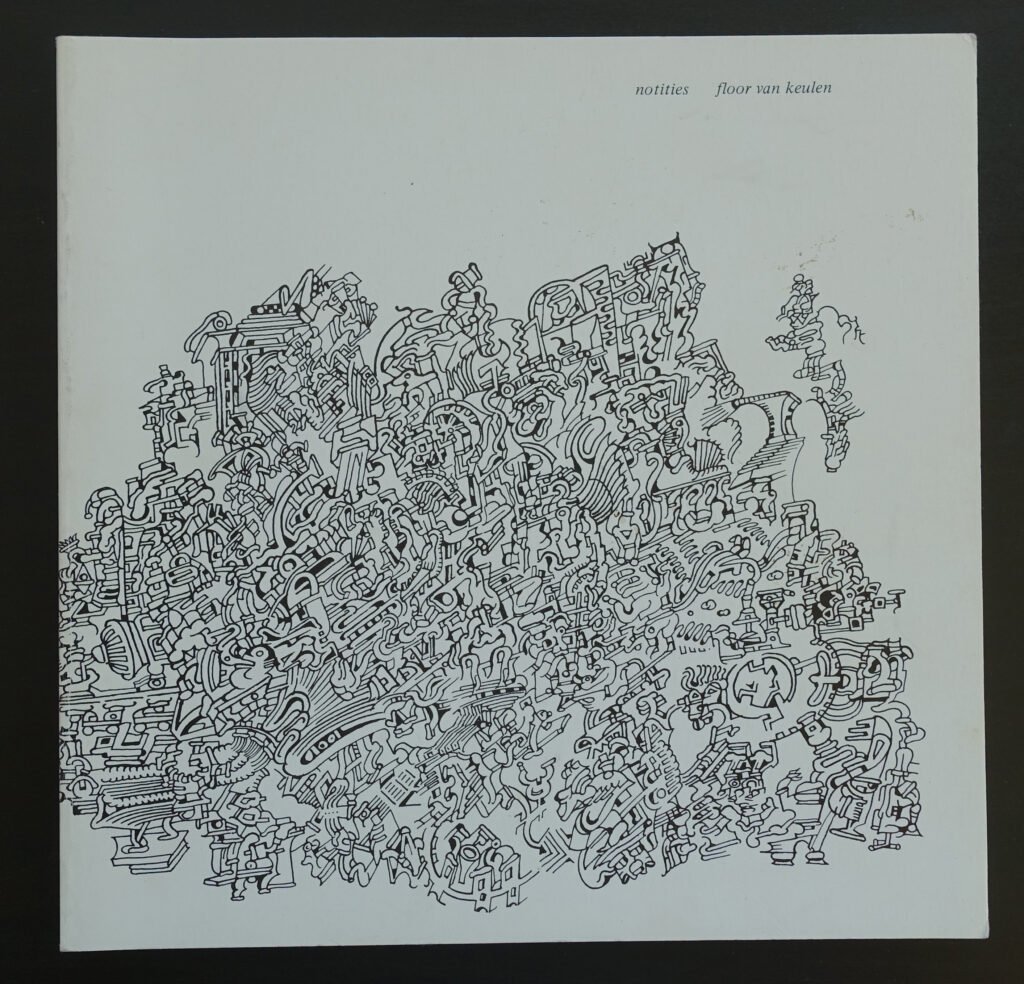
If the murals are about impermanence, the drawings are about persistence. Since around 1980, Van Keulen has worked from what’s been described as an internal “sample book” — a private vocabulary of human figures and cartoon-like characters that he’s built up over twenty-plus years of sketching in notebooks and on loose sheets, and that he draws on intuitively rather than systematically.
The striking thing when you look across decades of these drawings is that the cast doesn’t evolve in a straight line. Characters disappear for years and then resurface; a figure that was once a background detail becomes central, and vice versa. There’s no clean chronology to plot, which is unusual for an artist with a genuinely long practice — most draughtsmen show a legible “early period” and “late period.” Van Keulen’s vocabulary instead behaves like a repertory company: the same actors keep returning, in different roles, indefinitely.
Formally, the drawings sit at an odd, appealing angle to art history. Van Keulen himself has pointed to an early debt to the classic avant-gardes — cubism, Dadaism, expressionism — and traces of that show up in how his forms fracture and reassemble. But he never fully commits to abstraction; the figures stay legible as figures even as they melt into surrounding shapes. His own account of the drawings — that shapes “effortlessly melt into one another, debate with each other,” with emotion flaring and then resolving — is a fair description of what it’s like to actually look at one of these sheets. They read less like single images than like frozen conversations.
Van Keulen’s painting-performances go back to 1975’s Eerste eigen toeschouwer at the Shaffy Theater and 1977’s Zien is lezen, doen is schrijven at De Appel, where, partway through a live painting session, the phrase “doen-zien” (do-see) briefly emerged from a series of apparently random strokes on the wall before disappearing again under further overpainting. It’s a small anecdote, but it captures the whole logic of the format: the audience isn’t watching a painting get made, they’re watching a painting get made and unmade in real time, and most of them will miss the one legible moment because they’re not looking for it.
This is where Van Keulen’s work becomes genuinely theatrical rather than simply painterly — he’s spoken about how the live audience’s presence introduced something unusual for a visual artist: direct, real-time contact with viewers who are themselves deciding when the “work” is finished, often at a different moment than the artist does. Later iterations moved further from the object entirely: by the early 2000s he was collaborating with choreographers and musicians on pieces like Painted Theatre (with Bianca van Dillen and David Dramm) and, by 2005, projecting drawings directly onto buildings using light — a version of the wall painting that isn’t even physically there.
The performances are the most radical extension of his central idea, but they’re also the hardest to assess as “works” in any traditional sense, since assessment requires having been in the room. What survives — video stills, photographs, secondhand description — inevitably flattens something that depended on duration and live risk.
If the murals and performances are designed to disappear, Lost Paintings (Setola, 2011, 376 pages, bilingual English/Dutch) is Van Keulen’s own answer to that disappearance — a retrospective built almost entirely from what remains: photographs and film stills of works that no longer physically exist. It’s less a conventional monograph than an archive of afterimages
The book works because it doesn’t try to disguise its source material as something more polished than it is. Reviewers have noted that the reproductions are often grainy, sometimes poignant, sometimes dramatic — treated more like photojournalism than fine-art plates — and that this rawness suits the subject far better than glossy studio photography would have. You’re not looking at art-book documentation of paintings; you’re looking at evidence, which is the honest way to present work whose whole identity was built on not lasting.
www.ftn-books.com has original works and catalogs by van Keulen available.