

A Life Spent Inside One Square
There’s a certain kind of artist who doesn’t chase trends — they pick a single question and spend a lifetime turning it over in their hands. Günter Tuzina is exactly that kind of artist. For roughly fifty years, he has been asking the same deceptively simple question: what happens when you take a rectangle, cut it with a diagonal line, and fill the resulting shapes with color? That’s it. That’s the whole obsession. And somehow, out of that narrow constraint, he’s built one of the most quietly compelling bodies of work in postwar German painting.
Tuzina was born in Hamburg in 1951 and trained at the Hamburg Art Academy from 1971 to 1977. By 1975, while still a student, he’d already committed to the project that would define his career: stripping painting down to its most fundamental components — line, square, rectangle, color field — and using them to chase a single, elusive quality: equilibrium.
It’s worth sitting with how radical (and how patient) that decision was. This wasn’t someone dabbling in geometric abstraction as one phase among many. Tuzina picked his vocabulary in his early twenties and never really abandoned it. Instead, he kept refining it, decade after decade, the way a poet might spend a lifetime writing in a single fixed form.
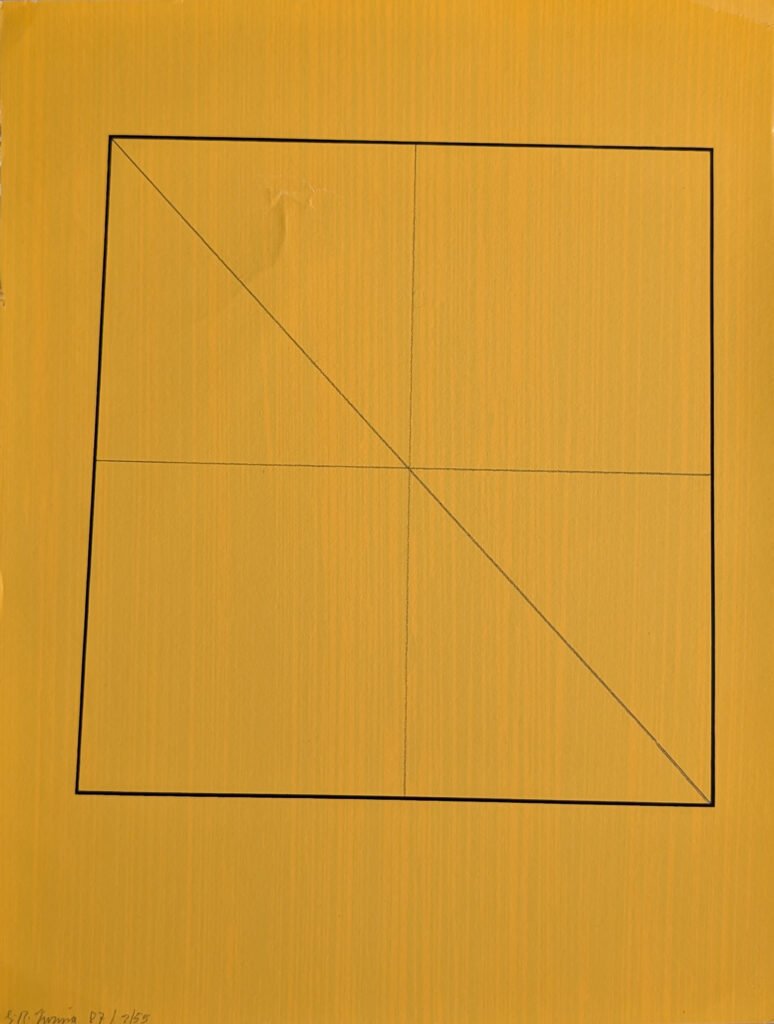
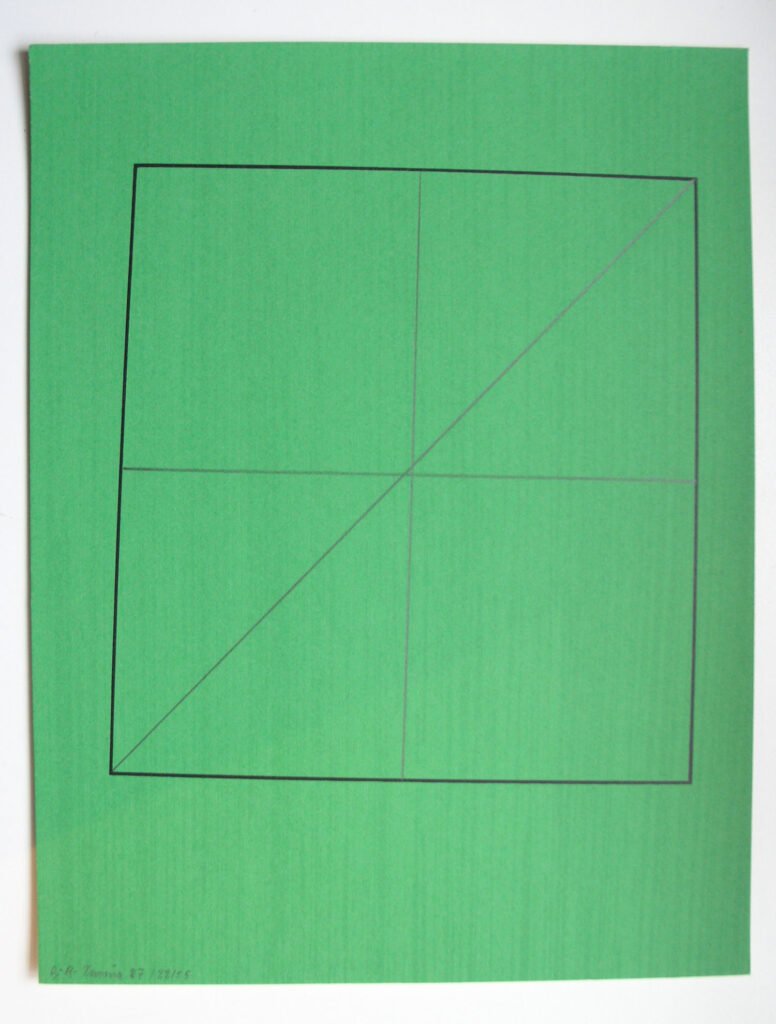
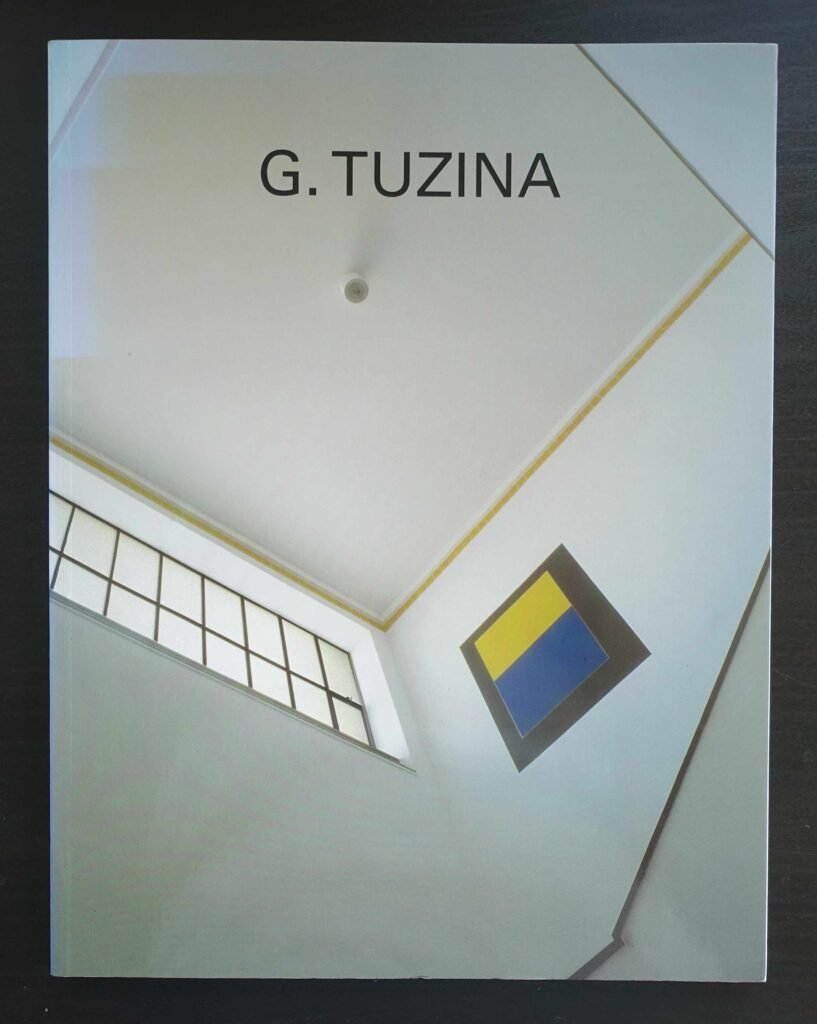
If you know one thing about Tuzina’s work, it’s probably this: a tilted, window-like rectangle, sliced corner to corner by a diagonal line, filled with saturated color. He arrived at this “divided angle” motif around 1980, reportedly borrowing the structural logic from the floor plan of a basilica — which tells you something about how Tuzina thinks. He isn’t interested in cold, systemic geometry for its own sake. There’s an architectural, almost sacred weight underneath the abstraction.
And here’s what separates Tuzina from the Minimalists he’s often compared to: his lines are never quite perfect. The diagonal doesn’t always cross dead center. The angles don’t always land at exactly 90 degrees. Where classic Minimal Art aimed for anonymous, industrial precision, Tuzina lets a human hand show through the geometry — a small imperfection that gives the work an unexpected emotional charge. It’s the difference between a blueprint and a confession.
Lineage: Minimalism Meets De Stijl Meets Romanticism
Tuzina’s work sits at a genuinely interesting crossroads. Formally, it draws on Minimal Art and the constructive principles of Theo van Doesburg and De Stijl — that early-20th-century Dutch movement obsessed with reducing painting to grids, primary colors, and structural balance.
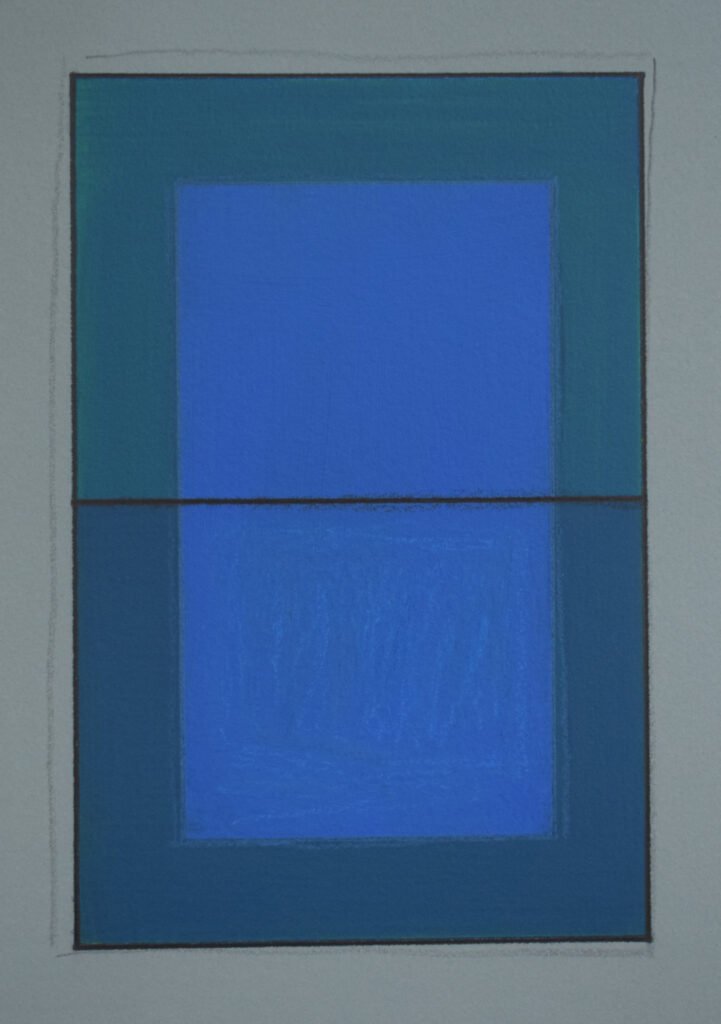
But Tuzina has also described his practice as circling back toward Romanticism. One of his most significant paintings, Frühschnee (2002), directly references a work of the same title by Caspar David Friedrich — the definitive Romantic painter of solitary figures staring into vast, sublime landscapes. That’s a strange pairing on paper: hard-edged geometric abstraction reaching back to touch 19th-century Romantic longing. But it clicks once you look at the paintings. Those saturated color fields, glowing behind their scaffolding of lines, do something atmospheric — closer to a horizon or a held breath than to a diagram.
A Career Built Slowly, Show by Show
Tuzina’s rise wasn’t a single splashy debut — it was a long accumulation of serious institutional attention:
- 1981 — Awarded the Villa Romana Prize in Florence, a career-making honor for German artists.
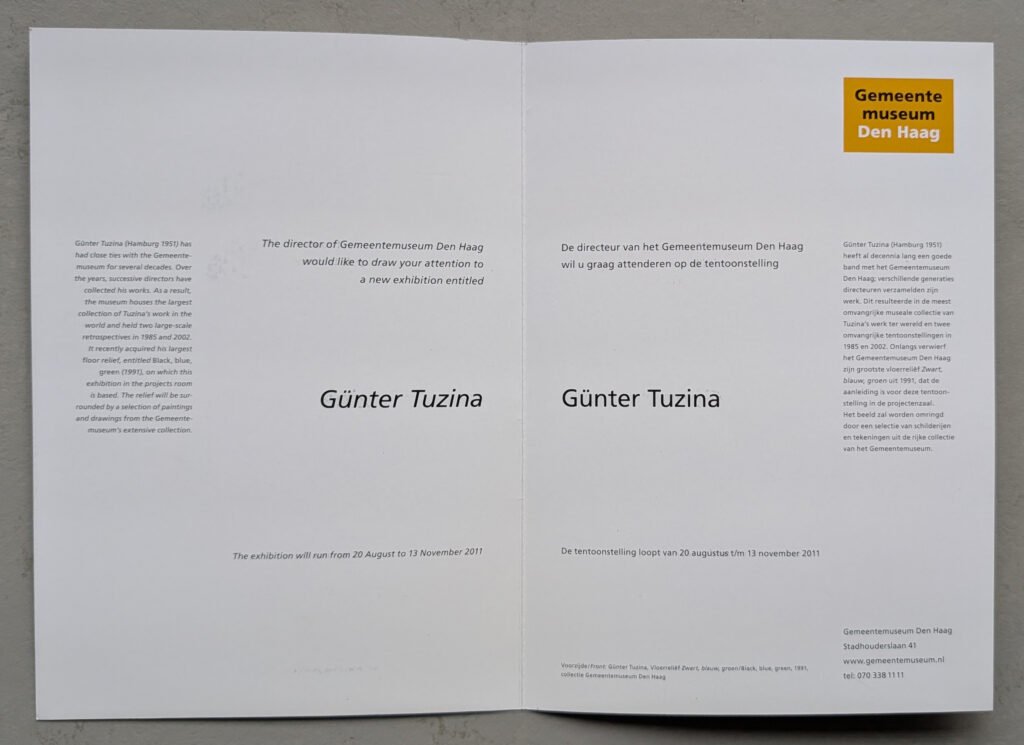
- 1985 — A retrospective at the Gemeentemuseum (now Kunstmuseum) in The Hague, followed by a mural painted directly onto the museum’s stairwell in 1987. That mural was later destroyed during a museum renovation — a loss that feels oddly fitting for an artist so preoccupied with fragility and impermanence within rigid structure.
- 1991 — Exhibited at the David Nolan Gallery in New York.
- 1992–1993 — Shows at the Cologne Kunstverein and the Städtische Galerie im Lenbachhaus in Munich.
- 2002 — A second major overview of his career, again at the Kunstmuseum in The Hague.
His work has found homes in serious public collections, including the Van Abbemuseum in Eindhoven, Museum Boijmans Van Beuningen in Rotterdam, the Stedelijk Museum Amsterdam, and MoMA in New York. He lived and worked in Cologne from 1982 to 1999 before relocating to Berlin, and he’s maintained a long-standing relationship with Slewe Gallery in Amsterdam, which has represented him for roughly a quarter of a century.
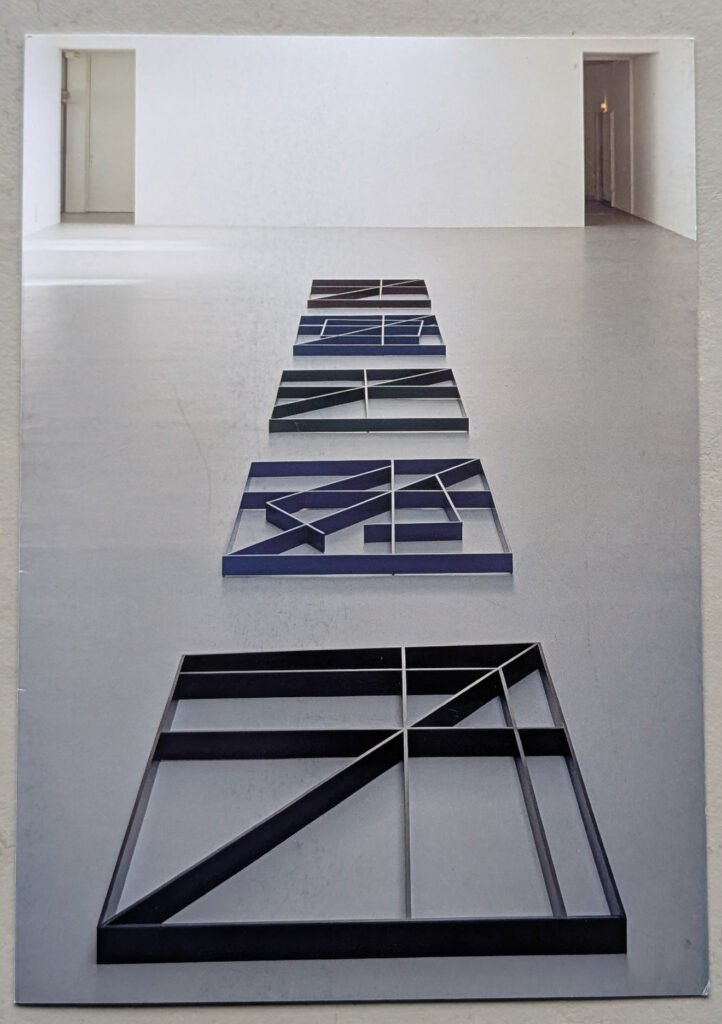
It would be easy to describe Tuzina’s career as narrow — one guy, one motif, five decades. But that framing misses what’s actually interesting here. Tuzina isn’t repeating himself; he’s excavating. Each painting is a fresh attempt at solving the same equation with slightly different variables: a different color temperature, a slightly shifted diagonal, paper instead of canvas, a wall instead of a panel.
Critics have described the resulting tension as a kind of suspended balance — paintings that feel like they could tip over at any moment, holding density and fragility, stability and movement, in the same frame. That’s a hard trick to pull off with such a stripped-down toolkit, and it’s precisely why Tuzina rewards slow looking. These aren’t paintings that announce themselves across a room. They ask you to stand still with them until the almost-imperfect geometry starts to hum.
Günter Tuzina isn’t a household name, and he’s probably fine with that. His work exists in the specific, demanding territory between Minimalism’s discipline and Romanticism’s yearning — a quiet, decades-long argument that constraint isn’t the enemy of feeling, but often the very thing that makes feeling visible. If you ever get the chance to stand in front of one of his tilted, color-filled windows, take the extra minute. The reward isn’t in what changes from painting to painting — it’s in how much he’s found inside never really changing at all.
I am a big fan and i have collected many Tuzina publications over the years of which pasrt is for sale at www.ftn-books.com