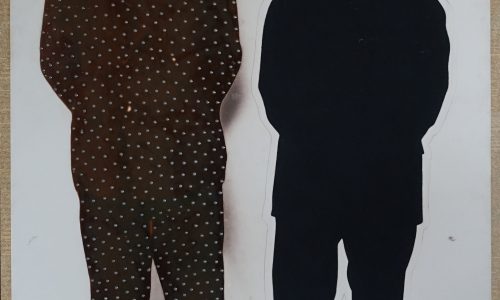
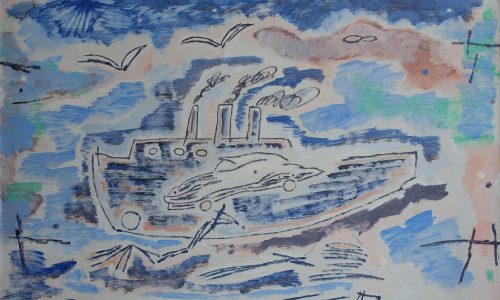
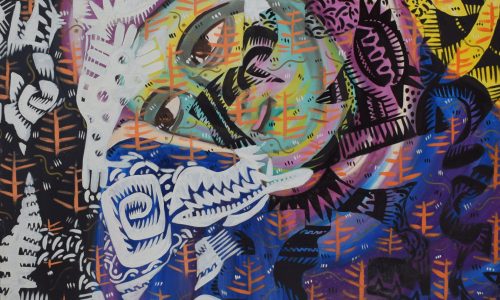
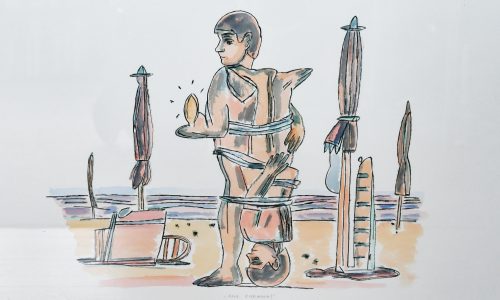
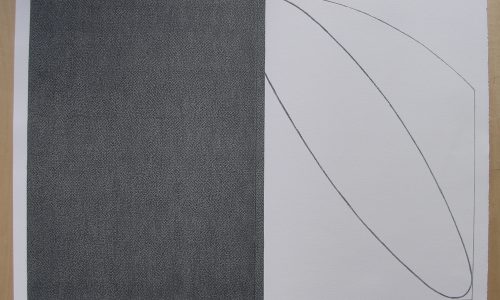
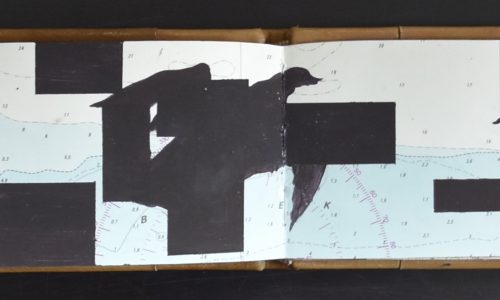
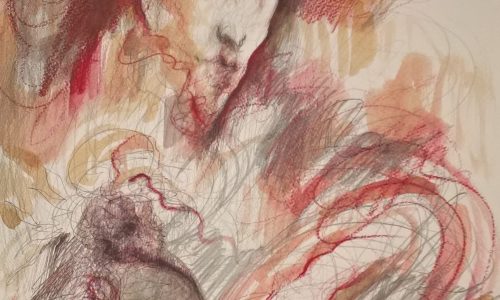
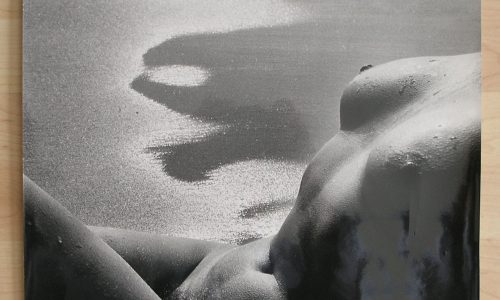
I have always been a great fan of Rene Magrite and now I even have become more of a fan. This is because this book I now have for sale gives great insight in his personnel documents that are the fundament of his larger works on paper and canvas. The book is published by Galerie Christine and Isy Brachot. Longtime gallerist who have represented Magritte during his life and after his death. The book is a beautiful publication and an absolute must for all Magritte admirers. The book is now available at www.ftn-books.com
Italian painter and sculptor. Born at Monza, Milan. Studied at the Brera Academy, Milan, under Carpi and Carrà. First one-man exhibition at the Galleria Bergamini, Milan, 1947. After a brief period of geometrical abstraction, collaborated with Fontana in the Spazialismo movement and signed the Spazialismo manifestos of 1950-3; friendships also with Dova, Peverelli, Donati. Pioneered action painting in Italy with his calligraphic spiral paintings, ca.1949-52. Partly through contacts with the Surrealists Lam, Matta and Brauner, Crippa turned in the mid 1950s to painting totem-like personages, and from 1956 also made cast iron sculptures of these. In 1958 he began to make collage-reliefs incorporating wood, newspaper, etc., evoking imaginary landscapes or figures; his later collage-paintings tended to become more brilliant in colour. A champion at aerial acrobatics, he was killed in a plane crash at Bresso, Milan.
www.ftn-books.com has a few Crippa items available.
Bellany was born in the fishing village of Port Seton, near Edinburgh. He studied at Edinburgh College of Art and at the Royal College of Art, London. His work of the 1960s and 1970s dealt with original sin, guilt, sex and death. His characteristic paintings are large compositions featuring his own personal symbolism, often derived from the sea and from religion, two elements that dominated his childhood. The flawed nature of humanity was usually central to his paintings. Bellany became seriously ill in the 1980s and underwent a liver transplant operation in 1988, after which his work became more optimistic in mood.
www.ftn-books.com has the Fischer art limited exhibition catalogue from 1986 available
A b log on Valley Curtain by Christo because I realized that at this time I have some highly collectible Valley Curtian items collected and now available at www.ftn-books.com. The unwrapping itself above is like almost all Chriso’s unwrapping almost poetical.
Visible Language is certainly the oldest , but possibly also the most important design journal.
The journal was founded with the primary tenet of the journal being that reading and writing together form a new, separate, and autonomous language system. The journal has evolved to focus on research in visual communication. The journal has covered the subject of concrete poetry, the Fluxus art movement, painted text, textual criticism, the abstraction of symbols, articulatory synthesis and text, and the evolution of the page from print to on-screen display. Guest editor-authors have included Colin Banks, John Cage, Adrian Frutiger, Dick Higgins, Richard Kostelanetz, Craig Saper, and George Steiner.
David Spillerwas born in 1942 in Dartford and grew up in the small town of Swanley in Kent. At the age of 15 he started a graphic design course at Sidcup Art School followed by a fine art painting course at Beckenham School of Art where he was classically trained in painting and drawing. This is where he also started to develop a lifelong passion for music of all kinds: rock‘n’roll, rock, the blues and music from the movies. In 1962 he gained a place to study at the Slade School of Art, where he was taught Frank Auerbach and William Coldstream and where he won the Henry Tonks Prize for Drawing.
In the late 70s-80s David Spiller worked as a senior lecturer at Ravensbourne College of Art. In 1985 he visited the Cologne Art Fair in Germany where he was extremely excited by seeing such a dynamic art scene that he decided he wanted to follow his own artistic career. In 1987 he moved to a studio in New York and began exhibiting at the Twinings Gallery on Broadway. The following year he moved to Berlin and had his first solo show with the Zeitkunst Galerie at the Cologne art fair. These opportunities led him to show regularly throughout Europe. With his work being presented at various European art museums and he has had solo exhibitions in over 10 countries. He currently exhibits with his Belgian gallery, Guy Pieters and in 1998 he began exhibiting in London at the Beaux Arts Gallery on Cork Street and now regularly shows with the Portland Gallery in Piccadilly. He has recently begun exhibiting his paintings with the Long-Sharp Gallery in Indianapolis. David Spiller continues to live and work at his studio in south London and his paintings are included in prestigious public and private collections throughout the world.
Spiller’s work appropriates concepts from popular culture and childhood memories. His art is filled with enthusiasm and energy, compressing a world of influences and ideas onto a single piece of artwork. From: Picasso, Dubuffet, Warhol, Disney, Graphic design, often taking an already iconic image he recycles and recontextualises symbols already packed with hidden connotations. Essentially David Spiller is an urban artist focusing on graffiti and media. By using different painterly techniques he creates rich and complex surfaces. Blending styles by mixing the hard-hitting immediacy of Pop Art, with bold colours, punchy texts and clean lines, alongside expressionistic painting and hard-edged abstraction. To these striking images he adds another layer of informal freehand texts and drawings including characters and motifs that echo in his mind, combining these elements with evocative lines from his favourite songs by: the Beatles, Bob Dylan, The Pogues and other lyrics that have seeped into his consciousness. With all of this information and emotion Spiller constructs a canvas or print that uniquely combines all of these elements.
Love is at the centre of David Spiller’s work. The Beatles sang All You Need is Love as if it were a mission statement. Spiller’s paintings are a cornucopia of appropriated and remembered images, a smorgasbord of influences from American Pop Art, boyhood comics, TV cartoons and art history.
www.ftn-books.com has the Linda & Guy Pieters publication on Spiller his works available.
For the past four decades, British artist Nicola Hicks’ practice has centred around a world of heroic sculptural figures, exploring an anthropomorphic relationship to the animal world through portraits of humanised creatures and beast-like humans.
Hicks’ works are unashamedly raw, her subjects ranging from a herd of worn out circus horses balancing on shaking legs, to a decaying, crow covered, ornamental bridge. Never afraid to shy away from darker content, in Hicks’ 1986 work The Fields of Akeldama (The Fields of Blood) the artist repurposed a field in West Cork, carving the forms of dead and dying animals out of Irish clay; all only to be washed away by the rain, recalling scenes of animals revealed after a flood. Hicks now predominantly sculpts in plaster, casting her works later in bronze – due to this process her sculptures are at once monumental and vulnerable. Alongside her sculptural practice Hicks creates drawings using charcoal on brown paper. Hicks believes that both practices are mutually beneficial and reliant on the other.
Nicola Hicks received a BA from the Chelsea School of Artin 1982, followed by an MA in 1985 from the Royal College of Art, London. In 1995 Hicks was awarded an MBE for her contribution to the visual arts. Hicks’ sculpture and drawings have been presented internationally in museums and galleries including a major 2013-14 solo exhibition at the Yale Center for British Art in New Haven. Hicks has numerous works on public display including the Crouching Minotaur at Schoenthal Monastery, Switzerland and Muscle and Blood at 600 Lexington Avenue, New York.
www.ftn-books.com has the Momentum publication on her works now available.
Reg Butler was born April 28, 1913, in Buntingford, in the United Kingdom. In 1933, he began to train as an architect. From 1937 to 1939 he taught at the Architectual Association and was responsible for the design of two private houses and the clocktower of Slough Town Hall in 1936. After the outbreak of World War II, he became a blacksmith in West Sussex and wrote a series of 69 articles on Wartime building practice. At the end of the war he briefly resumed his architectual practice in London and started to attend art classes at the Chelsea School of Art.
His first solo exhibition was held at the Hanover Gallery in London in 1949. The following year he preceded Kenneth Armitage in receiving The Gregory Fellowship awarded by Leeds University. It was during his three years in Leeds that he fully developed his sculptural style. He abandoned his past methods of welding iron and turned instead to modelling in clay or plaster and casting the models in thin, light-weight bronze. In 1952 Butler was among eight sculptors chosen to represent Britain at the Venice Biennale, where his work was highly acclaimed. The following year he was awarded First Prize in the international sculpture competition for a commemorative memorial to The Unknown Political Prisoner. He used the prize money to buy a house in Berkhamstead where he lived and worked for the rest of his life. He continued to make regular trips to London to teach at The Slade school of Art where he became head of the sculpture department.
A retrospective of his work was held at Louisville, Kentucky in October 1963. Apart from occasional group shows, Butler did not exhibit again until 1973 when he held an exhibition at the Pierre Matisse Gallery in New York. The ten years of silence were the result of his disillusionment with sculpture’s value as public art and the rise of a new generation of abstract sculptors in the 1960s which he made his modelled bronze figures appear dated. Reg Butler died in Berkhamstead, Hertfordshire, on October 23, 1981.
Gerard Polhuis was born in 1952 and grew up during the 1970s and was inspired by the artistic culture of the time. The 1970s were a period of consolidation and growth in the arts, most often characterised as a response to the central tensions of the preceding decade. Conceptual art emerged as a key movement, a partial evolution of and response to minimalism. Land Art took the works of art into the extensive outdoors, taking creative production away from commodities and looking to engage with the earliest ideas of environmentalism. Process art combined elements of conceptualism with other formal considerations, creating esoteric and experimental bodies of work. Expressive figurative painting began to regain importance for the first time since the decline of Abstract Expressionism twenty years before, especially in Germany where Gerhard Richter, Anselm Kiefer, Georg Baselitz became highly renowned figures worldwide. New York maintained an prominent position in the international art world, ensuring that global artists continued to flock to the galleries, bars and downtown scene there. A number of the artists who gained fame and successful in the 1960s remained dominant figures. For example, Andy Warhol branched out into film and magazine publishing, the first type of pan cultural activity for a visual artist. This secured his reputation as a globally renowned celebrity in his own right. International movements began to gain popularity included feminism, which translated strongly into the visual culture, and photorealism which had begun in the 1960s and enjoyed substantial commercial and critical success. For the first time painters and sculptors from Latin America were embraced by the leading critical and institutional levers in New York. Towards the end of the decade, the emerging practices of graffiti and street art were beginning to gain attention in the fine art community. Artists such as Keith Haring and Jean-Michel Basquiat were working in downtown Manhattan and ensuring that spray paint and tagging gained some validity as a fine art practice, a trend which would fully develop and dominate throughout the next decade. The predominantly Italian Arte Povera Movement gained world-wide recognition during the 1970s, with artists like Jannis Kounnelis, Mario Merz, and Michelangelo Pistoletto achieving global praise. In Japan and Korea, artists associated with the Mono-Ha movement explored on encounters between natural and industrial materials such as stone, glass, cotton, sponge, wood, oil and water, arranging them in mostly unaltered, fleeting conditions. The works focused on the interdependency of these various elements and the surrounding space, and had a strong interest in the European ideas of phenomenology.Show less
www.ftn-books.com has the Centraal Museum Utrecht catalog now available.
Cypriot in origin, he lived in Larnaca until the age of twelve. He studied Law and Political Science at the University of Athens while he was a self-taught painter though he had shown an inclination for it from his boyhood. In 1947 he started his career in the diplomatic service, from which he resigned in 1959 when he was elected Professor of Painting at the Athens School of Fine Arts. He remained in this position till 1982. During the period 1950-1952, working as a diplomatic employee in Paris, he had the chance to study modern art trends.
He began to exhibit in 1948 with the artistic group “Armos” (Junction), of which he was a founding member. He has also organized many solo shows and taken part in group exhibitions in Greece and abroad, among which are the Biennales of Sao Paolo in 1955 and 1957, where he was awarded honorable mention, Alexandria in 1961 and Venice in 1966. In 1986 his work was presented in a retrospective exhibition at the National Gallery.
From time to time he has been involved with stage design, while in the context of his broader intellectual interests he has published literary texts in magazines and published a collection of stories called Mirrors (1947).
Experimenting with oil and tempera, water color and encaustic, he paints landscapes, still lifes, portraits and dressed or nude female figures; expressionistic in nature his work is characterized by heavy distortion and powerful color combinations.
www.ftn-books.com has the 1966 Venezia Biennale publication available
Artist/ Author: Oliver Boberg
Title : Memorial
Publisher: Oliver Boberg
Measurements: Frame measures 51 x 42 cm. original C print is 35 x 25 cm.
Condition: mint
signed by Oliver Boberg in pen and numbered 14/20 from an edition of 20