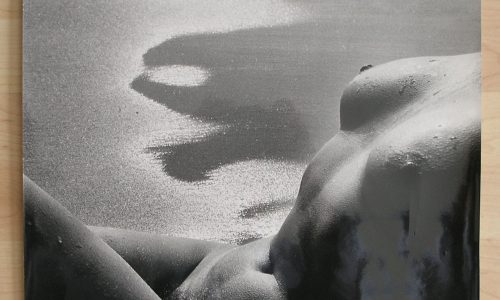
Readers of this blog know of my admiration for the Galerie Denise Rene. In all past decades they were the first to present Avant Garde artists and in the sixties they were one of the first to show ZERO artists and their works. One of these shows was the legendary UECKER exhibition in 1968. The catalogue is like a “ghost” catalogue since it is rarely seen or offered, but now I have a copy for sale. This is certainly not cheap , but extremely scarce and a solid investment. available at www.ftn-books.com
POne of the most memorable paintings i recently saw was at the Pompidou museum in Metz. Together with a magnificent large Miro the Delaunay impressed me most.
Robert Delaunay, and his wife Sonia, were influential artists from the 20th century who combined strongly in the same abstract movements
Orphism is the movement in which they are most strongly linked and this artistic style involved colourful, geometric shapes, similar to the Kandinsky circles painting, known as Farbstudie Quadrate. The Delaunays are generally regarded as having been involved from the very start of this movement. There are clear similarities between their work and other related artists such as Piet Mondrian, Wassily Kandinsky, Kazimir Malevich and Paul Klee.
This website will look into the careers of both Sonia and Robert. Robert Delaunay had a highly impressive control and understanding of colour and this was a crucial element for modern abstract artists, where objects would be symbolic but simple, making colour choices even more fundamental to each art work that they produced. Many from this era had the technical methods at hand to produce art in more traditional styles but they simply preferred the sort of art that you can see spread across this website.
Robert Delaunay was born and bred in France, though his career was to achieve success across Europe, once he had been embraced by other notable modern artists like Kandinsky who appreciated the direction that he was going in and also wanted to encourage the further spread of modern art movements down as many avenues as possible. French art had also had a history of leading from the front and so it was beneficial to have French artists who wanted to push abstract art onwards.
The original title of the painting above was Rhythm, Joie de Vivre and is one of the best known from this painter. Artist Delaunay began his career with many landscapes which held a touch of abstraction but it was only later in his life when he really took it further into the realms of what we consider Orphism with exceptionally simple displays of geometric shapes, complicated only slightly by his use of tones and colour.
Most contemporary artists show a development into the abstract rather than an immediate start there, particularly those who came at the start of this period. Franz Marc is another artist whose work may interest you if you enjoy the art featured here from the careers of both Robert and Sonia Delaunay. That artist produced many abstract works of animals but he was not quite as pure abstract as the Orphism styles of the Delaunays, who really took their work down to the most simplistic possible, whilst still maintaining symbolic messages in the background.
The early stages of this artist offered some similarities to the work of post-impressionists like Vincent Van Gogh and it seems that as the artist grew in experience and confidence that he began to forge his own original style which was later to create the Orphism movement, in conjunction with the similar style of his wife Sonia, who herself was a contemporary artist. Red Eiffel Tower in Paris is shown above and is a brilliant adaptation of this world-famous piece of architecture which has been included in the careers of countless artists, not all of whom have been French.
There is a beauty to the structure but also a highly symbolic nature to it as France’s most recognisable building. The role of French artists in European art has also ensured that many of these paintings of the Eiffel Tower have also been well-publicised. It was the artist’s depiction of the Eiffel Tower which really drew in a lot of new fans who found his work exciting and at that time it was not quite as radically abstract as he later became, thus appealing to a wider audience who were only just starting to embrace the ideas and techniques of abstract artists.
French art fans would always respond well to interesting depictions of their national symbol, and things were no different when Robert unveiled his Red Eiffel Tower. Colour was unquestionably the key to success for both of the Delaunays and they would go for bright tones which was very much the hallmark of contemporary art. Up until the French impressionists there had always been a relatively unoriginal use of colour, normally just to replicate exactly what the artist could see with their own eyes. Nowadays, there is a far great experimentation with colour and artists like those here helped to establish that. www.ftn-books.com has from both Delaunay artist books in its inventory.
For a short 10 months i lives in Paris. 16th Arrondissement, Rue La Fontaine, just a 20 minute walk from the Avenue Wilson where the Musee d’Art Moderne de la Ville de Paris was located . It witnessed the opening of the Centre Pompidou, but in the short period before the opening. The Modern Art Museum at the Avenue Wilson was the only modern art museum in Paris worth visitinbg. At that time they had Brancusi studio on show and at one of the months in 1977 an Andre Masson exhibition and yes….. i now have the catalogue of this exhibition available at www.ftn-books.com
He was born in Belgium. In 1908, he graduated from the painting courses at the Brussels embroidery school and entered the local Academy of arts. In 1912, he continued his studies at the Paris School of fine arts. At the beginning of WWI, he volunteered for the front and was seriously wounded. He lived mainly in Paris, initially earning as a ceramist and newspaper proofreader. Having signed a contract with the famous art dealer D.-H. Kahnweiler, he managed to devote himself entirely to art from mid-1920s.
He had a strong color-symbolist manner in his early works,. However, his works went through a period of cubism later. In 1924, he found himself in the mainstream of surrealism, having met A.Breton after Masson’s first personal exhibition. He developed cubist forms in a surreal manner, then, in 1926, he worked in the technique of “automatic painting”, creating pictorial and graphic compositions (graphics always played a full-fledged parallel role in his works), where individual figures and symbols are increasingly were subjected to the spontaneous play of rhythms, colors and strokes.
In 1940, he moved to the United States, where his art directly boosted the formation of abstract expressionism, Masson himself was deeply impressed by the works of classical Chinese painting in the American collections. Returning to France (1945), he created impressionistic local landscapes.
His work of 1953-1959 attributed to the” Asian period ” by their dominant echoes with the far Eastern ink painting.
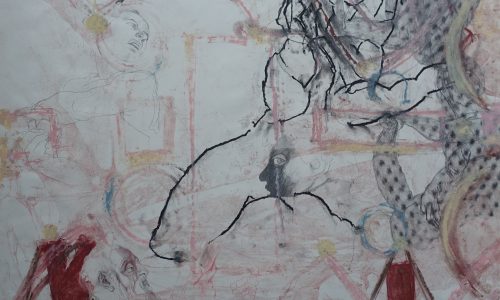
Miriam Cahn was born in 1949 in Basel, Switzerland. Her Jewish parents had left Germany between the two World Wars and had settled there. The artist spent a large part of her life in Switzerland and started her career as a graphic designer there. In the 1980s, Cahn also produced works, in black and white, before devoting herself from the 90s onwards to painting and colour, which she mastered perfectly. Her artistic abilities don’t stop there: she also makes performances inspired by her interest in the body, along with videos and practices a form of experimental writing, where language is a material to be processed like any other. She attributes a similar significance and importance to each of her modes of expression: her writings have the same status as her paintings or drawings.
In Miriam Cahn’s works, the body passes from ‘object of contemplation’ to ‘medium’, thus creating a new bodily expression. At the beginning of her career, the artist painted in the street, squatting or kneeling on her large format drawings, allowing her to play with the dust of charcoal and chalk and thus being in physical contact with her matter. She then left urban space, her ‘open-air studio’ to use her own words, and worked in a large warehouse, a ‘warehouse workshop’. She then raised the canvases off the ground, began working with smaller paintings, before gradually moving to large formats. The creation of her works is also characterised by performance: she involves her body completely and imposes a time of measured activity.
Space is of great importance to the artist who considers the hanging of her pictures as a performance in itself. The eyes of the characters must be located at eye level. It takes a few minutes of reflection before instinctively hanging her paintings, multiplying perspectives within a global set.
As for the figures that she features, Cahn opts for blurred silhouettes rather than marked outlines that generally distinguish the shape of the environment in which it is located. Cahn favours transitions between characters instead of constraining them within their outlines. This last point is probably explained by her interest in topics related to the Gulf War, the Balkans or immigration. Painting allows the artist to show solidarity without reverting to what she calls ‘political kitsch’. She prefers to tackle this kind of issues while remaining poetic and abstract.
Miriam Cahn is an artist associated with the feminist cause. War, sex and death are her main themes of predilection. Influenced by the egalitarian and utopian spirit of May 1968, her feminist approach is reflected in her paintings and in her reflective journey: “An artist needs a good dose of feminist consciousness,” she writes. I do not want to generalise but since I create bodies, I am nevertheless forced to give it is place.” She questions the role of the body in social and cultural life. By painting asexual figures, Cahn is emerging as a feminist activist. She reinterprets the classical themes of painting by seeking to reach a world before culture where man, woman and animals were not yet distinguished and separated.
Miriam Cahn’s reputation is international: many museums around the world have paintings by the artist. Her large formats make the news. In 1982, when she was 33 years old, she took part in Documenta 7 in Kassel and, in 1984, at the Biennale in Venice. In 1983, Jean-Christophe Ammann dedicated a personal exhibition to her at the Kunsthalle in Basel. Exhibitions followed in France, Germany, Bosnia, Spain, England, etc.
www.ftn-books.com has some scarce Cahn publication available at this moment
Araki Takako was a very well-respected and collected ceramic artist who pioneered the way for many female artists in Japan. She did many sculptural works, especially of decaying bibles. This slender vase has a passage from the Bible and is a very rare-unique work because it was fired after her passing. Not much more information on Araki, but her work is unusual and appeals to many and the catalogue niw available at www.ftn-books.com shows why
Born in Cagli, in the province of Pesaro, in 1940, Mattiacci graduated from the region’s Istituto di Belle Arti in 1959. After relocating to Rome, the sculptor mounted his first solo exhibition at La Tartaruga in 1967, which included historic works such as Tubo, nearly five hundred feet of yellow, nickel-plated, iron pipe that snaked its way throughout the gallery, traveling up a staircase and from one room into another. Mattiacci participated in international group shows such as the Paris Biennial; the Fujisankei Biennial in the Kanagawa Prefecture, Japan; and the São Paulo Bienal, and represented Italy at the Venice Biennale twice, in 1972 and 1988.
Recent notable exhibitions include “GONG” (2018), a presentation of twenty of his outdoor sculptures at Forte di Belvedere in Florence; a major 2016 retrospective of his work at the Museo d’Arte Moderna e Contemporanea di Trento in Rovereto, Italy; and “Eliseo Mattiacci,” the inaugural exhibition at the Fondazione Prada in Milan. Among his many accolades were the first prize at the 1995 Fujisankei Biennial at the Hokone Open Air Museum in Tokyo and the Feltrinelli Sculpture Award of the Accademia dei Lincei in Rome in 2008. Today, his work can be found in the permanent collections of the Museo Arte Contemporanea di Cassino in Italy; the University of California, Los Angeles; and the Zagreb Contemporary Art Museum in Croatia.
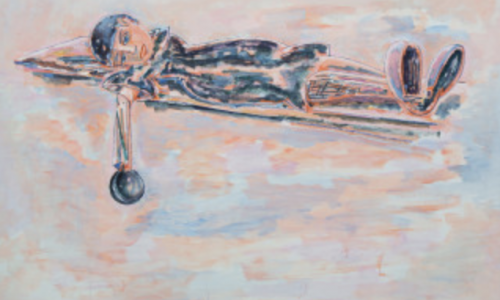
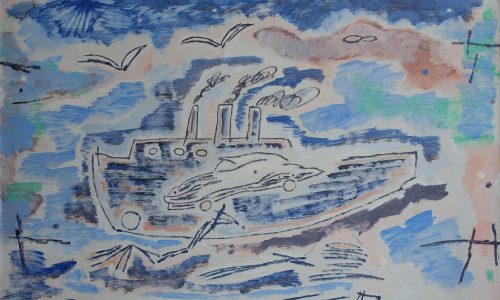
Not much info on Arie de Groot. However his children say that he was the best story teller in the world nad that shows…His works are like continuing stories divided into chapters. Timeless art and still at affordable prices.
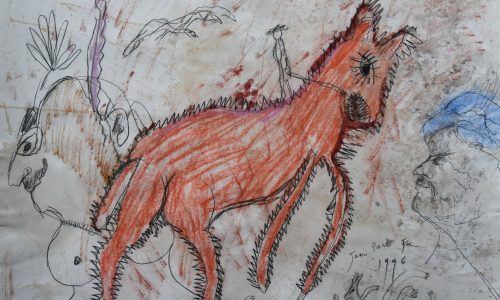
Arie de Groot was born in Hendrik-Ido-Ambacht, but lived and worked his entire life in Rotterdam. He followed his own imagination and created a characteristic visual language. His large oeuvre consists mostly of work on paper with additions of ‘worthless’ materials.
Over a period of over 30 years i encountered the works by Evren on and off. The first time was at an exhibition in Den Haag (HCAK ? )in which he showed his enamelled compositions. This was new ….this was exciting and i started following his career. Prices at that time were far too high to collect, but a year ago there was a enamelled shield, but unfortunately damages and not worth collecting. Now i am still waiting to find a work by Evren which is undamaged, but for now i am selling the Evren catalogue that was published at galerie Smits in 2007, which was the only Evrenb i could acquire last year.
There are a few iconic travel posters that always surface when people are decorating their homes. Many by Cassandre. But the one I am selling now at www.ftn-books.com is one of my personal favorites.
This one is from a painting by Kees van Dongen who depicted the Le Bar du Soleit at the Deauville beach. It has everything. Great art, atmosphere and really wants you to go there and have a drink on the beach.
Ton Frenken (1930-2004) studied law and cultural history at the Catholic University of Nijmegen from 1948 to 1954. Between 1951 and 1954 he took lessons at the Academy of Industrial Design in Eindhoven and the Jan Eyck Academy in Maastricht. From 1955 he worked as a painter and artist. Recognition of his work soon followed when he received the Willink van Collen Prize in 1956 and in 1959 the Royal Grant for Free Painting.
In addition to his work as an artist, Ton Frenken was very active in Noord-Brabant art life. For more than 25 years he wrote art reviews for the Brabants Dagblad, the Nieuwe Eindhovense Courant and Ons Erfdeel. Name and fame fell to him as the initiator and organizer of the large Jeroen Bosch exhibition in 1967. Between 1970 and 1986 he was director of the Cultural Council of Noord-Brabant and a teacher at the Royal Academy of Art and Design in Den Bosch. Between 1987 and 2004 he lived and worked successively for longer periods in Antwerp, Paris and Utrecht. Between 2000 and 2003 he was Director of the Jeroen Bosch Center foundation. After his death in 2008 in Den Bosch in memory of Ton Frenken’s great achievements in the field of Art and Culture in North Brabant, a bust was unveiled on the forecourt of the old Jacobskerk, in which the Noordbrabants Museum was once located.
www.ftn-books.com has several titles on Frenken available. ao the Nijmeegs Museum 1986 catalogue
Artist/ Author: Oliver Boberg
Title : Memorial
Publisher: Oliver Boberg
Measurements: Frame measures 51 x 42 cm. original C print is 35 x 25 cm.
Condition: mint
signed by Oliver Boberg in pen and numbered 14/20 from an edition of 20