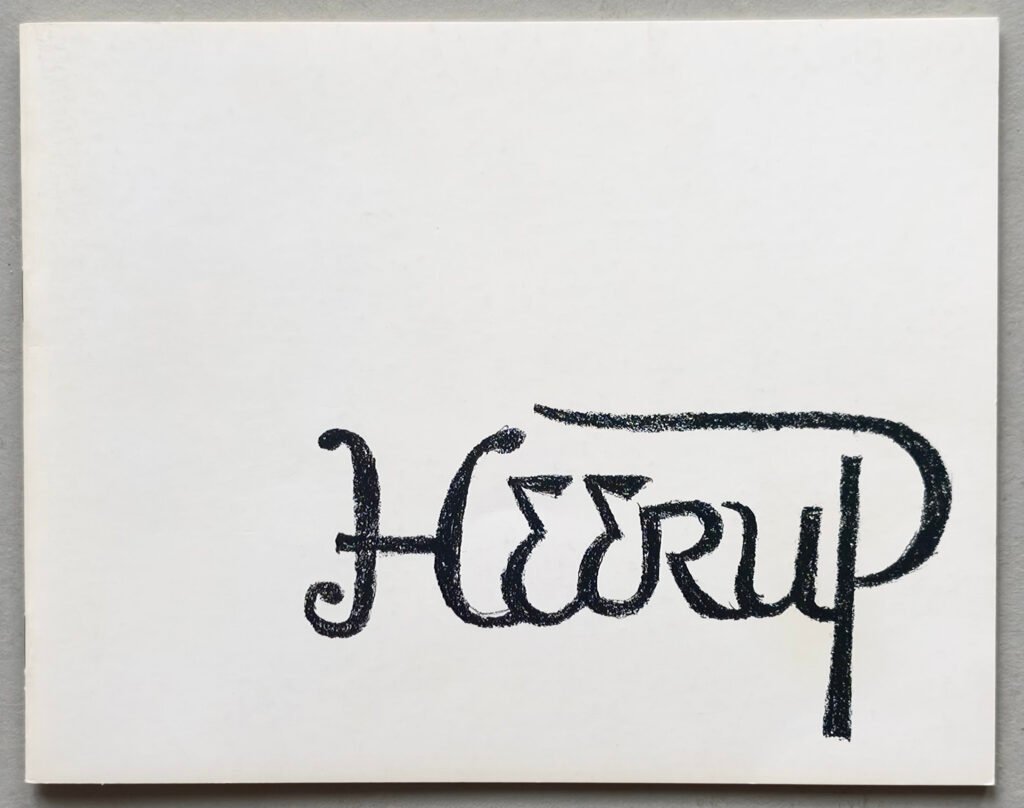


Henry Heerup occupies a curious niche in the collective Nordic consciousness. To the broad public, his legacy is filtered through the whimsical iconography of sprite-like figures on bicycles and tender pairs—a tapestry of folklore etched in paint and ink. Yet, his structural genesis remains shrouded in relative obscurity; the granite carvings and salvaged bric-a-brac assemblages he pioneered amidst the tumultuous, creative upheaval of the 1930s warrant a sharper focus.
Emerging from the hallowed halls of the Royal Danish Academy (1927–32), Heerup was an anomaly. Critics of the era frequently expressed bewilderment that a mind polished by academic rigors could propagate such raw, untethered spontaneity. He operated like a man deaf to the siren songs of shifting vogues, instead plunging into the tactile materiality of his surroundings. His “junk models”—curious chimeras fashioned from discarded relics—served as a vital interstitial bridge, deftly maneuvering through the calcified orthodoxies of early modernism. Picture a glass globe married to a rusted bottle stopper and a weathered seashell, bound by homemade wax; these were his initial experiments in alchemy.
A Nørrebro youth, he possessed an innate, kinetic affinity for the outdoors. This reverence for the untamed landscape, coupled with his disarmingly candid disposition, coalesced into a singular identity. When he acquired a parcel of earth in Rødovre in 1945, he effectively anchored his existence to the soil. For five decades, this garden functioned not merely as a studio or gallery but as a verdant crucible for the avant-garde. This migration from the urban dense to the suburban frontier mirrored the broader socioeconomic shifts of his era, ensuring his creative pulse remained synchronized with the working populace—the very subjects who animated his canvases.
Throughout his sprawling career, Heerup flitted between collaborative circles, weaving his thread through *Linien*, *Høst*, and eventually the radical, cross-border currents of the CoBrA movement. Regardless of these affiliations, he remained a solitary luminary. He was an idiosyncratic force, orbiting only the radiant sun of absolute creative liberty.
www.ftn-books.com has the scarce Nova Spectra catalog now available.