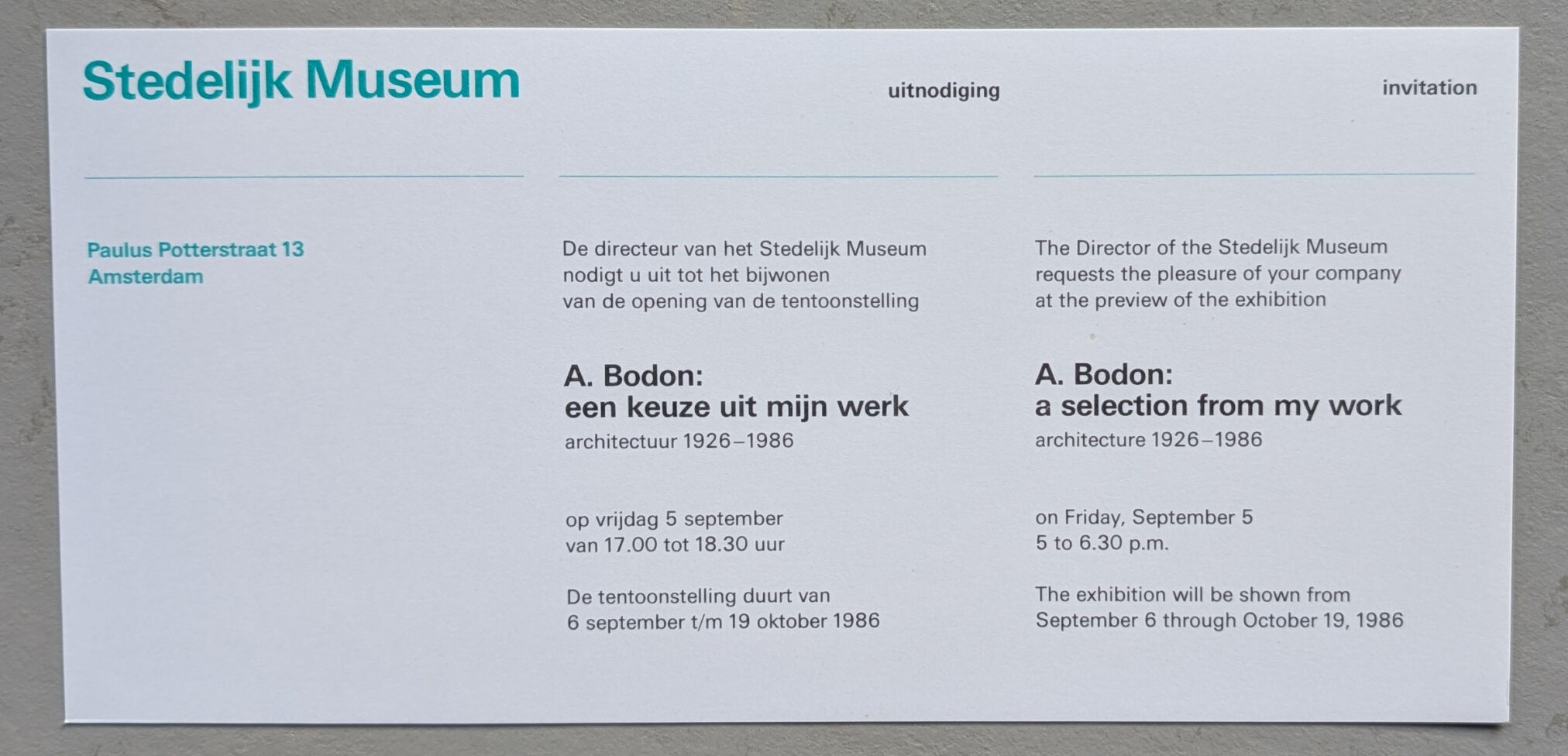
The finest work of Alexander Bodon (1903-1993) is characterized by delicacy and transparency. In Bodon’s view, architecture was a humble craft, where buildings should not take center stage and should remain free of trendy additions. Bodon, of Hungarian descent, trained as an interior architect in Budapest, but after an apprenticeship in the Netherlands, at the office of Jan Wils, he no longer felt at home in what he saw as a conservative Hungarian architectural climate. In the Netherlands, he became enamored with the New Objectivity movement. In 1929, he returned to the Netherlands to settle permanently. Three years later, he gained fame for his renovation of the narrow and deep Amsterdam bookshop, Schrˆder en Dupont, where a skylight, narrow galleries along the bookshelves, and graceful steel structures allowed for an abundance of light and space. Bodon designed countless furniture pieces, interiors, stands for exhibitions and fairs, and even entire exhibitions. Gradually, his practice shifted towards architecture. During the post-war reconstruction period, he designed several housing complexes. However, he struggled with tight budgets that often limited his creative freedom as an architect. After architect A. van der Steur designated him as his successor for the expansion of the Boymans-Van Beuningen museum on his deathbed, Bodon had the opportunity to express his passion for technological innovation at his old firm, including the massive spanning of the Europahal at the Amsterdam RAI complex.
www.ftn-books.com has several Bodon publications available.