

Born in Bristol in 1945, Richard Long stands as a foundational luminary within the ‘Land Art’ movement, an artistic vanguard he shares with the likes of Michael Heizer, Walter de Maria, and Robert Smithson. This aesthetic uprising, echoing the burgeoning ecological anxieties that rippled across Western consciousness in the 1960s, functioned as a trenchant rebuttal to the calcified traditions of classical sculpture and the grasping tentacles of the commercial art apparatus. These ephemeral, site-responsive manifestations—sculpted directly from the earth’s own marrow—first breached the public consciousness during the 1968 ‘Earthworks’ showcase at New York’s Dwan Gallery. By 1969, the nomenclature ‘Land Art’ was cinched firmly into the cultural lexicon by Gerry Schum, whose televised broadcast crystallized the movement’s identity for posterity.
Long’s practice transmutes the kinetic energy of human perambulation into an artistic crucible; he traverses the rural landscape, treating his own footsteps as both the primary instrument and the ultimate arbiter of form. His seminal labor, 1967’s *A Line Made by Walking*, serves as an elegant testament to this philosophy: a singular, obsessive trajectory paced repeatedly into the meadow grass until the verdancy succumbed to a visible scar, later immortalized through the detached gaze of a photographic plate. For four decades, this meditative practice has proliferated across global topographies—from the rugged expanses of Bolivia to the quiet, ancient soils of England and Japan—where he assembles megalithic monoliths of stone or timber.
Unlike the grandiose, earth-moving theatrics favored by his contemporaries like Heizer or Smithson—whose interventions often resembled tectonic aggression—Long operates with the quietude of a ghost. His methodology shuns the heavy-handed reconfiguration of geologies, preferring instead to exist in delicate, harmonious tension with the serendipitous bounty he discovers already scattered across the terrain.
Since he started out as an artist, Long has, however, also shown works in interior spaces. Here too, sculptures are created with archetypal forms of wood or stone: ovals, lines or circles. Long explains his choice of form as follows: ‘I like to use the symmetry of patterns between time, between places and time, between distance and time, between stones and distance, between time and stones. I choose lines and circles because they do the job.’
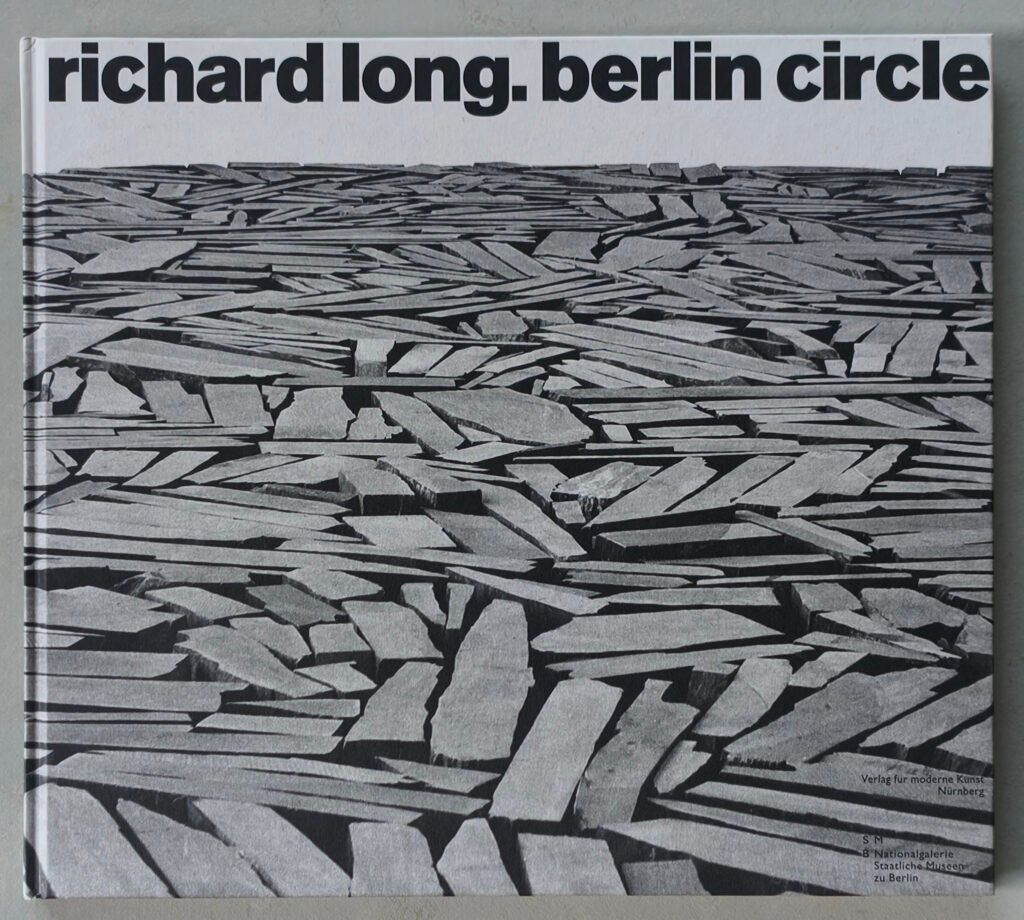
It is befitting then that the main work in the Hamburger Bahnhof exhibition, ‘Berlin Circle’, is a circle of stone, twelve metres in diameter, laid out on the floor. ‘Berlin Circle’ is an important work in the Sammlung Marx and was first unveiled and installed by the artist for the opening of the Hamburger Bahnhof in 1996.
www.ftn-books.com has many Richard Long titles available.