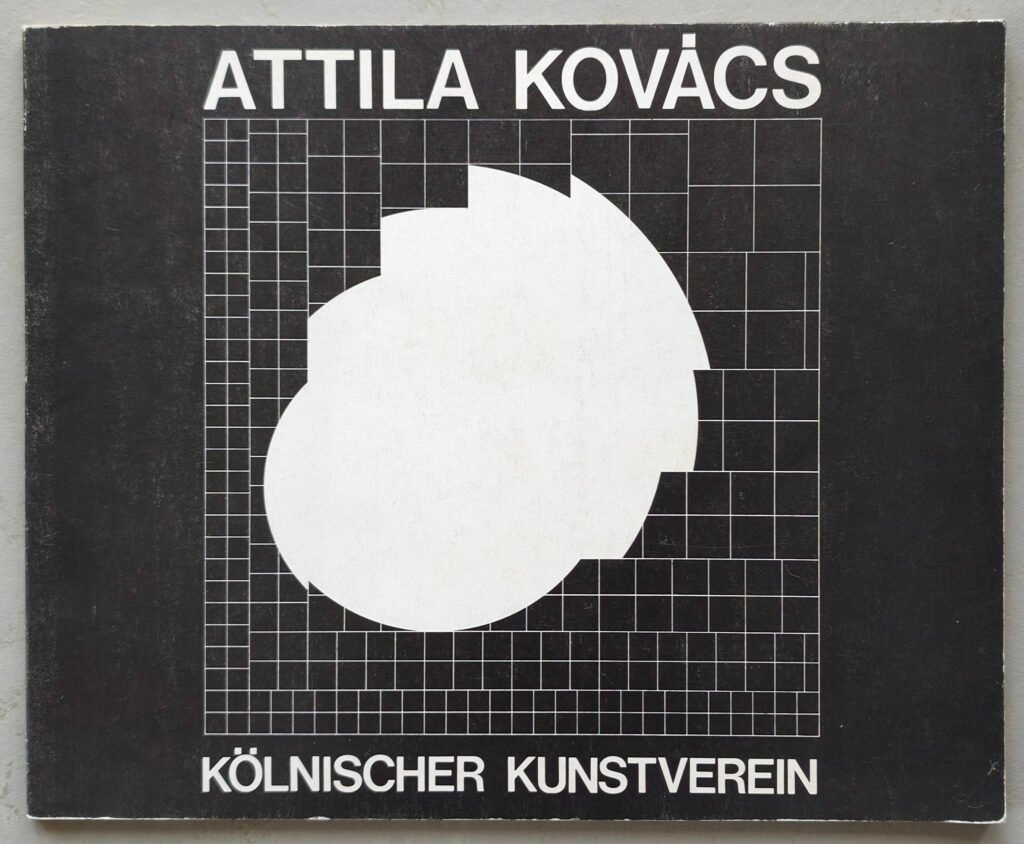


Born amidst the austere backdrop of Budapest in 1938, the late Attila Kovács operated not merely as a painter, but as an architect of the ethereal. His intellectual lineage traces back to the radical geometries of János Bolyai—a conceptual rebellion that severed the umbilical cord between mathematics and the physical world. Much like the High Renaissance titans, Piero della Francesca or Alberti, who harnessed Euclidean rigors to carve perfection into plaster, Kovács transmuted abstract calculations into autonomous visual realms.
Between the pivotal years of 1964 and 1970, he forged a lexicon of structural ingenuity. He dubbed this “Frame of Reference,” or perhaps more evocatively, “Transmuting Plasticity.” Within this framework, canvases ceased to be static surfaces; they transformed into vessels for non-Euclidean sequences. He navigated the x, y, and z axes with the meticulous hand of a cartographer, beckoning the temporal variable—the ‘t’ of spacetime—to collide with the pigment.
Observe his repertoire: works that linger within the two-dimensional veil, yet frequently defy their own boundaries. They initiate in a singular plane, then, obeying a mathematical cadence as pulse-driven as a heartbeat, they erupt into the third dimension. These pieces unfurl across gallery walls like geometric friezes—sculptural manifestations of pure intellectual rhythm.
His trajectory carried him from his Hungarian genesis to the avant-garde crucibles of West Germany in 1964. By 1970, he had distilled his vision at the Staatliche Akademie der Bildenden Künste. Through decades of international acclaim—culminating in his 1995 retrospective at the Kunsthalle Budapest—Kovács remained an artist whose logic was his aesthetic, leaving behind a legacy where the invisible architecture of space is finally permitted to breathe.
www.ftn-books.com recently added the scarce Kolnischer KUnstverein publication to its inventory.